
Title: First direct detection of an RR Lyrae star conclusively associated with an intermediate-age cluster
Authors: Cecilia Mateu, Bolivia Cuevas-Otahola, and Juan José Downes
First Author’s Institution: Departamento de Astronomía, Instituto de Física, Universidad de la República, Montevideo, Uruguay
Status: Published in Astronomy and Astrophysics [open access]
There is nothing astronomers get more excited about than weird stars. So much of astronomical research hinges on our accurate understanding of how stars form and evolve, so when we find something that challenges our models we start to pay very close attention. The open star cluster Trumpler 5 is currently feeling that sudden flood of interest after the authors of today’s paper discovered an RR Lyrae (RRL) variable star hidden inside.
Variable Stars in Star Clusters
First, let’s address what a variable star is exactly. These stars don’t have a constant luminosity, but rather their brightnesses vary periodically over time. RRLs in particular are intrinsic variables, meaning their luminosities are changing due to physical processes going on inside the star itself. There are lots of different classes of intrinsic variables that can have different masses and chemical abundances, but we can tell them apart based on the shapes of their varying light curves. RRLs have a distinct asymmetric light curve and are low-mass, low-metallicity, and (so far) have been found to be very old.
It is by no means odd to find an RRL inside a star cluster, a gravitationally bound group of stars that formed from the same massive cloud of gas at roughly the same time. In fact, RRLs used to be called “cluster variables” because they are most commonly found inside globular star clusters. But, there is a big difference between globular and open clusters: mainly, their ages. Globular clusters host some of the first stars formed inside galaxies and are typically more than 10 billion years old, while open clusters are at most only a few billion years old. If you find an RRL in an open cluster you can safely assume it was formed alongside all the other stars, making it only a few billions years old as well … less than half the age of any other confirmed RRL we have observed.
Hunting for RR Lyraes
The authors of this paper note that after the launch of Gaia, which has given us a wealth of data on Milky Way stars, we have started to find some RRL candidates that appear to be intermediate age (~5 billion years old). These stars, however, are found on their own, outside of star clusters and the methods used to determine their ages are indirect. These authors wanted to see if they could find an RRL whose intermediate age could be much more concretely determined. So, they combined open cluster stellar membership catalogs from Gaia kinematic data with Milky Way RRL catalogs to find overlap. From a catalog of 309,998 RRLs spanning the full sky they found one RRL flagged as a member of the open cluster Trumpler 5.
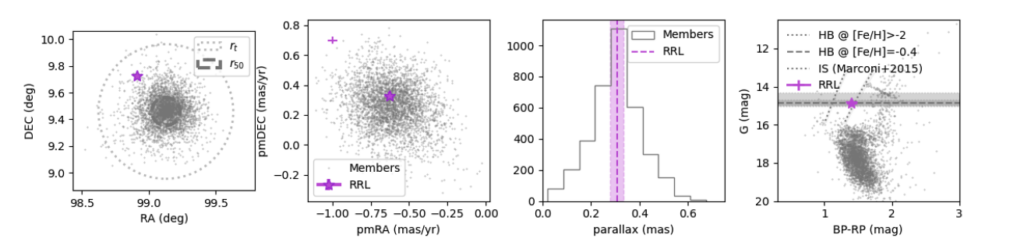
But this is not enough evidence to conclude that this star is actually an RRL and actually a member of Trumpler 5, so these authors needed to do their statistical due diligence. They studied the light curve of their star and where it sits on a colour-magnitude diagram (CMD) to confirm that it was, in fact, a true RRL and not some other kind of variable star or an imposter. They found that it did indeed have the expected light curve and sat where we would expect an RRL to be, inside the instability strip (see the rightmost panel of Figure 1 and Figure 2).
Next, they needed to determine if the Trumpler 5 membership flag from the open cluster catalog for this RRL was accurate. They compared the on-sky position, proper motions, and parallax of the RRL to the other stars in Trumpler 5 and found that they all lined up (Figure 1), meaning the RRL is at the same distance is moving at the same speed and in the same direction as the cluster stars. Finally, given all of this information, they computed the likelihood that this could still be a background RRL that was mistaken for a Trumpler 5 member, and found that there was only a 0.049% chance of that. So, based on all this, they can say quite confidently that this is an RRL and it is in the Trumpler 5 open cluster.
How to Fast-Track Your Variable Star
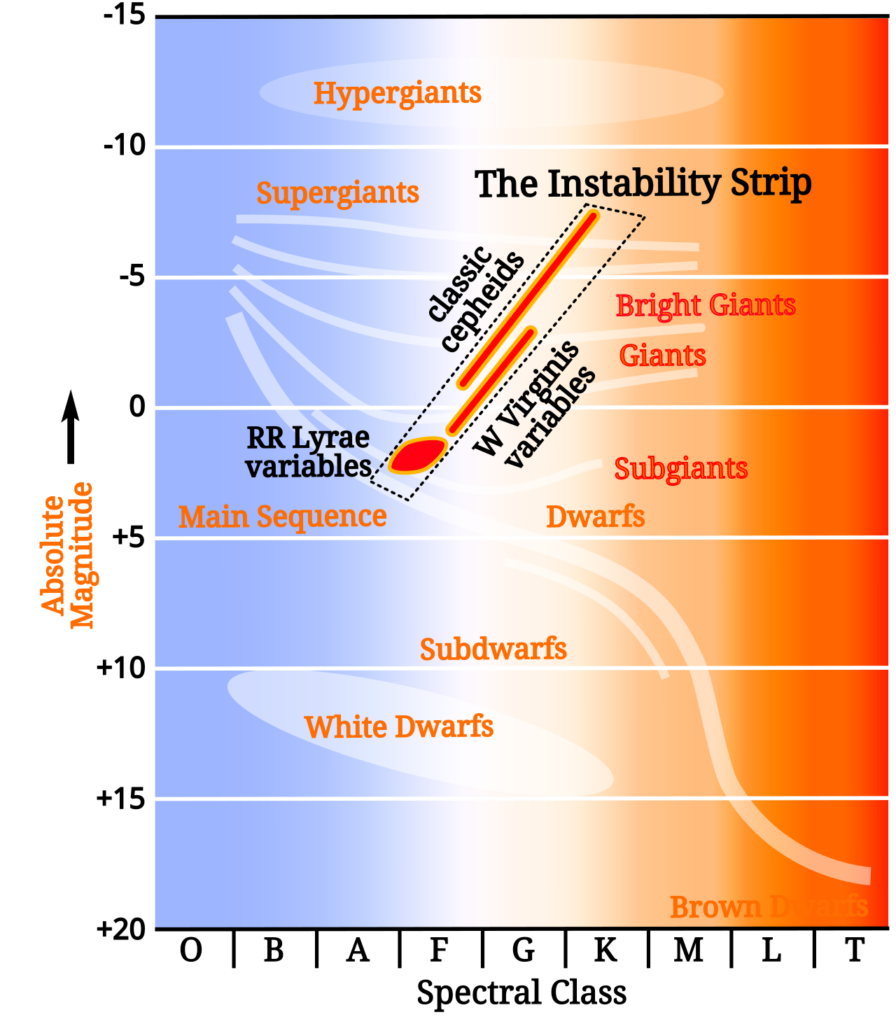
Stellar evolution is a complicated field, but we can still sum it up pretty simply as “big stars live fast and die young, and small stars take it slow and steady”. This means that stars with different masses take very different amounts of time to evolve, with low-mass stars (like RRLs) taking the longest time to evolve off the main sequence.
Evolving off the main sequence is critical for variable stars, since the internal processes that produce those luminosity variations can only occur if a star sits on the instability strip, which can be found in the CMD in Figure 2. This means that in order for the Trumpler 5 RRL to be only a few billion years old something external must have happened to speed up the process of moving it off the main sequence.
One way for this to happen is if the star’s outer layers are stripped off, completely disrupting the star’s structure and forcing it to move off the main sequence before it would normally be ready. This mass loss can happen if the RRL has a smaller binary companion that would accrete the RRL’s outer layer if it overflowed its Roche Lobe.
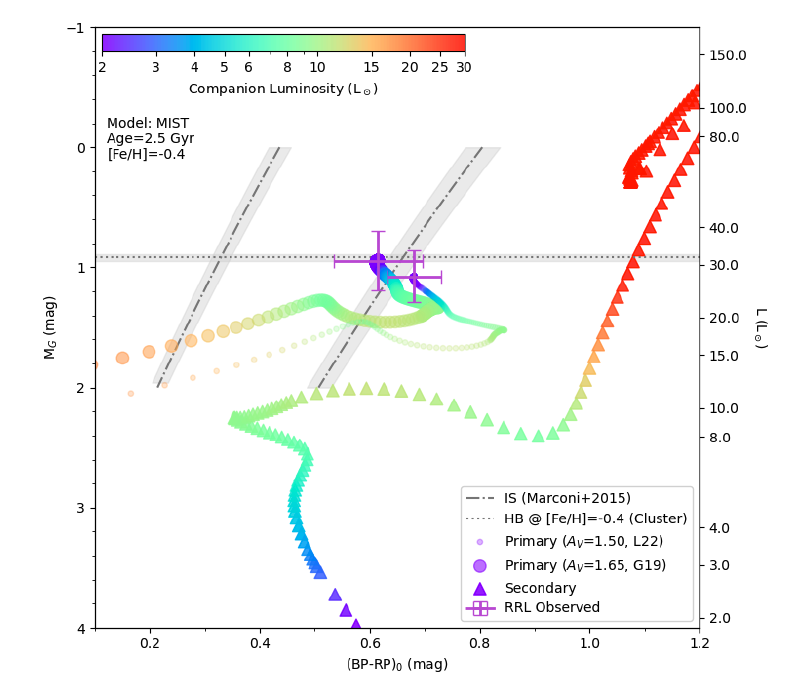
The authors used stellar evolution models to test out what combination of primary RRL and secondary companion star pairs would result in what we observe (see Figure 3). The constraints here are that the combined luminosity of the pair would need to match what we observe from the single RRL “star” (since this would be an unresolved binary), the primary RRL needs to still be in the instability strip, and the primary RRL needs to be above a certain luminosity by itself in order for it to have the observed variability period.
All together, the only options are either no companion, which would still be puzzling since we need some way for this mass loss to occur, or a very small companion (< 5 solar luminosities). Theoretical models of binary systems with a small companion just like this have already been shown to be able to create RRLs of roughly the age of Trumpler 5, so this is promising!
Show Me The Companion!
The bad news is that, with the data available to them at the time of publication, the authors cannot confirm or deny the existence of this potential binary companion. If it exists, it would be too small and dim relative to its RRL primary to be detectable via photometry alone.
The good news is that since publication this team has gotten spectroscopic data on the Trumpler 5 RRL! They are currently in the process of doing a rigorous analysis of the spectrum of the star to determine if there is any minor radial velocity variation caused by the gravitational pull of its unseen orbiting stellar companion.
If they can confirm not only the existence of the binary companion, but also that its properties align with the predictions from stellar evolution theory, then we will have the first observational confirmation of a binary system creating an intermediate age RRL! If they find that there is no binary companion … well, then our understanding of how RRLs evolve will get even more complicated, but astronomers love a challenge!
Astrobite edited by Sarah Stevenson
Featured image credit: NASA
