
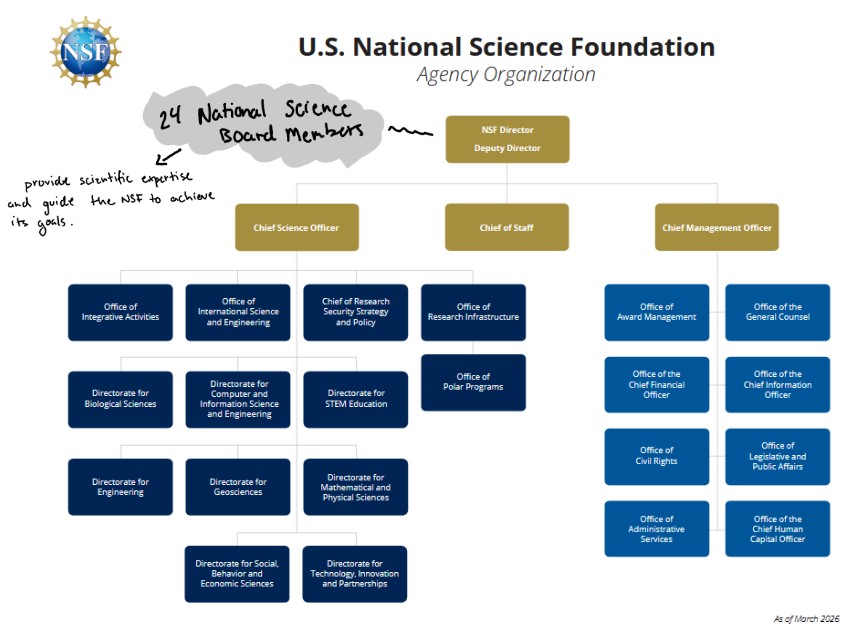
At the end of April, while scrolling through my news feed, I saw a headline that, while baffling, did not surprise me: “Trump Fired the Entire National Science Board.” Before I read the headline, I was actually not familiar with the existence of the National Science Board (NSB), the NSF’s science advisory board. What I was familiar with were the goals and history of the NSF, an organization created in post-WWII America in order to advance science without undue political influence, as well as the more visible structure of the NSF. This is the director and the associated sub-offices with their own directors–akin to something like the Congressional Committees in my mind. So what was this board I hadn’t heard of, and what does it mean that there no longer is one?
What does the NSB do?
On their website, the NSF states that the “National Science Board establishes the policies of the U.S National Science Foundation and serves as advisor to Congress and the president.” Dr. Keivan Stassun, an astrophysicist at Vanderbilt and an NSB member until the April firing, likens the National Science Board to a company’s Board of Directors, who have a responsibility for “stewarding the organization and establishing a strategic direction and priorities” he says. Put simply, the function of the NSB is to ensure that the wants of the American public are listened to and followed, while bringing expertise from their science divisions.
There are 24 members of the NSB (other than the NSF Director), all serving six-year terms. Every two years there is a call for nominations for 8 members, sent out to “leading scientific, engineering, and educational committees;” these nominations are considered and then vetted by the current Board and the Office of the Presidential Personnel, and finally appointed by the president. The Board has a variety of scientific expertise, from physics and astronomy to engineering education, information sciences, and nuclear security.
If this still seems a bit vague (as many governmental jobs can), there is a National Science Board YouTube channel that posts panel discussions and discussions on policy briefs. Dr. Stassun mentions these policy briefs as one of the major deliverables NSB provides. These can be found on the NSF’s webpage, and feel similar to the astronomy decadal surveys. The NSB and the decadal surveys seem to ask similar questions: How can we ensure the best research happens with the money we’re given? What exact steps need to be taken in order to make good on that promise?
Dr. Stassun and members of the NSB also view the NSF as the central liaison to workforce development in the sciences: “The NSF has the primary responsibility for, basically, the training of the next generation of scientists.” Dr. Stassun relays. “One of the things on the board we had come to try to develop some language around… is to refer to NSF as the nation’s STEM talent development agency.”
What does the firing of the NSB mean?
So, why did the White House fire the NSB, and what does this mean for the future of the NSF? As Dr. Stassun put it, “in a corporation, if its entire board of directors were somehow fired, the CEO [which NSF doesn’t currently have] would just be running it rogue, with no accountability.”
This accountability is essential to the NSF, which was by definition established to serve the people of the United States. The existence of the National Science Board was encoded in law: Specifically Public Law 507 of the 81st Congress (1950), which establishes the National Science Foundation, and explicitly states that the Foundation shall consist of a National Science Board and a Director.
The White House has since said that the reasoning for the firing was based on the question of how constitutional the original 1950 establishment of the NSB was, after a 2021 5-4 Supreme Court case brought up the question of how much power non-Senate-confirmed Executive officials should have. But if the White House is concerned about the congressional validity of the National Science Board, why fire them en masse with absolutely no clear plan for the future? Why has there been no indication of how they will move forward to make the NSB appointees get Senate confirmation as well, if that is indeed what they want here?
Dr. Stassun reminds us that this is not just a problem we encounter as scientists, but also as citizens and people living in the United States: “The job of the executive is to faithfully execute the laws… so when the administration dismisses the National Science Board, when it directs its office of management and budget to tell NSF to not issue grants in the ways that Congress has directed… what you have is a major disturbance to our Constitutional order.”
Put simply, there is no one at the helm of the NSF right now. If we as people want our science funding to remain independent of the erratic needs and wants of the executive branch, and if we want to fund the most interesting and insightful research, we must have an organization governed by trusted and experienced experts in science, not politicians and venture capitalists.
Even though these problems are out of our immediate control, we can continue to support the NSF and its independence through contacting Congress to provide NSF a full budget. We can also stay informed about policy updates with AAS’ weekly-update policy blog. If you’re a researcher, maybe reach out to your Senators and Congressperson to share how important NSF has been in your work. This is not the end of the NSF, but it’s certainly a moment to analyze what we as scientists want in our governmental support.
Astrobite edited by Mckenzie Ferrari
Featured image credit: Shari Weisberg. Federal Art Project, WPA
