
Authors: Niayesh Afshordi, Phil Halper, Matteo Rini, Michael Schirber
First Author’s Institution: Waterloo Centre for Astrophysics, University of Waterloo
Title: Big Mysteries Survey: Physicists’ view of Cosmology, Black Holes, Quantum Mechanics, and Quantum Gravity
There is a particular genre of physics that sounds like civilization has already figured something out.
The Big Bang was the beginning of time.
Inflation explains the early universe.
Dark matter is probably a particle.
Dark energy is the cosmological constant.
Information escapes black holes.
String theory is the leading candidate for quantum gravity.
These sentences are not necessarily wrong. Some of them are even, in a careful enough context, approximately right. But they have a scent ….of textbook compression. Of public-facing certainty. Of a universe being made tidier than the people studying it actually believe it to be.
Today’s paper is not about a new telescope, a new exoplanet, a new simulation, or a new detection. It is about something much stranger: what physicists think they know.
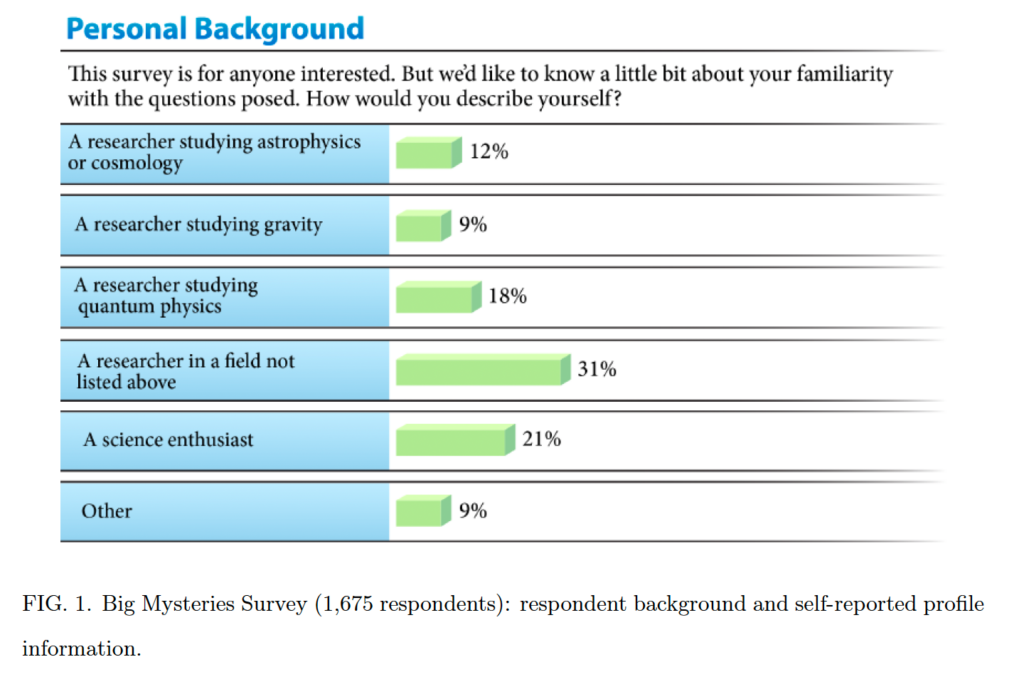
The authors present the Big Mysteries Survey, a large survey conducted through Physics Magazine and the American Physical Society. The survey asked 1,675 respondents about foundational questions in cosmology, black holes, quantum mechanics, quantum gravity, and anthropic coincidences. Because it was an open online survey rather than a random sample of all physicists, the results should not be treated as a perfect census of the field. But they are still a rare and fascinating snapshot of how a broad group of physics-interested respondents think about the biggest open questions in fundamental physics.
The result is not that scientists are confused.
The result is better than that.
Physics is alive.
The universe, as a contested object
Let us begin, naturally, with the beginning.
The Big Bang is one of the most famous ideas in science, but the phrase itself hides a conceptual trap. Does “the Big Bang” mean an absolute beginning of time? A singularity? Or simply an early hot, dense state from which the universe evolved?
Most respondents chose the cautious version. About 68.4% said the Big Bang means that the universe evolved from a hot dense state, without necessarily saying whether there was an absolute beginning of time. Only 19.5% chose “an absolute beginning of time with a singularity,” and another 4.5% chose an absolute beginning without a singularity.
This is perhaps the cleanest majority result in the whole survey. The Big Bang, in this view, is not necessarily the universe’s birth certificate. It is more like the earliest reliable chapter in the biography.
I like this distinction because it captures something essential about science communication. The public story often wants a beginning. A moment. A cosmic “once upon a time.” But the scientific claim is usually more disciplined: we have strong evidence that the universe was once hotter, denser, and more uniform. Whether that state was the beginning of time itself is a deeper question, and the universe is under no obligation to satisfy our narrative instincts.
The beginning, apparently, may not have begun the way we say it did.
Inflation wins, but not by a landslide
Inflation is one of cosmology’s great ideas: a period of extremely rapid expansion in the early universe that can explain why the universe looks so smooth, flat, and causally puzzling. In many textbooks and popular accounts, inflation appears as the standard solution to the early-universe puzzle.
In the survey, inflation does come out on top—but barely. About 50.8% of respondents chose cosmic inflation as the best explanation for early-universe puzzles. The rest were split across alternatives: bouncing or cyclic universes, where the cosmos may expand and contract in repeated cycles; quantum-gravity-inspired ideas; “not inflation, but I don’t have an alternative”; other answers; or no opinion.
Inflation wins the election….barely.
This matters because “leading explanation” and “consensus” are not the same thing. A field can have a dominant framework and still have significant live disagreement inside it. In fact, that is often exactly what a healthy frontier looks like. Not a democracy of equal theories, but not a monarchy either.
Cosmology, here, looks less like a finished cathedral and more like scaffolding around a very ambitious building.
ΛCDM? It’s (emotionally) complicated.
The standard model of cosmology is called ΛCDM: Lambda Cold Dark Matter. It says that the universe is largely governed by cold dark matter and dark energy, often modeled as a cosmological constant, Λ. It is one of the most successful scientific frameworks humans have ever built. It fits a spectacular range of observations.
It is also, judging by this survey, not something physicists necessarily carry around as one indivisible creed.
For dark matter, no single candidate dominates. The most common answer is actually “a hybrid of the above” at 20.6%. Low-mass dark matter particles such as axions get 17.4%, WIMPs get 10.0%, modified gravity gets 11.5%, primordial black holes get 5.4%, quantum-gravity effects get 10.1%, and 15.1% choose no opinion.
That is not a community marching in formation. That is a community looking at the gravitational anomalies and saying: yes, something is deeply strange here, but no, we are not all betting on the same horse.
Dark energy is even more deliciously awkward. A cosmological constant receives 24.0% support. A time-varying dark energy field receives 25.9%. In other words, the simplest textbook version of dark energy is not even the most popular answer in this survey.
This does not mean ΛCDM is dead. Please do not go to your cosmology professor and say Astrobites told you ΛCDM is dead. It is very much alive, empirically powerful, and annoyingly hard to beat.
But it does mean that the sociology of belief is more complicated than the acronym. Physicists can use a model, respect a model, publish with a model, teach a model, and still privately suspect that it is not the final story.
This is not hypocrisy. This is science.
The Hubble tension and the dignity of “no opinion”
The Hubble tension is one of the most famous current problems in cosmology. Measurements of the universe’s expansion rate from the early universe, such as those inferred from the cosmic microwave background, disagree with measurements from the late universe, such as those using supernovae and distance ladders.
The survey asked respondents what they thought was most likely responsible. The most common answer was not early dark energy, a theory in which the early universe had an extra form of energy that temporarily changed its expansion rate. It was not systematic errors. It was not modified gravity.
It was no opinion, at 24.4%.
Early dark energy came next at 22.1%, followed by systematic errors in supernova data, modified or quantum gravity, other answers, and systematic errors in CMB or galaxy-survey data.
There is something almost beautiful about this.
“No opinion” is not a weakness in this case, it is intellectual honesty. It is the opposite of performative certainty. It is the respondent invoking the Socratic method: I know enough to know that I do not know enough.
In an age where everyone is incentivized to have a take, “no opinion” may be one of the last refuges of seriousness.
Fine-tuning, without the forced drama
Then comes the anthropic question.
Some quantities in physics are called constants of nature: numbers that appear to be built into the laws of the universe. These include things like the strength of gravity, the speed of light, the mass of the electron, and the cosmological constant, which controls the accelerated expansion of the universe. They are not settings we can easily derive from first principles. We measure them, put them into our equations, and then ask why they have the values they do.
The fine-tuning problem begins with the uncomfortable observation that if some of these numbers were very different, the universe might not form galaxies, stars, planets, chemistry, or anything resembling life. Popular discussions often turn this into a dramatic forced choice: multiverse or intelligent design. Infinite cosmic lottery or cosmic intention. Pick your metaphysical fighter.
The surveyed respondents mostly refused the framing.
The most common answer, at 26.0%, was that the constants are brute facts requiring no further explanation: they simply have the values they have. Anthropic selection in a multiverse got 19.9%, meaning that we observe life-compatible constants because only universes with such constants can contain observers. Intelligent design got 8.9%. A principle such as naturalness got 15.7%, meaning the hope that the constants are not arbitrary after all, but follow from a deeper physical principle or symmetry. Other answers and no opinion took the rest.
This is a useful correction. The fine-tuning debate is often narrated as if everyone must eventually choose between metaphysics with extra universes and metaphysics with extra theology. But many physicists seem to be saying something quieter: perhaps the question is ill-posed, perhaps the explanation is still missing, or perhaps not every number in nature owes us a satisfying story.
Sometimes a constant is a clue.
Sometimes it is a brute fact, just sitting there and glaring at your face.
Quantum mechanics: undefeated and unresolved
Quantum mechanics has a strange cultural status. It is both the most successful physical theory we have and one of the least conceptually settled. It predicts experiments with astonishing accuracy, but physicists still disagree about what the mathematics actually means.
The survey reflects exactly that.
The Copenhagen interpretation is the most popular, at 35.7%, but it is nowhere near a majority. This question asks how physicists think we should understand quantum measurement: when a quantum system seems to “choose” one outcome from many possibilities, what is actually happening? Copenhagen, the most popular and tradional view, treats measurement as the moment when a quantum system stops being described as a spread of possible outcomes and is found in one definite state. Many Worlds, where all possible outcomes occur in branching realities, receives 11.0%. QBism, where the quantum state represents an observer’s personal expectations about future measurements, gets 9.2%. Pilot-wave theory, where particles have definite positions guided by an underlying wave, gets 5.8%. Collapse theories, where the wavefunction really does physically collapse, get 6.5%. Consistent histories, which describes quantum systems through sets of possible histories rather than single measurement events, gets 5.2%. “Other” and “no opinion” together make up more than a quarter of responses.
This is hilariously profound. After a century of quantum mechanics being right about everything it is asked to calculate, physicists still disagree about what kind of story it tells.
The universe keeps passing the exam while refusing to show its work.
Black holes: where certainty goes to be compressed
Black holes are where our best theories stop politely disagreeing and start actively fighting.
General relativity says black holes form event horizons and, classically, singularities. Quantum mechanics says information should not be destroyed: in principle, the present state of a system should still contain enough information to reconstruct its past. Hawking radiation says black holes slowly radiate away energy and can eventually evaporate. The paradox is that this radiation appears to carry away only featureless thermal information, so when the black hole disappears, the detailed information about what fell in seems to disappear with it. Together, these ideas create one of the deepest puzzles in modern physics: the black-hole information paradox.
The survey shows that even here, where popular accounts sometimes imply that the broad picture is settled, the community is not unanimous.
For the fate of matter crossing an event horizon, 40.5% say it is crushed into a singularity. But many respondents choose fuzzballs, bounces, other answers, or no opinion.
For black-hole information, information preservation narrowly exceeds a majority only if two options are combined: 30.5% say information is preserved in Hawking radiation, while 23.7% say it is preserved in astrophysical remnants. Meanwhile, 18.8% say it is irretrievably lost.
This is not a minor disagreement. This is a disagreement about whether one of the deepest principles of quantum theory survives contact with gravity.
Black holes are not just astrophysical objects. They are philosophical stress tests with accretion disks.
Quantum gravity and humility is at the frontier
Finally, the survey asks the obvious nightmare question: what is the best candidate for a theory of quantum gravity?
The most common answer is no opinion, at 28.7%.
String theory/M-theory is the most popular named candidate, at 18.9%. Loop quantum gravity gets 12.7%. “Gravity is not quantum” gets 17.7%, which is higher than loop quantum gravity and not far behind string theory.
That result should make everyone sit up a little straighter.
Not because it proves any particular approach right or wrong. Surveys do not quantize gravity. But it shows that the frontier is not simply a race between preordained favorites. Even the premise that gravity must be quantum is, for a non-negligible fraction of respondents, apparently still open.
If quantum gravity is the mountain, physicists are still arguing not only about the route, but about the shape of the mountain…..and possibly also whether it is a mountain.
Not chaos. Structure.
One of the paper’s most interesting parts is not just the answers, but the correlation between them. The authors look at which answers tend to be chosen together. They find clusters: respondents who choose quantum-gravity explanations in one domain often choose them in others; modified-gravity answers cluster together; time-varying dark energy is strongly linked with early-dark-energy explanations of the Hubble tension; and information preservation in Hawking radiation is linked with preference for string theory/M-theory.
This is important because it means the survey is not showing random confusion. It is showing structured disagreement.
People have worldviews. Priors. Aesthetic commitments. Mathematical loyalties. Historical instincts. Some physicists are attracted to unification, some to minimal modification, some to radical alternatives, some to empirical caution, some to “please do not ask me this until the data improve.”
Science is often taught as a method, but lived as temperament disciplined by evidence.
That is not a flaw. That is part of the machinery.
So, do physicists agree?
Yes.
No.
Sometimes.
Enough to build models, run experiments, publish papers, launch telescopes, teach courses, and argue productively for decades. Not enough to justify the popular fantasy that foundational physics is a clean list of settled doctrines occasionally interrupted by calls to Stockholm.
The Big Mysteries Survey does not make physics look weak. It makes physics look human.
Perhaps that is the point. The frontier of physics is not a courtroom verdict. It is a living argument. It is thought versus thought: leading theories, dominant frameworks, minority reports, aesthetic preferences, sociological clusters, and very smart people saying “I don’t know” in different dialects.
This is not embarrassing.
This is the work.
The universe is not obliged to make our explanatory categories neat. It does not care whether “Big Bang” sounds better as a beginning, whether ΛCDM fits on a slide, whether quantum mechanics should have a story, or whether quantum gravity would be easier if everyone picked the same candidate.
Perhaps the most useful lesson from this survey is simple: most popular is not the same as settled.
Physics is not a museum of answers. It is a civilization-scale argument with the universe.
And thank God for that.
Editor: Madison LaRee VanWyngarden

Wasi: Thank you so much for your astrobite. It is at once useful and elucidating, as well as being beautifully and eloquently written. I’m definitely putting this one in my file of things to keep and remember.
I wish you the best of luck in your career, and hope that you continue to use your excellent communication skills to inform the rest of us about our amazing and strange universe.
Best Regards,
gReG
Hi Greg,
Thank you for your kind words. Feel free to check out my other work or the amazing work that our team at astrobites puts out!!
Cheers,
Wasi