

This guest post was written by Kennedi White, a 1st-year PhD student at the University of California, Santa Cruz. She works on gas and ice giant atmospheres and interiors, and occasionally dabbles in their evolution. Outside of research, she can be found writing speculative fiction, roller skating, and/or listening to alternative rap.
Title: The Nature of the Radius Valley: Hints from Formation and Evolution Models
Authors: Julia Venturini, Octavio M. Guilera, Jonas Haldemann, María P. Ronco, & Christoph Mordasini
First Author’s Institution: International Space Science Institute, Bern, Switzerland
Status: Accepted to A&A [open access]
Despite sub-Neptunes and super-Earths being the most common type of exoplanet discovered so far, we don’t know much about their origins or makeup. What are they? How did they form? What makes them so different? How come we have none in our Solar System? Even the distinction between the two can vary from paper to paper. The general consensus defines super-Earths as rocky bodies without a hydrogen-dominated envelope and sub-Neptunes as rocky bodies with a hydrogen-dominated envelope. The presence of an envelope makes bodies larger (increasing their radius), but directly observing these layer distinctions is difficult. As a result, astronomers rely on more easily measured quantities such as the planet radius to categorize super-Earths and sub-Neptunes. Amongst everything we don’t know, what we do know is that very few exoplanets have sizes between 1.5 – 2.0 Earth radii, creating a noticeable gap in the exoplanet population. This is known as the radius valley, and planets lying above the valley are dubbed sub-Neptunes and planets below it, super-Earths.
Scientists have since tried to physically explain this valley. Whether a planet falls on either side of the valley is determined by the presence or absence of an envelope. Thus, pinning down what causes atmospheric loss is key. Two hypotheses, photoevaporation and core-powered mass loss, are seen as the most likely mechanisms. With photoevaporation, the planet is hit with an extreme wave of radiation from its host star during early formation, causing its envelope to evaporate. This process can prevent a planet from ever developing, or keeping, an envelope, turning a potential sub-Neptune into a super-Earth. In the case of core-powered mass loss, the energy radiated off of a cooling rocky core causes the envelope to dissipate later in a planet’s lifetime. Whichever hypothesis reigns true, both result in a stripped rocky core or rocky core with a hydrogen/helium (H/He) envelope in its wake. Today’s authors instead propose that the valley can be explained even earlier than that, asking readers: what if the radius valley naturally forms based on a planet’s initial core mass/core composition and can be explained purely from their formation and evolution?
Their oh so ‘fuzzy’ origins
And by fuzzy, we really mean unknown. The aforementioned ways to produce the radius valley assume that: cores are strictly rocky (⅓ iron, ⅔ silicates) in composition, subsequent amassed pebbles were dry/rocky, and were formed within the snow line, a distance from the central star where the temperature is low enough for volatiles (like water, ammonia, and carbon dioxide) to condense. Today’s authors, however, acknowledge that there are multiple ways to form these planets and try to account for this.
It’s currently unclear whether planets grow via pebble or gas accretion, so the authors test both scenarios by running various formation models wherein planetesimals grow within a disc. The subsequent embryo then undergoes photoevaporation by X-ray radiation from the central star. Three photoevaporation cases were considered:
- Case 1 (Model A) = water in the form of ice makes an ice/rock mix core with a H/He envelope laid on top. Mass loss is only experienced by the H/He envelope
- Case 2 (Model B) = the envelope is made of water vapour, uniformly mixed with H/He . Mass loss is experienced by the H/He/water mix
- Case 3 (None) = Presence of a gaseous envelope is neglected
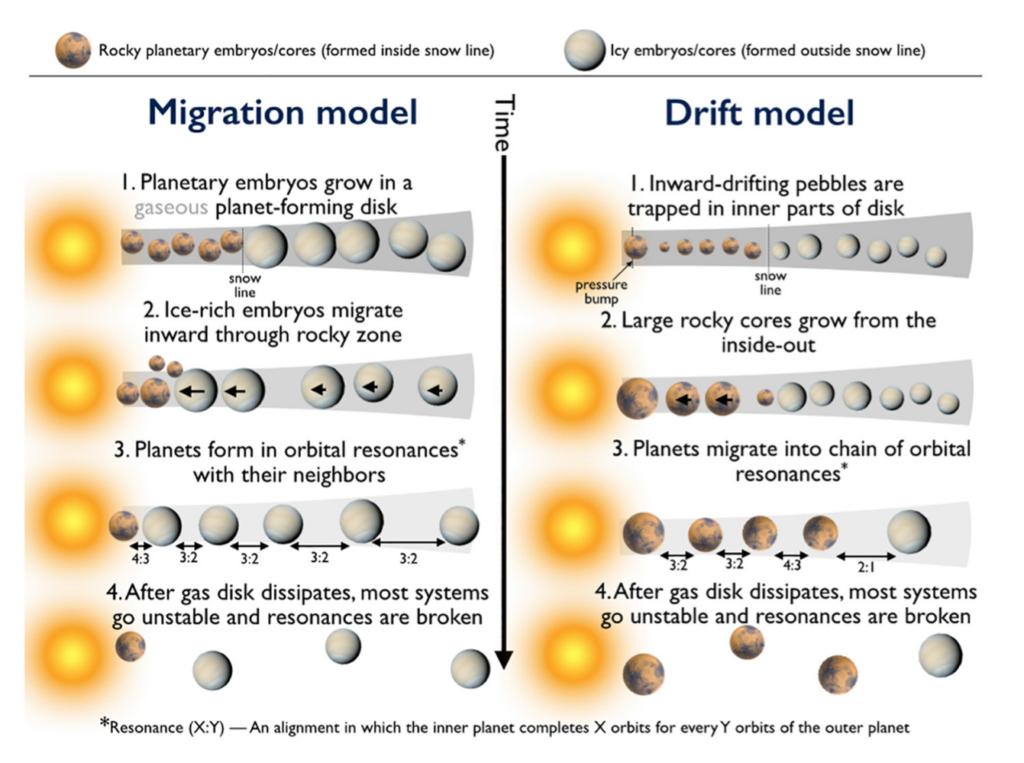
In their formation models, each disk housed one planetesimal that was allowed to migrate (as described via the migration model in Figure 1) through the disk. Planetesimals accrete either rocky or icy pebbles depending on their proximity to the snow line. Considering ice pebble accretion allows the authors to assess the type of planets left behind after photoevaporation (in cases 1 and 2, will core composition impact the valley being reproduced) or if the valley can be produced without photoevaporation at all (in case 3, will the valley be reproduced simply by the core composition). This choose-your-own-adventure planet edition is then evolved out to 5 billion years, at which point, the final planetary radius is calculated. Core-powered mass loss was not considered in any of the evolution models. The authors simulated the formation of 665 planetesimals from a variety of initial conditions and disc properties.
What was found…
The planet’s core mass had a whole lot to do with where it formed, relative to the snow line. Generally, the further beyond the snow line a planetesimal forms, the more ice found in its core, and the higher the core ice mass fraction, the more massive the planet. The authors found that these icy cores also had a wider distribution of core masses than their rocky counterparts. Icy core masses can be found as low as 1 Earth mass and as high as 36 Earth masses, with a spike around 10 Earth masses (blue histogram, left panel of Figure 2). Rocky core masses had a noticeable peak at 3 Earth masses and grew no larger than 5 Earth masses (red histogram, left panel of Figure 2).
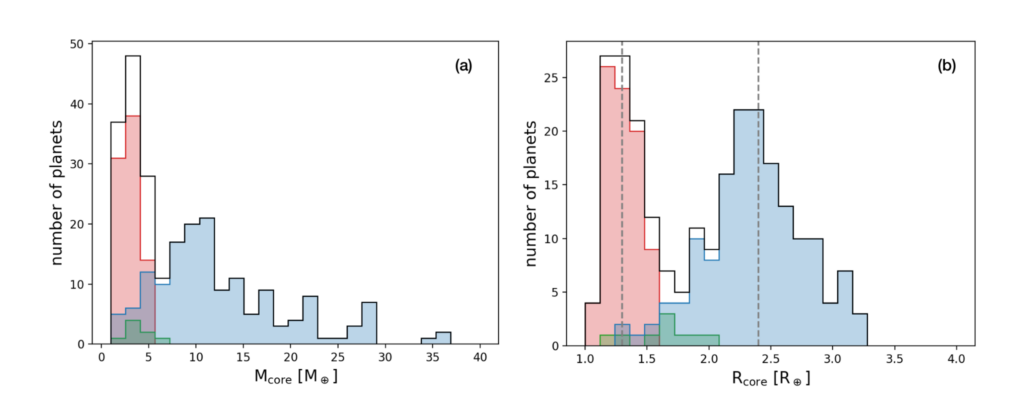
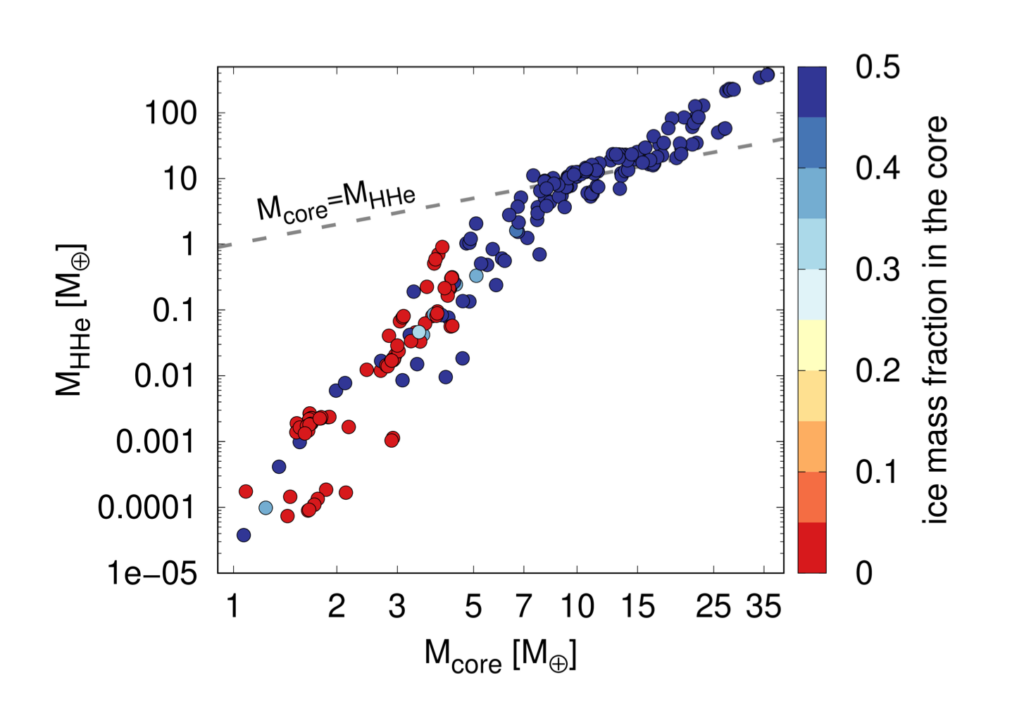
This discrepancy in overall size is easily explained by the process of gas accretion. More massive cores tend to accrete more gas, which disproportionately benefits icier cores (see Figure 3). What’s interesting to note is that, regardless of the photoevaporation case, there is still a noticeable dip in the number of planets between 1.6 and 2.0 Earth radii (right panel of Figure 2). The model’s envelope type, however, impacts whether a second radius peak would appear around 3.1 Earth radii for heavy icy core planets (right panel of Figure 2). This second peak was observed in the Case 2 models and echoes what’s observed in other papers.
Okay, cool, what about their makeup?
Planets in the first radius peak were rocky, devoid of water and H/He, and could originate either within or beyond the snow line (aka what we can call super-Earths). In cases where a planet originated beyond the snow line, they managed to fit in the first peak by losing all of the water it started with via stellar irradiation. The authors found that this was heavily correlated with the orbital period; the number of rocky planets originating from beyond the snow line decreases as the orbital period increases.
Planets found in the second radius peak were rocky planets with thin H/He envelopes, and sizes akin to icy celestial objects (aka what we can call sub-Neptunes). In every case, the planet is inherently water-rich, originates from beyond the snow line, and occasionally migrates to other parts of the system.
Today’s authors show that the radius valley can be explained by core composition if we don’t assume strictly dry cores and account for ice pebble accretion. Although core-powered mass loss was not considered in their models, the authors’ results show that regardless of the presence of a gaseous envelope or photoevaporation, a radius valley will form; in the case of no photoevaporation, a radius gap is still present. The commonality between the planets in each peak was tied to how dry or wet the planet was, with the gap housing the sparse amount of planets that balance this. This tosses a new hypothesis into the ring of possibilities, and although it doesn’t explicitly provide answers to the secrets of super-Earths and sub-Neptunes, it gives a potential new direction for exoplanet formation and evolution models.
This guest post is part of Astrobites coverage of #BlackSpaceWeek presented by Black in Astro. Black in Astro is a grassroots organization that offers support and networking for Black people working in or studying astronomy and space-related fields across the globe. Black Space Week is a virtual conference that features panels, talks, art, giveaways, and various other virtual events to celebrate Blackness in astronomy and space science. For more information on Black Space Week and Black in Astro, please visit their website: https://www.blackinastro.com/.
Astrobite edited by Nathalie Korhonen Cuestas
Featured image credit: NASA, ESA, CSA, D. Player (STScI)
