

This guest post was written by Elise Seaward, who is getting her master’s in scientific & technical communication at the University of Central Florida, and works as a software engineer supporting the GOES weather satellites’ operations. Elise has a passion for exoplanet detection methods, space-based telescopes, and making astronomy research accessible to everyone.
Title: Combining reference-star and angular differential imaging for high-contrast imaging of extended sources
Authors: Sandrine Juillard, Valentin Christiaens, Olivier Absil, Sophia Stasevic, Julien Milli
First Author Institution: STARInstitute, Université de Liège
Status: published in Astronomy & Astrophysics [open access]
Imagine you are an archaeologist at a dig site, carefully uncovering a fossil buried beneath layers of sand and rock. You meticulously remove the dust and sediment, knowing that if you brush away too little, the fossil will go unseen. However, if you brush away too much, fragile structures may be lost forever.
Astronomers face a surprisingly similar challenge when searching for faint planets in circumstellar debris disks. Like fossils, these exoplanets are not new—they have been orbiting their stars for millions or billions of years. And just as fossils are buried in dirt, exoplanets are often obscured in star-lit, dusty debris disks, or shrouded in particulate patterns of quasi-static speckles.
While exoplanet detection methods that use planetary transit, radial velocity, or gravitational microlensing are less affected by these obfuscations, direct detection methods require a way to “see” through the fog. An exoplanet typically orbits a star billions of times its own brightness, making the task of directly photographing it like finding a needle in a haystack. For this reason, direct imaging is one of the least common exoplanet detection methods, despite the valuable data it can provide.
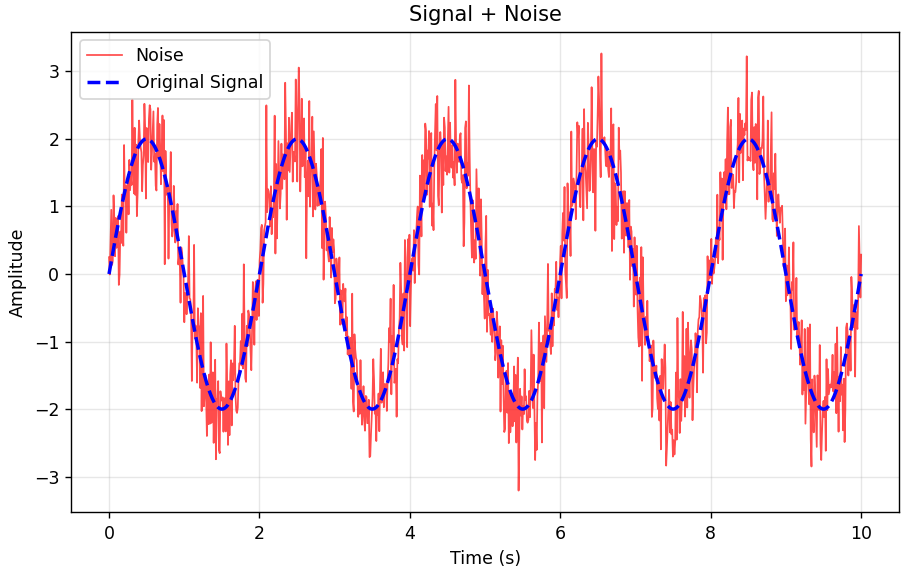
This is the key dilemma of High Contrast Imaging (HCI), which is used to support direct imaging of exoplanets. HCI is a process that requires careful techniques that remove the surrounding “sediment” of noise without damaging the signal beneath (see Figure 1). When imaging exoplanets, HCI techniques are often used to extract the exoplanet’s signal from the ambient noise of its host star.
To help solve this problem, today’s authors have developed a new combination of differential imaging techniques and algorithmic analysis that may open new frontiers in direct imaging of exoplanets.
Excavating the artifacts with ARDI
The first step of any archaeological dig is to excavate your artifacts. To do this, astronomers rely on HCI techniques such as Angular Differential Imaging (ADI) and Reference-Star Differential Imaging (RDI).
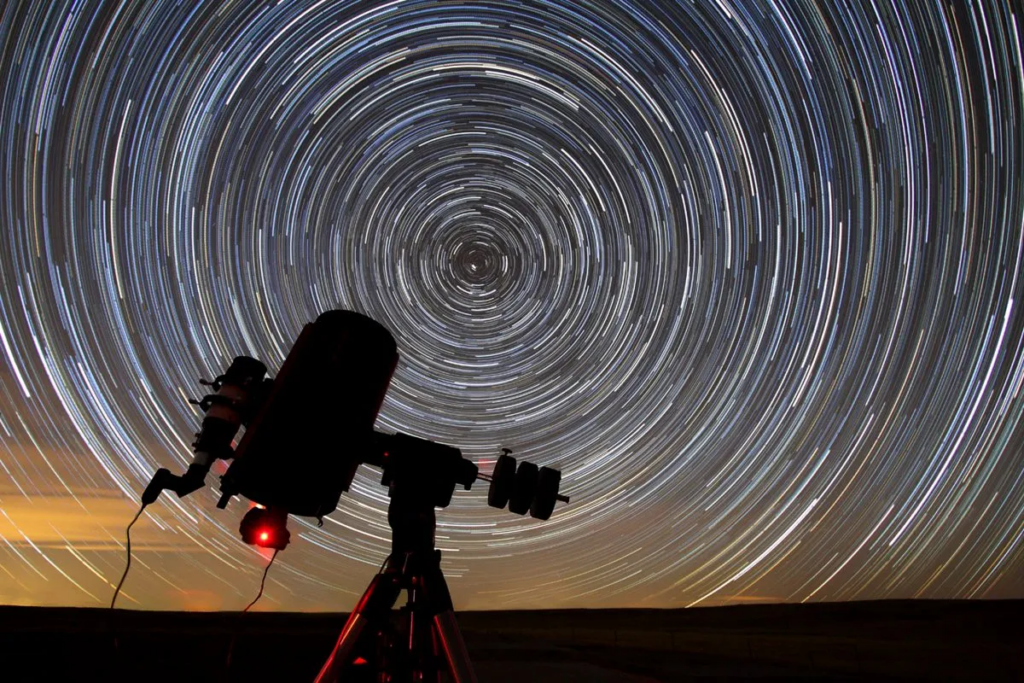
Astronomers use ADI to detect erroneous speckle patterns that contaminate astronomical images. For example, imagine a telescope’s perspective as it photographs the sky while the Earth rotates (Figure 2). As the night progresses, all the stars should appear to move, right? ADI takes advantage of this by flagging any point-like sources that appear to remain fixed in the detector frame. While these pesky speckles may initially look like stars, the fact that they don’t move along with the rest of the night sky reveals that they are a faulty optical phenomenon, not real astronomical objects.
Alternatively, RDI uses (you guessed it) images of a reference star with characteristics similar to the target star, as well as reference images that exhibit a similar speckle pattern. These images are used together to identify and subtract out the unwanted speckle noise. RDI is great for stable speckle patterns and produces high-quality images of disks.
So, if these two are already common methods, what’s the novelty here? While ADI and RDI are powerful techniques, they have significant limitations. ADI can distort extended structures such as protoplanetary disks, while RDI depends heavily on the availability of suitable reference stars observed under similar conditions. To work around this, today’s authors have creatively combined ADI and RDI into a new hybrid approach: ARDI. By uniting the strengths of ADI and RDI, ARDI reliably recovered faint disk structures while suppressing speckle noise.
Cleaning up the artifacts with IPCA
Once you have your exoplanet image artifacts excavated by ARDI, you still need to brush off the residual detritus. To do this, today’s authors use a technique known as Iterative Principal Component Analysis (IPCA). IPCA’s better-known sister, Principal Component Analysis (PCA), is a statistical procedure for reducing the dimensionality of a dataset, involving a bunch of math that illuminates patterns in your data that you might not otherwise detect. IPCA, however, is a more algorithmic variation of PCA that updates the model iteratively, allowing the formula to adapt gradually as it processes the data. Think of IPCA like gently brushing away sand off of a fossil with many small strokes, careful not to lose valuable features, and PCA more like taking a sandblaster to it — getting the job done quickly but with greater potential for loss
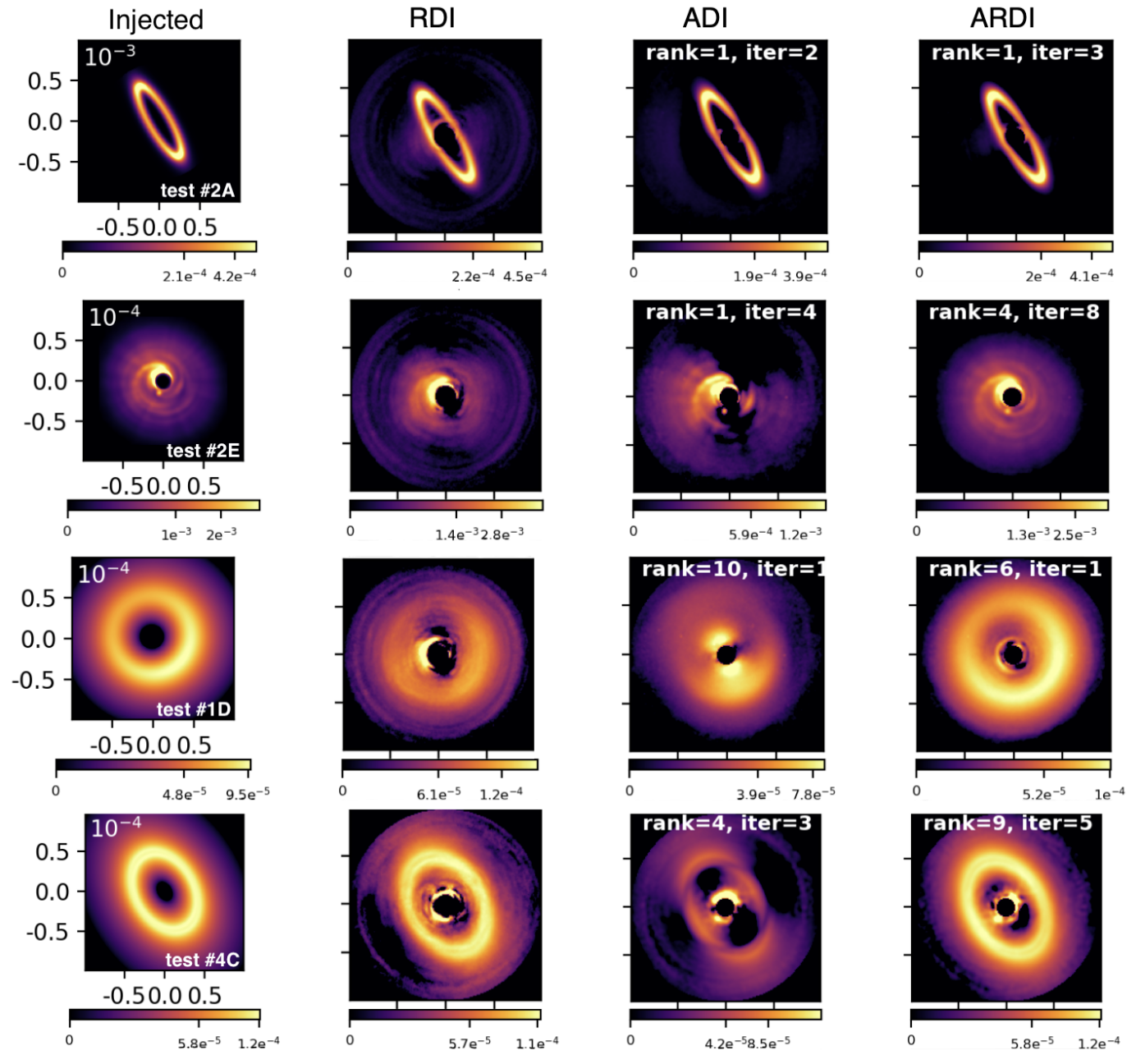
The authors use IPCA to generate four estimated images of protoplanetary disks (Figure 3), including images processed with ARDI techniques (column 4) to reconstruct the original images (column 1), compared with ADI or RDI (columns 2 and 3). By applying ARDI and IPCA to dozens of datasets, the authors found that ARDI consistently improves the recovery of extended signals, especially compared to using ADI or RDI alone. Using a quantitative image-quality metric known as the Structural Similarity Index Measure (SSIM), the authors found that ARDI was most often selected as the best-performing strategy for reconstructing disk structures. Most significantly, they found that the ADI component mitigates the weaknesses of RDI in seeing the planet through time-varying speckle patterns, and the RDI component steps up where ADI struggles to capture the disk structure through rotation-invariant flux.
Interpreting the finds
So, with the ARDI-excavated, IPCA-processed artifacts, astronomers can begin the real scientific work of interpreting what they see. Are the structures in the image consistent with a debris disk? Is there a point-like source that could be a planet embedded within the disk? While IPCA cleans up the images nicely, this additional analysis is essential for astronomers to understand the results.
Of the 29 star systems to which the authors applied their ARDI process and IPCA algorithm, all were successfully reconstructed, though none were found to have exoplanet candidates. This could indicate that these previously proposed exoplanet candidates may turn out to be artificial artifacts or disk structures instead of planets. Even without a new planetary discovery, their study demonstrates that their new IPCA-ARDI method can recover disk structures while still preserving potential planetary signals.
As modern telescopes probe further and fainter star systems than ever before, advancements in high-contrast imaging will be essential in sifting out planets from their dusty circumstellar disks. New techniques like ARDI may be the key to helping astronomers brush away cosmic sediment — revealing the planetary fossils underneath.
Astrobite edited by Samantha Wong
