
This guest post was written by a transgender woman getting her PhD at a university in the United States. Since her state is generally hostile to transgender rights, she has chosen to stay anonymous to avoid disclosing her transgender identity to her colleagues, a decision discussed in the bite.
In the early 2000s, the military’s rules on homosexuality were summed up by a simple mantra: “Don’t Ask, Don’t Tell”. The United States military “didn’t care” if you were gay, as long as you kept it to yourself. Imagine how it would have felt to be a queer soldier in that era: the anger at hypocrisy, fear of being outed, and despair from hiding one’s true self. Even though it has been fifteen years since the policy ended, disapproval towards openly expressing queer identities continues. Academia is no exception. Indeed, my transgender colleagues and I often feel like our transgender identities are best kept undisclosed due to fears of retaliation.
Selfhood vs Safety
I began transition prior to entering graduate school, having adjusted my name, pronouns and appearance enough that few people knew of my pre-transition existence, allowing me to have plausible deniability about my transgender identity. This self-inflicted policy of non-disclosure often feels necessary, due to legal and social factors making graduate school seem cold or actively hostile towards transgender students.
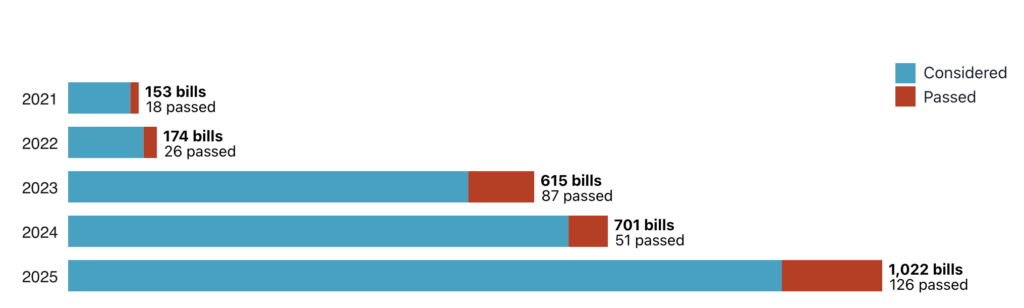
Legally, anti-trans bills in various states make it increasingly harder for transgender students to thrive in our communities: the explicit banning of name or gender changes, bathroom bills which make it difficult or illegal for transgender students to use the relevant bathroom, laws targeting transgender support groups or curriculum specifically in higher education, and restrictions on medical access, just to name a few. These bleed over into our astrophysics communities, affecting university bathroom policies, teaching practices, and general student welfare.
Furthermore, social factors often have led towards the fear of disclosing my identity. In addition to the imposter syndrome provided by being both female and transgender in a field dominated by cisgender men, there have also been incidents where I have felt explicitly un-welcomed, whether it be overhearing transphobic slurs in the office, or seeing a colleague explicitly argue that “cisgender men are more naturally attuned to physics than others”. While HR and Title IX resources in theory could resolve such incidents, they are rarely able to do so in hostile states.
As such, many transgender students are often stuck making the choice between living freely as their true selves or living safely.
Support in the Shadows
Yet, we still persist. Despite the social and legal pressures to remove us from the academic sphere, support from other transgender scientists and our allies can help us feel like wanted members of the scientific community. Advocacy work on the state, university and departmental levels has been essential for making me feel welcome in astrophysics: protesting at the state capitol, pushing against university policies that cave to anti-trans rhetoric, and calling for single occupancy bathrooms in astrophysics buildings to combat bathroom bills. Support also comes through minimal compliance, whether it’s allowing advocacy groups to continue unofficially or with adjustments, or not paying close attention to who uses the bathroom – following only the letter of the law, not its transphobic spirit.
Outside of “official” channels, I find the most support comes in private, closed-door conversations with my colleagues. Many of these conversations have been with other transgender scientists, focusing on our unique challenges both in astronomy and the wider world, and believing that it is possible for us to remain in this field. Others have been an outpouring of support from cisgender colleagues, including my graduate advisor, promising to support my journey in physics even if I have to leave my state. It is through these support networks that I have been able to continue.
What can YOU do?
Being transgender in astronomy is hard, regardless of location. Even if you aren’t in a hostile state or in the US, astronomy is an international community, and the social and political attitudes in one area of the world have effects everywhere. So then, what can we do?
For cisgender people in astronomy, awareness is the first step. You can’t fight for transgender rights in astronomy if you don’t understand how they’re threatened. Following that, signaling your support for transgender students in quiet ways can make quite a difference, whether it be a tiny pro-pride sticker on a laptop or a statement in a syllabus. Actions also speak louder than words, explicit advocacy or silent non-compliance may help relieve pressure on transgender students.
For transgender people in astronomy, take care of yourself. Focus on your physical and mental health, avoid the news and social media when possible, and build community. Avoid giving into imposter syndrome and do not let the factors against us make you feel incapable. Be careful but not cynical; stay safe but don’t let fear prevent you from opening up when possible. Reach out to other transgender astronomers and trusted allies. Do not give into despair.
Astrophysics is a community for all types of people, even as social and political factors try to convince us otherwise. The more we can recognize we are stronger collectively than those who try to divide us, the more we can build a stronger, more inclusive, and more thoughtful astrophysics for all. Only then can the era of “don’t ask, don’t tell” astrophysics finally end.
Astrobite edited by Kylee Carden
Featured image credit: Adapted from JWST First Deep Field, NASA
