

This guest post was written by Savaria Parrish, an incoming first year Physics PhD student at the University of Alabama, Huntsville with an interest in planetary atmospheres and exoplanets. She is especially interested in exoplanet dynamics and modeling. Outside of school, she enjoys listening to Michael Jackson, Stevie Wonder, and spoken word poetry.
Title: Increased Surface Temperatures of Habitable White Dwarf Worlds Relative to Main-sequence Exoplanets
Authors: Aomawa L. Shields, Eric T. Wolf, Eric Agol, and Pier-Emmanuel Tremblay
First Author’s Institution: Department of Physics and Astronomy, University of California, Irvine; Irvine, CA
Status: Published in the Astrophysical Journal [open access]
Rethinking Habitability Around White Dwarfs
When we think about habitable planets, we usually picture Earth-like planets orbiting stars like our Sun; but other types of stars exist too. White dwarfs are the leftover cores of Sun-like stars. Before becoming a white dwarf, a star expands into a red giant, becoming so large that it engulfs nearby planets. After shedding its outer layers, what remains is a small, dense core known as a white dwarf. Even though it no longer produces energy through fusion like a normal star, it does not collapse under its own gravity. Gravity is constantly trying to squeeze it inward, but the electrons inside are packed so tightly together that they resist being compressed any further. This keeps the white dwarf from collapsing even though it no longer produces energy, and it slowly cools over time. Because they are stellar remnants and could have disrupted planetary systems during their preceding red giant phase, they’re not usually viewed as stars that could host habitable planets. However, there is evidence of planets and planetary debris around white dwarfs, suggesting that some planets may migrate inward or form after the white dwarf stage begins.
Habitability is generally tied to whether a planet can sustain liquid water at its surface and heat suitable for life. This is often framed in terms of a habitable zone, the range of distances from the host star where liquid water could exist. But being in the right location alone is not enough. Atmospheric composition, cloud behavior, and planetary rotation all shape how energy is retained and redistributed. A planet’s atmosphere regulates how much heat is trapped versus lost to space, while clouds can either increase reflectivity or trap outgoing radiation depending on their structure. Clouds form when air rises and cools, causing vapor to condense. The way heat is distributed around a planet influences where this rising air occurs, which in turn affects where clouds form and how much sunlight they reflect. Rotation adds another layer, especially for tidally locked planets, where one side permanently faces the star. Faster rotation tends to spread heat more evenly, while slower rotation allows energy and clouds to build up in one region.
The Set-Up
The key result of this work is that a modeled Earth-like planet orbiting a white dwarf star can actually be warmer than a similar planet orbiting a main-sequence star, even when both receive the same amount of incident stellar flux (stellar radiation). This leads to surface conditions that are more favorable for maintaining liquid water. The white dwarf case reaches a global mean surface temperature about 25 °K higher, showing that atmospheric dynamics play a major role in setting climate.
Using planetary atmosphere simulations to explore this, Earth-like planets are placed around two stars: a 5000 K white dwarf and the main-sequence star Kepler-62, which has a similar effective temperature. Both planets are positioned within their respective habitable zones and given identical atmospheric compositions, so the incoming energy is controlled. The main difference comes from orbital distance. Even though they have the same temperature, because the white dwarf is much fainter, the white dwarf planet orbits much closer to its star at around 0.01 AU, which leads to a much shorter orbital period of 10 hours, compared to 155 days for the Kepler-62 case. Both planets are tidally locked, so their rotation rates are the same as their orbital periods and differ significantly from each other as a result.
What Makes This One Warmer
A three-dimensional climate model (ExoCAM) is then used to simulate atmospheric circulation, cloud formation, and heat transport. The rapidly rotating white dwarf planet develops strong winds that redistribute heat more efficiently across the surface. This reduces the contrast between the dayside and nightside and prevents the formation of thick cloud layers. In contrast, the slower-rotating Kepler-62 planet allows clouds to build up in one region, especially on the dayside, where they reflect a large fraction of incoming stellar radiation. This increases the planet’s overall albedo and cools its surface. Although clouds can also trap heat, the cooling effect from reflecting sunlight dominates in this case. The white dwarf planet, with fewer reflective clouds and stronger atmospheric circulation, allows more radiation to reach the surface and retains more heat, leading to a warmer global climate.
Probing Atmospheric Structure
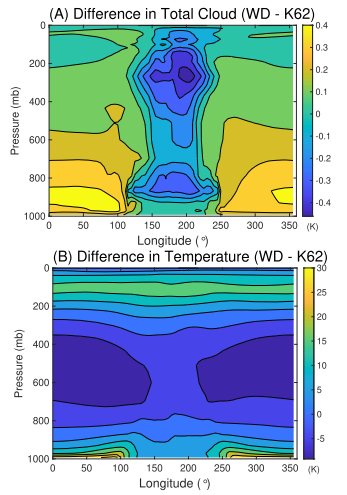
This difference in atmospheric behavior is evident in Figure 1. The white dwarf planet shows reduced cloud cover across much of the dayside atmosphere. With fewer clouds present, less incoming radiation is reflected or absorbed higher in the atmosphere, allowing more energy to reach the surface. This directly impacts the temperature structure. The lower atmosphere of the white dwarf planet is consistently warmer, as more radiation penetrates downward instead of being blocked by clouds. In this case, clouds are less effective as a cooling mechanism, and their reduced presence allows the planet to retain more heat.
Implications for Future Exploration
These results are exciting because they open up white dwarfs as a completely new class of targets in the search for habitable worlds! Instead of limiting the search to Sun-like stars, this work shows that even stellar remnants can host planets with warm, potentially life-supporting conditions, simply through differences in atmospheric circulation and rotation. That shift matters for future missions, since planets around white dwarfs orbit much closer in, making them easier to detect and more favorable for atmospheric characterization through transits and spectroscopy. With observatories like JWST already capable of probing small exoplanet atmospheres, this work points toward white dwarf systems as promising targets for future observations, expanding where and how we search for habitable environments beyond traditional stellar hosts.
This guest post is part of Astrobites coverage of #BlackSpaceWeek presented by Black in Astro. Black in Astro is a grassroots organization that offers support and networking for Black people working in or studying astronomy and space-related fields across the globe. Black Space Week is a virtual conference that features panels, talks, art, giveaways, and various other virtual events to celebrate Blackness in astronomy and space science. For more information on Black Space Week and Black in Astro, please visit their website: https://www.blackinastro.com/.
Edited by Sahil Hegde
