
In this series of posts, we sit down with a few of the keynote speakers of the 248th AAS meeting to learn more about them and their research. You can see a full schedule of their talks here, and read our other interviews here!
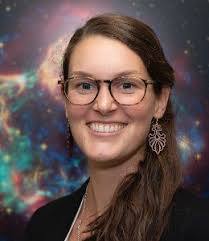
Antimatter sounds like the stuff of science fiction, but it is being made all around us, even as Dr. Carolyn Kierans likes to point out, inside a banana. Bananas contain a little potassium, and some of that potassium is radioactive; when it decays, it throws off positrons, the antimatter twins of electrons. Stars do the same thing on an enormous scale, forging unstable elements that decay and release positrons as they settle back toward stability. When one of those positrons meets an ordinary electron, the two annihilate and release a flash of light at one very specific energy: 511 kiloelectronvolts (keV).
This is the puzzle Dr. Kierans has spent her career chasing. The center of our galaxy glows at exactly that energy, but the shape and distribution of that glow don’t match any known population of astrophysical sources we can see at other wavelengths. “We don’t know enough about the sources in our galaxy to actually explain the distribution of the positrons we see,” she says. The antimatter signatures in our Galaxy don’t match known sources, and reconciling that mismatch means looking at the sky in a way almost no telescope can.
Dr. Kierans is a research astrophysicist at NASA’s Goddard Space Flight Center, and this June she will give a plenary lecture at the 248th meeting of the American Astronomical Society as the winner of the 2025 High Energy Astrophysics Division (HEAD) Early Career Prize. Her corner of the sky is one most observatories simply cannot see: the “MeV gap”, a band of medium-energy gamma rays, roughly 100 keV up to 100 MeV, that she describes as one of the least-explored windows in astronomy. It’s not that the gap is boring, where some of the universe’s most energetic processes reveal themselves, from exploding stars to the environments around black holes. And it is just genuinely, stubbornly hard to look there.
Dr. Kierans did not set out to study antimatter, or even astronomy. She grew up in Canada with a mother who taught math, and a household where numbers were never intimidating: “we used to do math around the dinner table,” she remembers. She went into her undergraduate degree at Simon Fraser University assuming she would become a physics teacher, following in her mother’s footsteps as an educator.
Then a summer co-op placement put her inside a real research lab: Canada’s national particle physics laboratory, TRIUMF, building vacuum systems for an experiment. She discovered that what excited her most was not the theory itself, but the process of building and testing instruments. A master’s in quantum optics at the University of Toronto taught her something else about herself: the experiments lived “in a basement, and it was dark, and a lot of twiddling with knobs,” and she wanted, in her words, “to see a little bit more sunlight.” So when she arrived at UC Berkeley for her PhD and heard that one group there built detectors and flew them into space, she was sold. “The idea of building something and then putting it into space was just, like, that seems extra fun.”
What she fell into is the strange art of seeing gamma rays. You cannot focus them the way an optical telescope focuses starlight, she explains : a gamma ray is so energetic that it sails straight through any lens or mirror you put in front of it. Instead, astronomers have to build large, heavy particle detectors and catch the gamma ray as it scatters and deposits its energy inside, then work backward to reconstruct where it came from. And because gamma rays are absorbed by Earth’s atmosphere, the whole apparatus has to fly above it.
That is where giant balloons come in. During her PhD, Dr. Kierans helped fly an instrument called COSI (The Compton Spectrometer and Imager) on a NASA super-pressure balloon the size of a football field. It launched from Wanaka, New Zealand in 2016 and floated for 46 days, long enough to capture the galaxy’s 511 keV antimatter glow with a new kind of telescope for the first time. That success helped COSI graduate from a balloon experiment into a full NASA satellite, now scheduled to launch in August 2027, with Dr. Kierans working on its data pipeline.
Her talk, though, is for what comes next: a prototype called ComPair, the mission she leads as Principal Investigator, which her team flew from Fort Sumner, New Mexico in 2023 to prove the technology for a future mission that could finally cover the entire MeV gap. Even the launches themselves, she says, are “slow motion nerve-wracking”, years of work, and often a graduate student’s whole thesis, riding gently up into the sky.
What she actually tells students thinking about grad school is specific. “Grad school is tough, but not in the way most people expect,” she says. “Classes are hard, sure, but the most challenging part is learning to do self-guided research, balancing the workload, and convincing yourself you truly belong there with your seemingly more brilliant peers. Hard work and perseverance outweigh brain cells.” For students and especially the young women, who love physics but quietly wonder whether they belong, her advice is more personal. “Find a mentor”, she says, “ideally one who looks like you”. The only reason she went to graduate school at all, she explains, was a woman she knew who had a PhD in physics and told her, plainly, that she had gotten B’s and “wasn’t Einstein”. Seeing that up close changed everything. “She’s human. She didn’t always get straight A’s, she wasn’t top of her class, but through hard work and perseverance she became a faculty member, and it just becomes tangible. Without that, it’s really hard to see yourself in that place unless you see someone that looks like you.”
There is one thing Dr. Kierans wants to make sure readers hear, and it doubles as a preview of her plenary. We celebrate telescopes for the images and discoveries they deliver, but we rarely hear about the years of unglamorous building that came first. “We don’t hear about how the instruments get built,” she says. “We just hear about the amazing things that they do once they are built.” Behind every great observatory is a long lineage of graduate students and postdocs who soldered, calibrated, and coaxed the hardware into working and who often grow into the leaders of the next mission. “The people who worked on this first version of ComPair,” she points out, “might be the PI of the later version, 10, 15 years down the line.” Her talk will be, in part, a tribute to those people: the instrument-builders and pipeline-writers whose careers make science possible. It is also an invitation. The next telescope to peer into the MeV gap will be built by people who are undergraduates right now, and one of them might be reading this.
To hear more about the MeV gap and the instruments being built to explore it, tune into Dr. Carolyn Kierans’s Plenary Lecture at 11:40 A.M on Tuesday, June 16th at #AAS248!
Edited by: Katya Gozman
Featured Image Credit: AAS
