
This interview is part of Astrobites coverage of #BlackSpaceWeek presented by Black in Astro. Black in Astro is a grassroots organization that offers support and networking for Black people working in or studying astronomy and space-related fields across the globe. Black Space Week is a virtual conference that features panels, talks, art, giveaways, and various other virtual events to celebrate Blackness in astronomy and space science. For more information on Black Space Week and Black in Astro, please visit their website: https://www.blackinastro.com/.
Today’s interviewee is Amina Diop, a fifth-year doctoral student at the University of Virginia.
Disk-Planet Connections
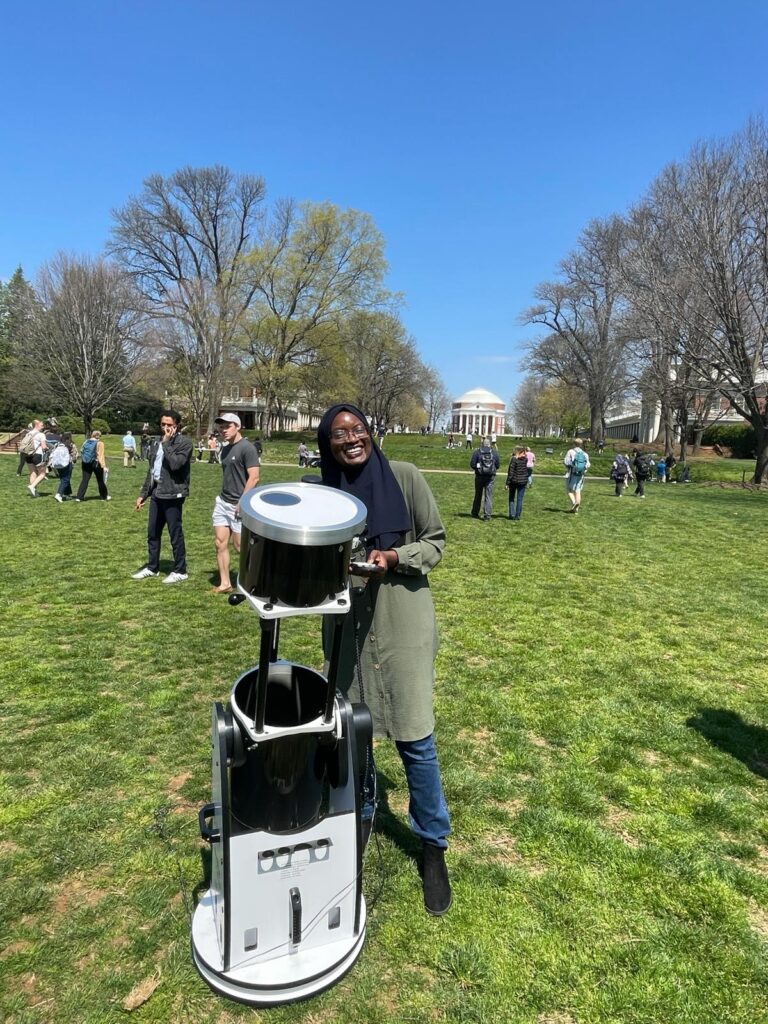
Diop first discovered astronomy, and her love for it, from her TV, growing up on a healthy diet of French dubbed space documentaries. It wasn’t until she watched these documentaries that she realized the field of astronomy even existed as her home country of Senegal had little opportunities to study astronomy at that time. Through these documentaries, she learned about institutions such as NASA in the United States where she could pursue her dream of studying the stars. “I remember thinking ‘I need to get myself to the US, to NASA, to study astronomy.’” Her family had little idea of what an astronomy career entailed and she would be the first in her family to pursue a PhD.
However, Diop was determined. She was selected to attend the African Leadership Academy in South Africa and devoted herself to her math and physics classes. At the end of her degree, she was accepted to Williams College in Massachusetts. It was there, during her second year, that she started her first research project on protoplanetary disks with Dr. Kevin Flaherty. She studied turbulence in protoplanetary disks using ALMA data. “It was a really interesting field to me. How do we go from these beautiful disks of dust and gas to these beautiful diverse planetary systems that we see?” After graduating, Diop was accepted to the University of Virginia (UVa) where she has continued her work on protoplanetary disks through the lens of astrochemistry. She looks at the chemical composition of protoplanetary disks and explores how we can link their elemental abundances to the exoplanets we see today.
Diop has also applied machine learning to better understand the complex chemistry in these disks. She used these techniques combined with chemical models to study how CO chemistry responds to the physical conditions in disks (read the paper here!) She’s now part of the Disk-Exoplanet C/onnection (or, DEC/O, because astronomers love acronyms always) and was introduced to the collaboration by her graduate advisor, Dr. Ilse Cleeves. The collaboration has taken ALMA data of over 80 protoplanetary disks and are looking to constrain elemental abundances of disks across different stellar types, sizes, and star-forming regions of the galaxy. “The goal of DEC/O is to understand the typical elemental abundances in protoplanetary disks and how these translate to exoplanet formation.” She’s generated a large grid of disk physical-chemical models representative of the DEC/O sample in order to interpret the observations and extract C/O and C/H ratios for these disks. She is currently finalizing her paper for submission and the DEC/O collaboration expects to publish their first wave of papers detailing their initial findings this Fall.
Human Connections
While Diop has found success in her academic career, including winning a prestigious NASA FINESST fellowship, the journey so far hasn’t always been so smooth. The transition from Senegal to South Africa was tough as she was coming from a non-English speaking country to an English-speaking environment. Later, when she came to the U.S. for college, she started experiencing mental health issues and struggling with burn-out. “In my second year of college the classes got significantly harder and the amount of time I was putting into my courses wasn’t being reflected in the grades. I was failing some of my physics classes and at that point began questioning if this was really for me. I had always been a high achiever in life so the idea of failing and not doing well in school was giving me a lot of trouble.”
However, it was through these struggles that Diop learned the power of resilience and opened herself up for support. “I had this mindset that I was going to do everything by myself and that didn’t serve me. I remember telling my undergraduate academic advisor [Dr. Steve Souza] that I didn’t think I could continue in the major. He immediately said ‘No, you can get through this’ and advised me to start working with others. I had to learn how to collaborate and ask for help from others. Go work with a group, go to office hours, don’t be afraid to ask for help! If you fail, it’s not the end of the world. You can always evolve in life, you can always grow and do better. When I first came to the South Africa, I could read and write English pretty well but I couldn’t speak it. It was through that, and being uncomfortable, that I really grew in my English speaking skills. I apply this mindset everywhere now.”
The power of support, especially from her community in Black in Astro, has been instrumental in Diop’s success. “I have been in Black in Astro for about 4 – 5 years. It’s been a great resource to have people who understand you and understand the struggles you’re going through. They’ve given me so many opportunities and a space to celebrate wins. Even if it’s small wins like I baked a pie or bigger wins like I just graduated, they are the type of people to remind you who you are when imposter syndrome inevitably takes control. ”
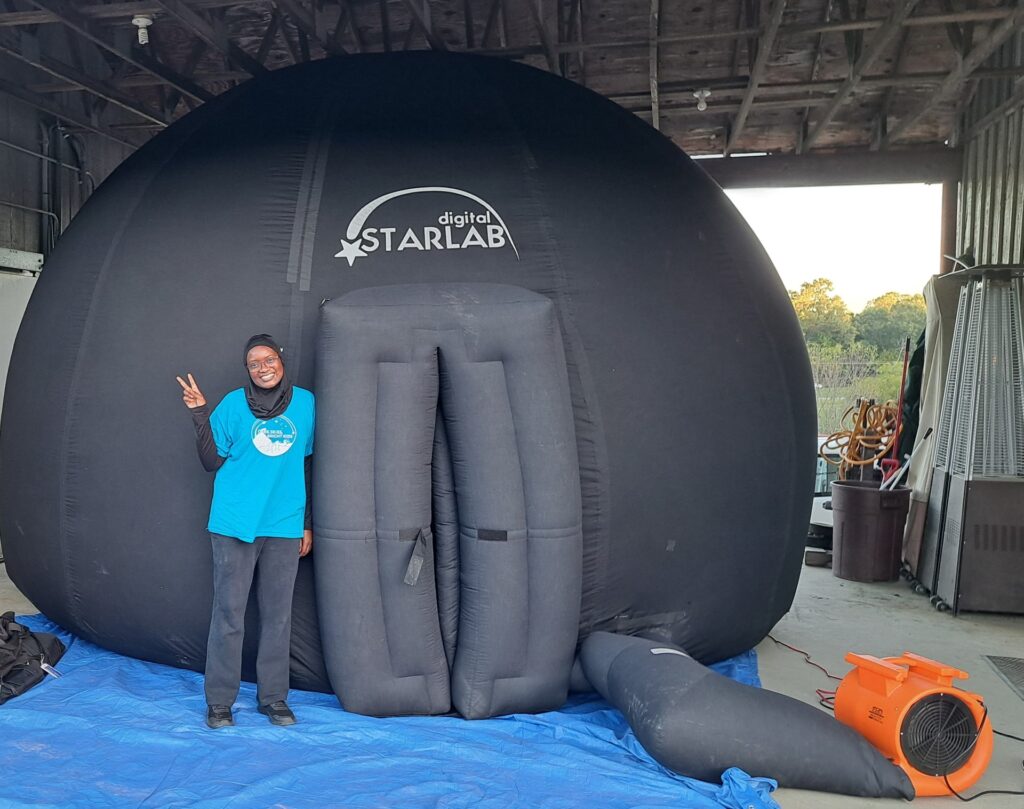
Another big part of her journey has been engaging in outreach, both at UVa and in her home country of Senegal. “Astronomy has never been much of a thing in my country. There’s now a lot of people working on bringing astronomy to Senegal and I collaborate with them often. I’ve mentored students, given presentations, and recently was selected by the Ministry of Education to be a mentor for female contestants in a big scientific competition that I won while in Senegal. It’s been a nice way to give back to younger women and people in my country.
Diop is also part of her department’s outreach group, Dark Skies, Bright Kids, where she gives planetarium shows and brings astronomy to local schools. “I believe in giving back and sharing the wisdom and helping those who want to pursue a scientific path, whether it’s in astronomy or not. It’s important to me, especially as a minority, to share that wisdom because I’m the first one in my family to pursue a degree beyond Master’s. There’s a lot of things I have had to learn and not having someone else to guide me. It’s a big part of my journey to give back and guide the next generation.” Diop hopes to continue her work on protoplanetary disks in a postdoctoral research position after she graduates next year.
Advice for young Black scientists
“Be resilient. This journey has not always been easy and don’t let the first sign of failure deter you from the path. Don’t let perfection be the enemy of good and learn how to be ok with messy drafts. At the end of the day, you are a person doing astronomy. You can’t work all the time. It’s good to take a break and then come back. These things can be hard and when they are, sometimes it’s the other things in life that keep us going. It’s the family, it’s the other hobbies and activities that bring us joy. Seize any opportunity to chase joy and make the most out of it.”
Edited by Nathalie Korhonen Cuestas
Featured image credit Amina Diop
