
Title: The role of major mergers in triggering super-Eddington accretion
Authors: Riccardo Caleno, Tommaso Zana, Raffaella Schneider, Alessandro Lupi, Pedro R. Capelo, Lucio Mayer, Alessandro Trinca, Rosa Valiante, and Marta Volonteri
First Author’s Institution: Dipartimento di Fisica, Università di Roma
Status: Submitted to Astronomy & Astrophysics [open access]
At the center of almost every large galaxy lies a supermassive black hole (SMBH). Supermassive is no exaggeration; these black holes are a million times more massive than the Sun and grow by accreting interstellar gas. Astronomers have been studying supermassive black holes (including the one at the center of our own galaxy) for decades, but the James Webb Space Telescope (JWST) has allowed astronomers to study black holes earlier in the Universe’s history than ever before. Many of these SMBHs that formed only a few hundred million years after the Big Bang are more massive than previously thought possible. In the local Universe, there is a known relation between the mass of a SMBH and the mass of its host galaxy. In the distant Universe, however, SMBHs aren’t playing by those rules. Instead, they are much more massive relative to their host galaxies.
Too Big For Their Britches
How did they get so big? Black holes mainly grow through gas accretion, but their growth is limited. As material falls towards the black hole, it loses energy in the form of radiation. As the black hole accretes material, there is a build up of radiation pressure that opposes the gravitational pressure forcing the material towards the center. This process restricts the rate at which black holes accrete material and is known as Eddington-limited accretion. However, the Eddington limit is only a theoretical limit and makes a lot of simplifying assumptions about the black hole. In reality, SMBHs are complex and dynamic environments that can sometimes accrete at rates faster than the Eddington limit. For example, if the black hole is accreting from a disk with high gas density or has strong jets that direct the radiation away from the infalling material, it can experience “super-Eddington” accretion.
Astronomers have used simulations to test whether super-Eddington accretion can explain the presence of overmassive SMBHs observed by JWST in the early Universe (see other astrobites on this topic here and here). However, many previous studies have not fully accounted for all the radiative and kinetic feedback effects present in the SMBH’s environment, such as winds from supernovae, jets powered by twisting magnetic fields in rotating accretion disks, and mergers with other galaxies.
The authors of today’s bite use simulations of galaxy mergers to investigate whether mergers can trigger super-Eddington accretion and create overmassive SMBHs in the early Universe.
Can Cosmic Collisions Bulk Up Black Holes?
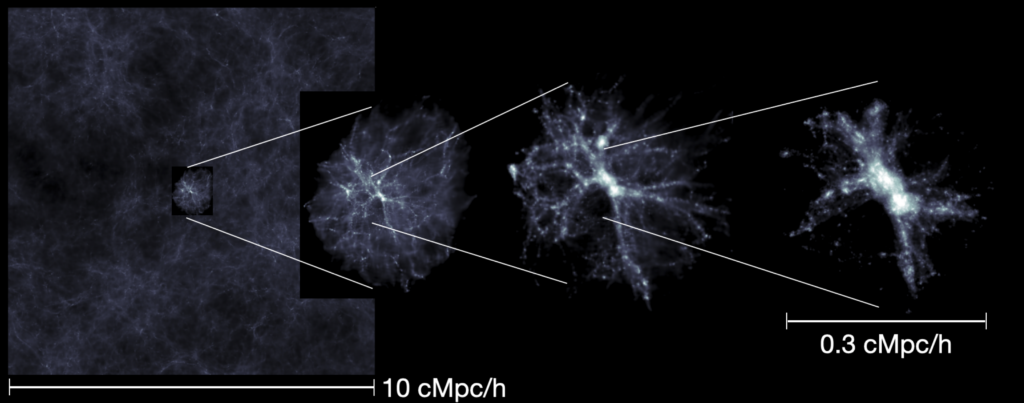
The authors use the code Gizmo to create a hydrodynamic simulation of a galaxy merger and its effects on the black hole accretion rate. One of the major difficulties with these simulations is they must include both large-scale and small-scale physics. Galaxies reside within dark matter halos spanning hundreds of thousands of light years, while the gas accretion is influenced by processes occurring over just a few light years. There isn’t enough computational power in the world to simulate such an enormous range of scales at the same resolution. Instead, the authors begin with a large simulation box at lower resolution containing many dark matter halos and identify two halos that will merge at redshift 11 (only 400 million years after the Big Bang). They then zoom in on the small portion of space containing the final merged halo and rerun the simulation at a much higher resolution to study the black hole growth before, during, and after the merger with great detail (see Figure 1).
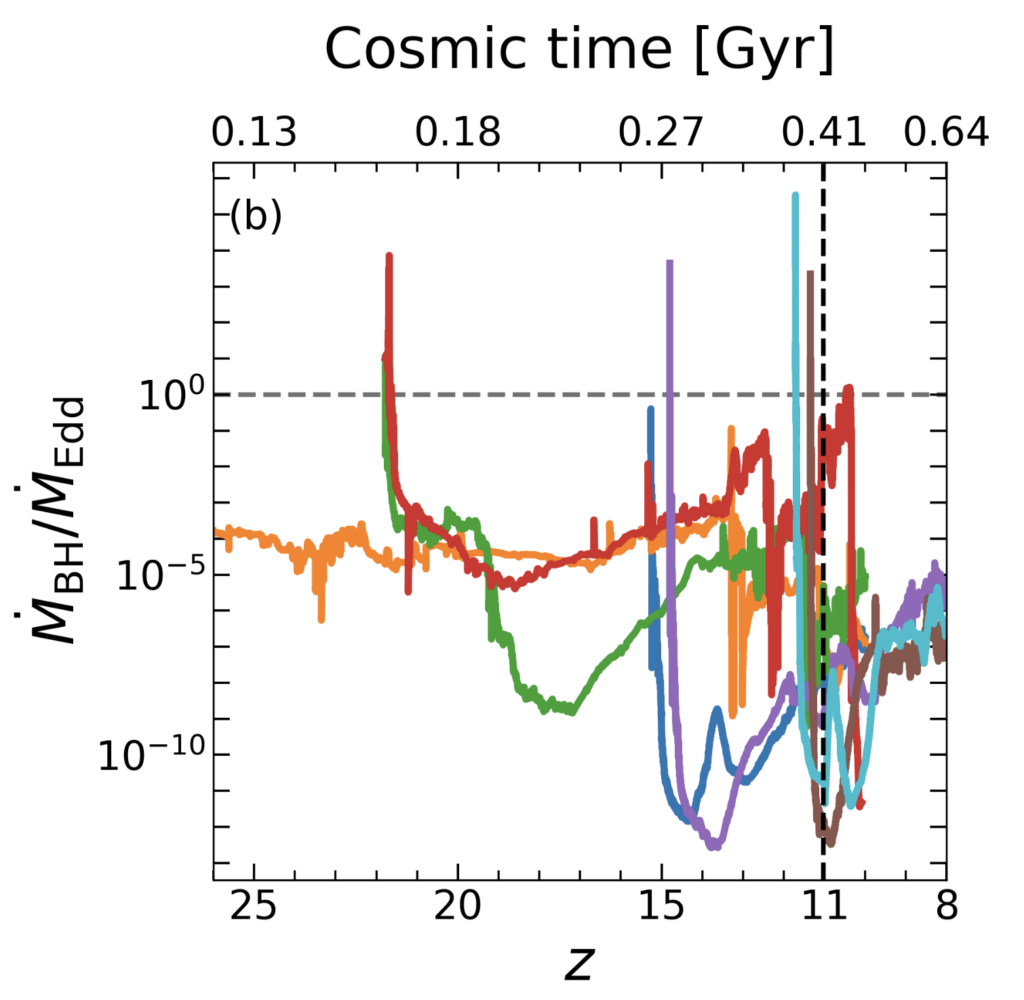
The authors perform seven runs of their code, varying the initial conditions and the strength of the radiative and kinetic feedback to investigate what factors could lead to super-Eddington accretion. The evolution of the SMBH accretion is shown in Figure 2. They found that if the SMBHs are born in a dense environment, they may experience short bursts of super-Eddington accretion at the beginning, but these bursts cannot be sustained for long periods of time. The simulations showed that the merger does push gas towards the center of the SMBH, which helps the black hole grow, but is not enough to trigger super-Eddington accretion. Even in merging galaxies, it takes a substantial amount of time to build up enough gas density to achieve such high accretion rates. During that time, supernovae explosions in lower-mass halos can blow away large amounts of gas, preventing further growth of the gas density. Kinetic feedback, like the winds from supernovae, is the dominant accretion-limiting mechanism. The only simulation run that reached super-Eddington accretion after the merger was the one where all black hole feedback mechanisms were turned off (see the red line in Figure 2).
This simulation was only done with lower-mass dark matter halos, but mergers between larger galaxies may have more success in triggering super-Eddington accretion. However, the surprisingly high number density of overmassive SMBHs in the early Universe suggests that their presence cannot be explained with high-mass mergers alone. Our understanding of supermassive black holes is clearly incomplete. As our computational capabilities grow in complexity and telescopes see further into the Universe with greater clarity, observers and theorists will have to work arm in arm to understand these (super)massive mysteries.
Astrobite edited by Anavi Uppal
Featured image credit: ESO
