
Title: Molecular hydrogen in the extremely metal- and dust-poor galaxy Leo P
Authors: O. Grace Telford, Karin M. Sandstrom, Kristen B. W. McQuinn, Simon C. O. Glover, Elizabeth J. Tarantino, Alberto D. Bolatto & Ryan J. Rickards Vaught
First Author’s Institution: Department of Astronomy, University of Utah, E2108 Stewart Building 270 S 1400 E, Salt Lake City, UT 84112
Status: Published in Nature (2025 June 11) [closed access]
Deep within the cores of stars, elements are formed by way of fusion: the not so delicate art of slamming protons into each other until new elements are formed. Over the course of many stellar lifetimes, these elements enrich the host galaxy, increasing its metallicity, or fraction of the galaxy that is made up of elements heavier than hydrogen and helium. Metallicity drives many processes within a galaxy, including how it forms stars.
Stars are born in cold dense molecular clouds, made up primarily of molecular hydrogen (H2). This H2, despite being the most abundant molecule in the universe, is practically invisible at these low temperatures, forcing astronomers to use carbon monoxide (CO) and a known abundance relationship between the two molecules instead. While this correlation holds true at higher metallicities, in metal-poor regions the relationship breaks down, leading to smaller CO-emitting regions. This creates uncertainty in astronomers’ understanding of star formation, especially in the early universe where cosmic recycling has not gone on for long enough to dramatically affect the interstellar medium’s metallicity.
The Little Galaxy That Could
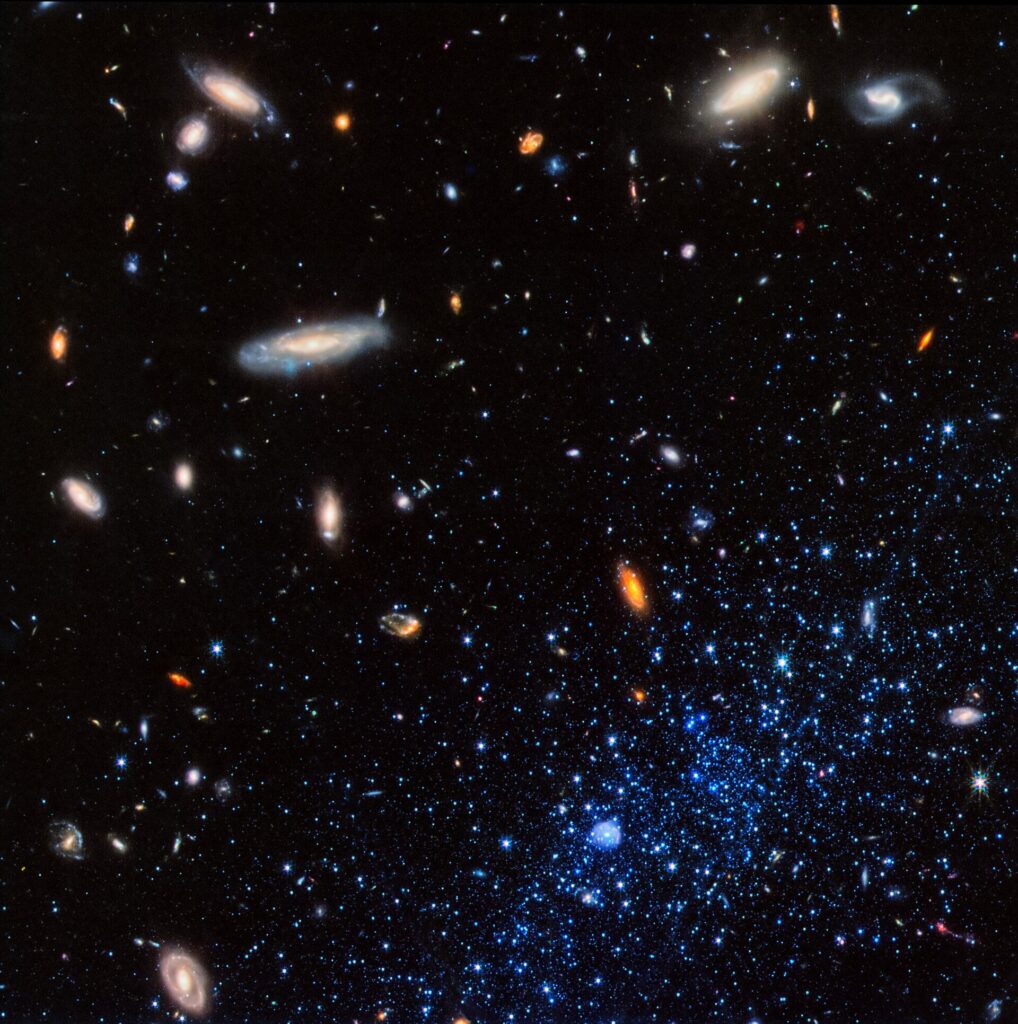
The launch of JWST in 2021 has allowed astronomers to probe the universe like never before. Its combination of high angular resolution and wavelength coverage across the near and mid-infrared make it the perfect candidate for exploring the mechanics of local star formation. Let me introduce you to Leo P (Figure 1): at a little over a megaparsec away, it is one of the local universe’s most metal-poor dwarf galaxies, coming in with a metallicity that is 3% of our Sun’s. It is understood that star formation occurs in metal-rich environments, meanwhile Leo P hosts one single O star, a young star that only survives for a couple million years. This lonely star is not only the cause of the galaxy’s one and only HII region, but it also indicates that Leo P is indeed forming stars, albeit at a low rate. This simple star forming region provided the perfect opportunity to study the ISM in low-metallicity environments, and determine how stars form in these environments.
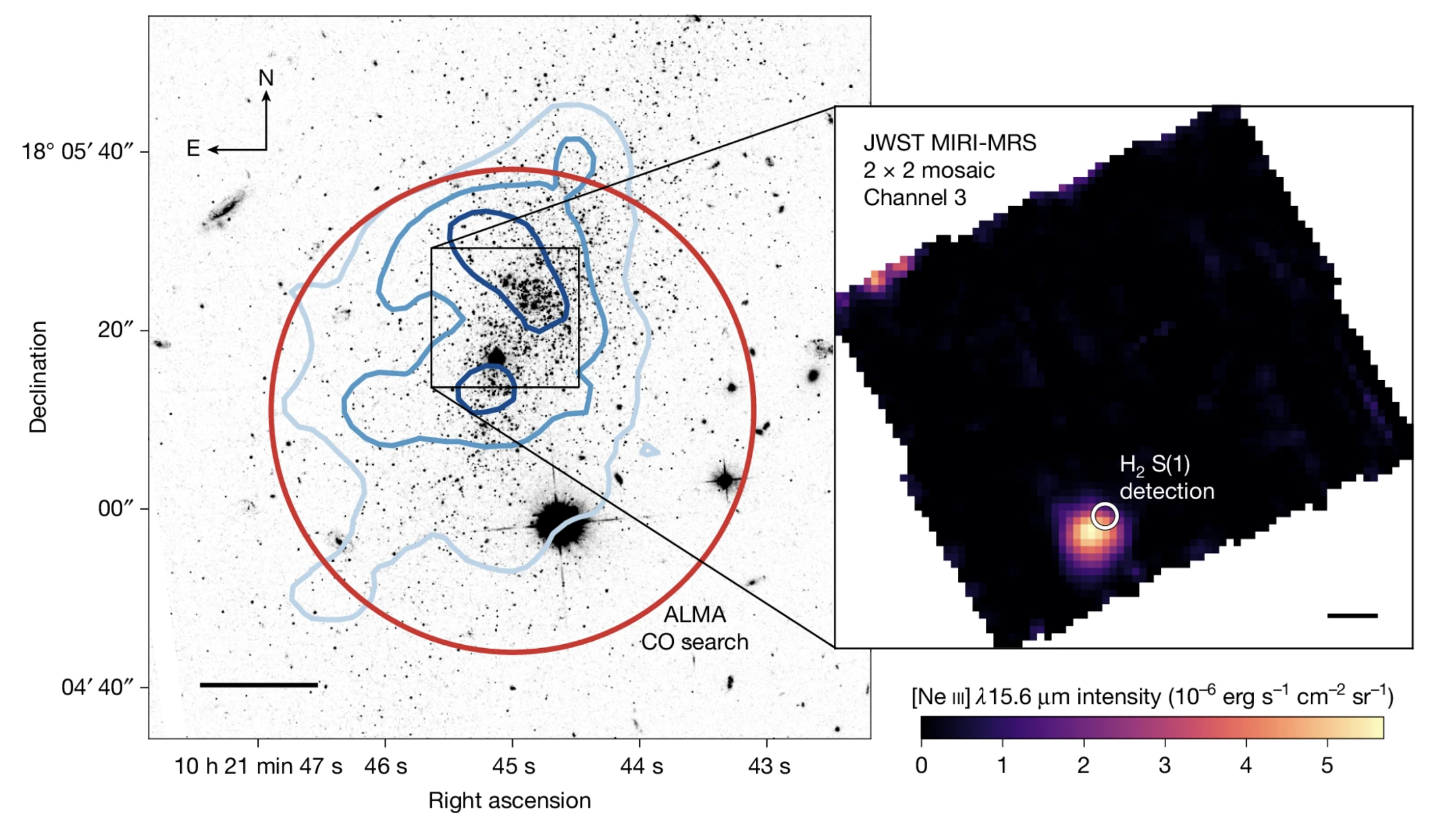
That’s what today’s authors did. Using JWST, they were able to detect molecular hydrogen emission, which correlates to a small H2 cloud 5.2 pc across, as seen in Figure 2. By measuring the density of this region, the authors were able to measure its temperature to be 420K. Due to its proximity to the O star, this region likely is heated almost entirely by radiation from that star. This emission line was even fainter than the authors expected, but it confirmed their suspicions, while Leo P is forming very few stars, it does indeed have the gas composition to continue doing so.
Unlocking the Secrets of the Universe
This was not the first time astronomers tried to constrain Leo P’s ISM features. Using their findings and archival 21 centimeter and CO emission data from ALMA, the authors were able to combine previous ISM data to obtain a deeper understanding of Leo P’s structure. Their findings suggest that even in low metallicity environments, molecular hydrogen forms easily in the absence of dust and in large enough quantities to be detectable. With their results in hand, Leo P provides a new benchmark for star formation models, as its low metallicity makes it a strong analog for the earliest galaxies in our universe. Thanks to Leo P, astronomers can go back in time from the comfort of our own epoch, shedding light on the mechanisms at play near the beginning of the universe.
Astrobite edited by Ryan White
Featured image credit: NASA, ESA, CSA, K. McQuinn (STScI), J. DePasquale (STScI)

