
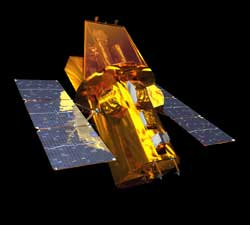
NASA’s Neil Gehrels Swift Observatory, or Swift for short, had a life-saving orbital boost mission set into motion on July 3rd, 2026. After nearly twenty-two years of scientific operations studying the X-ray sky, the satellite observatory was projected to fall back to Earth due to natural orbital decay by the end of 2026.
An unprecedented decision was made, however, to save Swift from its demise. Its high scientific impact and the uniqueness of the telescope (there exists no comparable X-ray telescope for GRB detection) have led NASA to organize a mission to lift Swift back into orbit for another ten years. In today’s bite, we take a look at how and why Swift is getting a second chance.
I don’t know about you, but Swift’s feeling 22
Swift’s main goal is to understand what powers gamma-ray bursts (GRBs) – powerful, high-energy explosions driven by core-collapsesupernovae or neutron star mergers and was launched in 2004. Swift has three on-board instruments that work together to characterize and understand GRBs:
- The Burst Alert Telescope (BAT), which has a large field of view to promptly detect gamma ray bursts in the X-ray/soft gamma-ray energy range;
- The X-ray Telescope (XRT), a higher angular resolution instrument for detailed studies of X-ray sources;
- The UV/Optical Telescope (UVOT), an optical monitor that takes spectra and images of GRB afterglows in order to determine their distances via the redshift of spectral lines.
The combination of these three instruments makes Swift the best instrument for detecting and localizing GRBs, even compared to the many newer GRB-detecting satellite observatories that are much younger. The precise GRB localizations and distance measurements that Swift provides thanks to the extreme precision of its instruments are crucial for enabling follow-up observations of GRBs in order to better understand these powerful cosmic engines.
To-date, Swift has observed 1760 GRBs, 1474 supernovae, and many more persistent and flaring sources in the universe. There are 7074 refereed publications from 1999-2024 related to Swift instrumentation or data, with over 400 publications per year since 2016. This science CV is so impressive that it has prompted NASA to rescue Swift from what would be an untimely demise.
Some of Swift’s notable science discoveries include:
- The discovery of mega flares from the red dwarf DG CVn, which showed that these dim, small stars are capable of producing giant flares (more than 10 000x the brightness of the brightest solar flare!) that last for weeks.
- The first observation of a magnetar-powered wind nebula. Though pulsar wind nebulae have been found around young pulsars, there was no evidence that magnetars – pulsars’ highly magnetic cousins – can form their own nebulae, until the discovery of Swift J1834.9-0846.
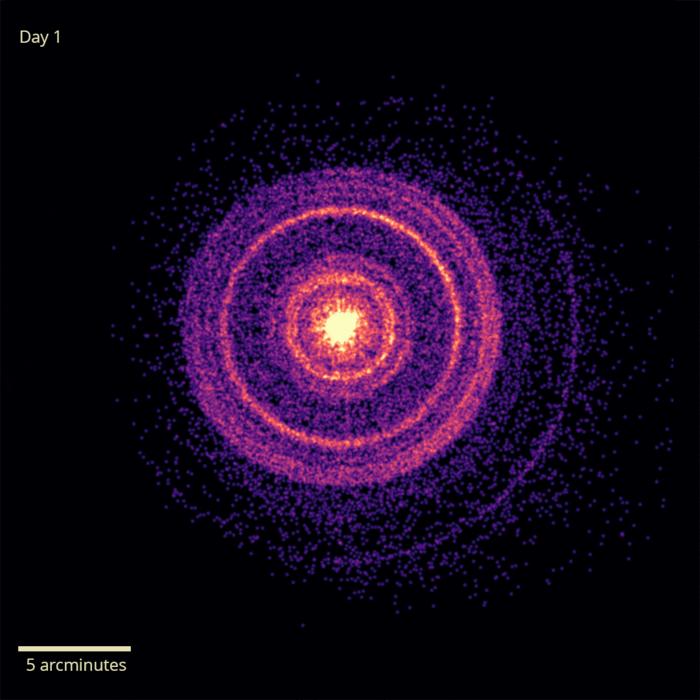
- Finally, Swift observed the Brightest Of All Time (BOAT) GRB 221009A, a major highlight for many GRB instruments. Swift discovered a series of “dust echos” from this burst, which form when X-rays from the GRB bounce off of nearby dust along the their paths, giving vital information for understanding the GRB’s prompt emission and mapping dust clouds in the Milky Way. You can see a dust echo from GRB 221009A in Figure 2.
Swift’s second chance
Originally, a two-year mission was planned for Swift, with a total projected lifetime of seven years. However, Swift has stayed in orbit and collecting data until present day (though observations were paused in April 2026 to repoint the satellite to reduce atmospheric drag). Normally, satellites deorbit and burn up in the Earth’s atmosphere at the end of their lives, because instrument failure or the launch of a more powerful instrument usually happens before the satellite naturally deorbits. This isn’t the case for Swift though: it’s been aging very gracefully, and it would be a shame to just let it fall out of the sky. So, scientists have agreed that it would be worthwhile to give Swift an orbit-sustaining boost to keep it operating for the next 10+ years.
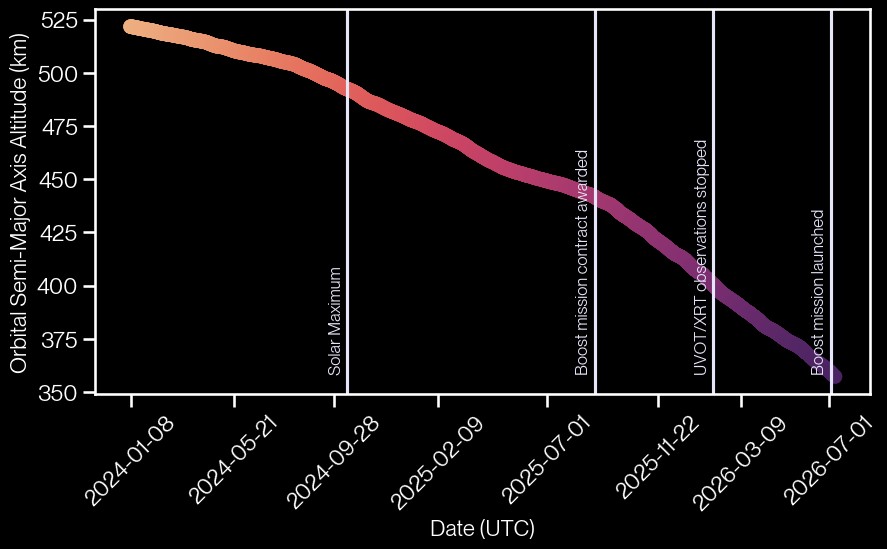
Swift’s orbital decay was particularly accelerated by solar maximum in 2024, in which increased radiation from solar activity causes the Earth’s thermosphere (where aurora form) to heat and expand, increasing the density of the atmosphere at higher altitudes than usual and increasing drag on low Earth orbit satellites. Though it’s hard to predict when exactly Swift would re-enter the Earth’s atmosphere, most predictions from orbital data (see Fig. 3) suggested a re-entry in 2026, necessitating quick action to save Swift.
Katalyzing the boost
In a scramble to save Swift in its possible final year, NASA awarded a contract to the startup Katalyst Space in September 2025. Katalyst built a fully robotic spacecraft called LINK that will be launched into the same orbit as SWIFT, grab the satellite with its robotic arms, and boost it up to its original orbit. Remarkably, everything was accomplished on the tight schedule necessary to save Swift before it got too low in its orbit to be rescued!
The launch ended up being a bit unusual, since Swift is in a fairly eccentric orbit that crosses between 20 degrees north and south latitude, which is difficult to access from typical launchpads. For this reason, the rocket carrying LINK was actually launched by a commercial airplane from the Kwajalein Atoll, Marshall Islands. The plane then carried the rocket to high altitude before the rocket was released and fired its way up to near-Earth orbit.
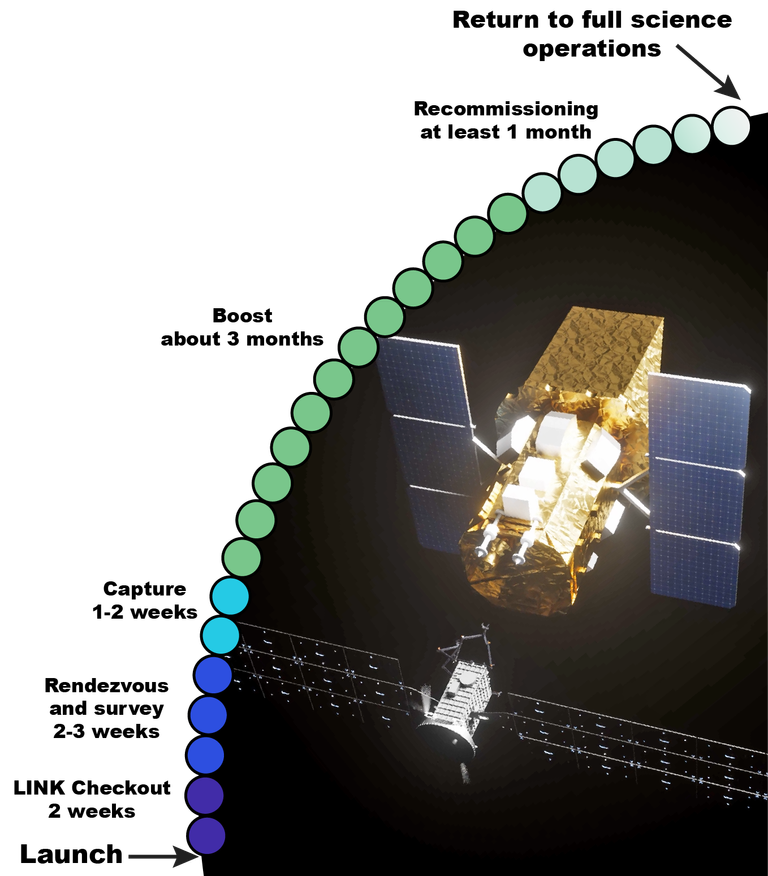
Although everything is going according to plan so far, Swift isn’t quite in the clear just yet. The next few months will be crucial for determining if the boost will be successful: testing needs to be done to ensure that LINK is working well and is well-prepared for the rest of its boost mission over the next few weeks, and the boost itself is expected to take a few months afterwards (see Fig. 4).
It turns out this wasn’t the only Swift-centred event on July 3rd (and might’ve actually been the cheapest!) with $30 million USD spent on the orbital boost mission and a surprisingly similar amount spent on Taylor Swift’s wedding. In the satellite world, the $30 million boost ends up being a pretty good deal compared to the initial launch costs ($250 million was spent to launch Swift in 2004) and the cost of developing and launching a replacement. If Swift’s boost succeeds, this could mean a brighter future for extending the lives of other aging satellites.
To stay up-to-date on the rest of the mission, you can check out NASA’s Swift blog for ~weekly updates.
Astrobite edited by Joe Williams
Featured images adapted from: NASA
