
Title: Watching Our Galaxy Grow Up: The Mass and Color Evolution of the Milky Way
Authors: Gail Zasowski, Julie Imig, & Hayley Coluccio
First Author’s Institution: Department of Astronomy, University of Utah, E2108 Stewart Building
270 S 1400 E, Salt Lake City, UT 84112
Status: Published in The Open Journal of Astrophysics (2025 July 23) [open access]
How Do You Observe Something From the Inside?
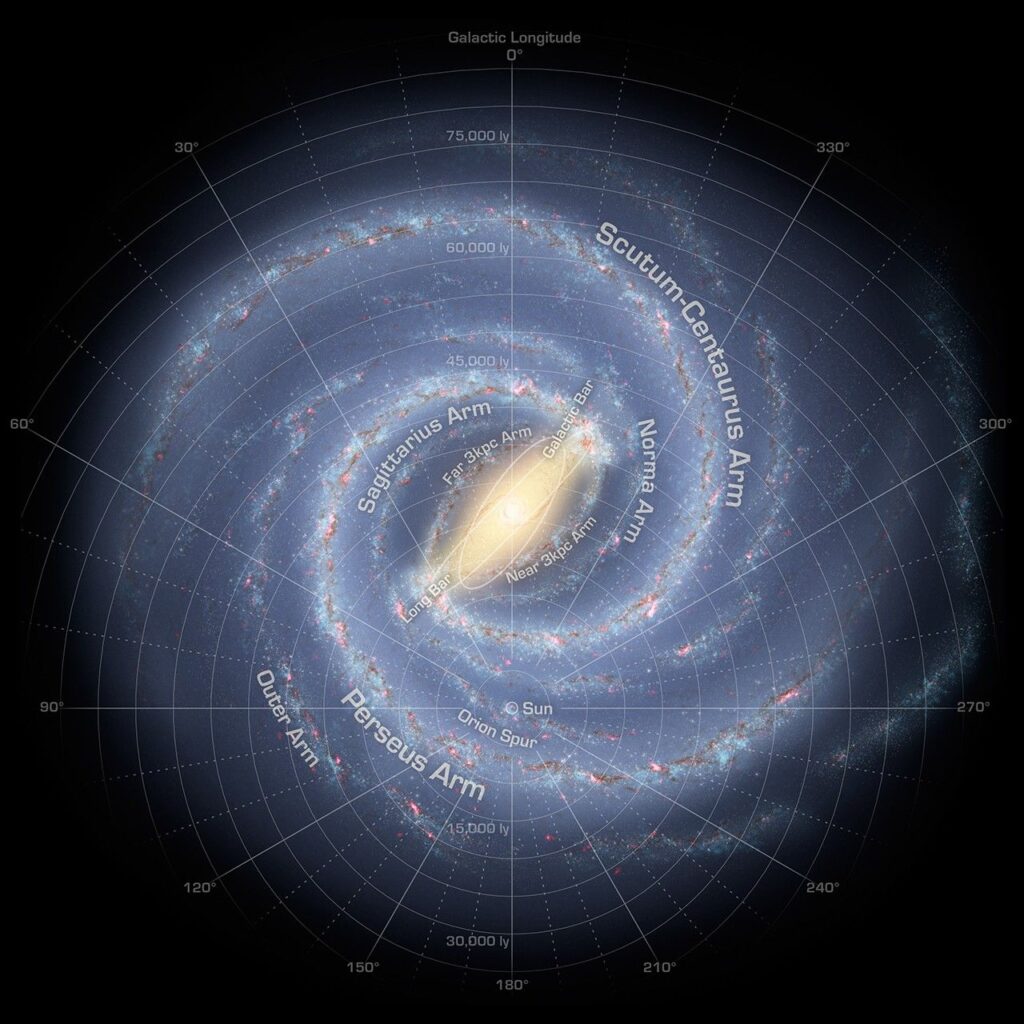
Astronomers are located in an ideal position to observe hundreds of thousands of objects, from nearby stars, to high redshift galaxies with high precision. But they have not been able to constrain fundamental properties of our own Milky Way. As seen in Figure 1, the closest attempts at understanding the structure of the Milky Way are artists’ interpretations of limited observations.
An example of unconstrained measurements would be a galaxy’s stellar mass. The stellar mass of a galaxy can be found by relating a galaxy’s luminosity to the mass of stars that would be required to produce said luminosity. For nearby galaxies, this is straightforward, but most of our Galaxy is obscured by dust, resulting in uncertain measurements. Without certain measurements, astronomers cannot compare the Milky Way to other similar galaxies, preventing them from inferring the Milky Way’s evolutionary past and future.
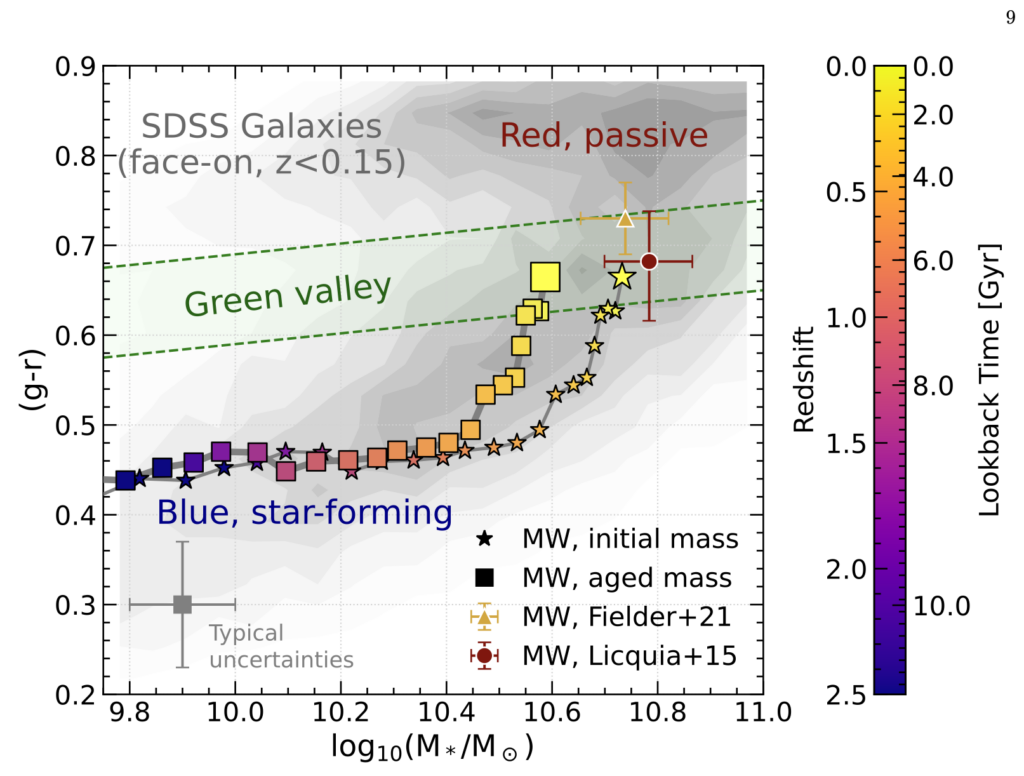
Past work paints a picture of a somewhat flocculent, barred, compact spiral galaxy. Surprisingly, it has a green tinge as a result of its dwindling star formation rate, which places it in the green valley, a classification for galaxies that are still forming stars, but at low rates. But this is all based on rough estimates of the Galaxy’s properties, with wide margins of error. Today’s authors sought out to integrate the Milky Way’s properties not just at our current epoch, but over its full morphological history.
They Grow Up So Fast
The Milky Way is modeled at the current epoch by creating Mono-Age and Abundance Populations (MAAPs), stellar density models spanning a variety of ages and metallicities. These MAAPs served as the foundation for the model Galaxy, and allowed the authors to see how overall properties of the Galaxy changed over time as these MAAPs are allowed to change over time, essentially turning back time for the Milky Way. They even were able to use the properties of the MAAPs to convert to mass and luminosity, painting an even clearer picture of the Milky Way over its lifetime.
By comparing the Milky Way’s color and mass to a galactic mass-color diagram for each step in time, the authors were able to determine the Galaxy’s evolutionary path. As seen in Figure 2, they found that it has been a “green valley galaxy” for roughly a billion years, and prior to this period was actively forming stars. Their models are comparable to previous work, all of which supports the idea that the Milky Way is at the end of its star forming lifetime.
Not Like Other Galaxies
With a better understanding of how the Milky Way evolved over time, the authors could compare it to other simulated galaxies. They were then able to determine what exactly a Milky Way analog, a galaxy with similar properties and evolutionary history, might look like. They found that while analogs of the Milky Way do exist, they don’t exactly follow the same evolutionary paths as the Galaxy. High redshift analogs of a young Milky Way exhaust their gaseous material for star formation much earlier, and in the current epoch would be much redder than our green Galaxy. The Milky Way also seemed to have much of its mass distributed into its stars earlier than its analogs. As a result, it likely had less material available to form stars. Over the course of it’s lifetime, it then formed stars at a much lower rate, possibly extending its life on the star-forming main sequence.
The Milky Way is not just special for being our home, it also has a unique star formation history that sets it apart from other galaxies. And thanks to today’s authors, we can finally see it for what it is in its entirety, without ever having to leave.
Edited by: Sowkhya Shanbhog
Featured Image Credit: NASA/JPL-Caltech/R. Hurt (SSC/Caltech)
