• RSS
  • Submit a Guest Post
  • Undergraduates: Submit your Research!
  • Suggest a Paper Topic!
astrobites
  • About
    • About Astrobites
    • Meet the Authors
    • Statement of Inclusivity
    • Copyright & Permissions
  • Latest Research
    • Daily Paper Summaries
    • Classics
    • Undergrad Research
    • Physical Review Coverage
  • Beyond astro-ph
    • Beyond astro-ph Library
    • Interviews
    • Career Navigation
    • Personal Experiences
    • Current Events
    • Teaching with Astrobites
  • Guides
    • EM Spectrum
    • Galaxies & AGNs
    • Spectroscopy and Spectral Lines
    • Adaptive Optics
    • Gravitational Waves
    • Transient Astronomy
    • Astrophysical Software
    • Graduate School
    • Writing a personal statement for grad apps
    • First Observing Run
    • …More Guides!
Select Page
UR #30: How do you grow a galaxy?

UR #30: How do you grow a galaxy?

by Guest | Sep 30, 2020 | Undergraduate Research

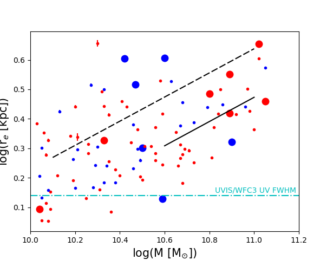
Using new observations from the UVCANDELS survey, a possible link between recent star formation, merger frequency, and the size-mass evolution of massive, quiescent galaxies is investigated.

UR #29: Measuring the White Dwarf Mass-Radius Relation using Thousands of Stars

UR #29: Measuring the White Dwarf Mass-Radius Relation using Thousands of Stars

by Guest | Sep 28, 2020 | Daily Paper Summaries

Today’s undergraduate research post features a student who measures the white dwarf mass-radius relation using thousands of stars and a neat effect predicted by general relativity
UR #28: Photometry and Analysis of a Sample of Quasars on Archival Yerkes Observatory Photographic Plates

UR #28: Photometry and Analysis of a Sample of Quasars on Archival Yerkes Observatory Photographic Plates

by Guest | Sep 11, 2020 | Undergraduate Research

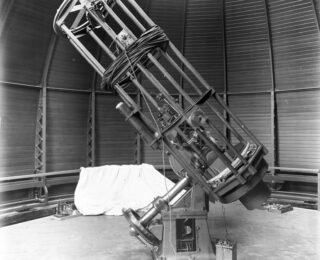
Today’s guest post looks at the work of undergraduate physics student Buduka Ogonor on using astronomical photographic plates to study quasars.

Mind the gap: A tale told by black holes

Mind the gap: A tale told by black holes

by Guest | Sep 2, 2020 | Daily Paper Summaries

How massive can stellar black holes be?
How Can Fast Radio Bursts be Produced in Binary Neutron Star Systems?

How Can Fast Radio Bursts be Produced in Binary Neutron Star Systems?

by Guest | Aug 19, 2020 | Course Assignments, Daily Paper Summaries

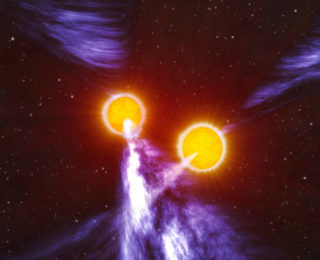
Fast radio bursts have unknown origins, but today’s guest post discusses one possibility: interacting BNS systems.

« Older Entries
Next Entries »

Loading

Follow our socials

  • Bluesky
  • Facebook
  • Instagram
  • RSS Feed

More Posts About

AAS AGN astronomy astrophysics binary stars black holes cosmology dark matter dwarf galaxies exoplanets galaxies galaxy evolution gravitational waves habitability JWST Kepler Milky Way observations planetary science planet formation protoplanetary disks radio astronomy simulations solar system spectroscopy star formation stars stellar evolution supernovae theory

Posts by Category

  • Accessibility
  • Applications
  • Beyond
  • Book Reviews
  • Career Navigation
  • Classics
  • Climate Change
  • Course Assignments
  • Crossposts
  • Current Events
  • Daily Paper Summaries
  • Game Reviews
  • Guides
  • Historical Astronomy
  • Instrumentation
  • Interviews
  • Outreach
  • Personal Experiences
  • PRJ
  • Quick Notes
  • Satellites
  • Teaching
  • Undergraduate Research

More Astronomy

  • AAS
  • AAS Nova
  • astro-ph
  • AstroBetter
  • APOD

Read Astrobites in Other Languages

  • Astrobitos (Spanish)
  • Astropontos (Portuguese)
  • staryab (Farsi)

Listen to Astrobites

  • astro[sound]bites

Discover More Incredible Science

  • ScienceBites Network
  • RSS

© 2026 Astrobites | All Rights Reserved | Supported by AAS | Designed by Elegant Themes | Powered by WordPress