by Sandy Chiu | Aug 15, 2025 | Classics, Daily Paper Summaries
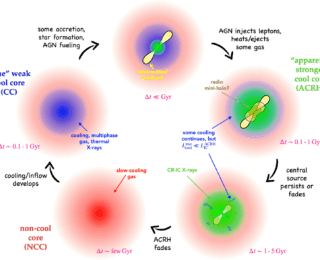
It is generally believed that the X-ray emission from cold-core clusters comes from hot gas, where there is a delicate balance between gas cooling and feedback from active galactic nuclei. This paper explores another possibility: are these X-rays simply an illusion of inverse Compton scattering by cosmic rays?
by Sandy Chiu | Jun 25, 2025 | Daily Paper Summaries
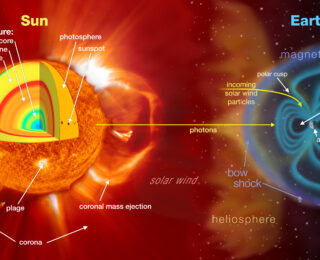
The Sun doesn’t just shine—it also shapes the high-energy γ-ray sky by interacting with cosmic rays. Using 15 years of Fermi-LAT data, researchers detected the solar γ-ray halo in unprecedented detail and linked it to the same cosmic ray electrons measured near Earth. This study reveals how γ-ray observations can uncover the invisible influence of the Sun’s magnetic field across the heliosphere.

by Sandy Chiu | May 7, 2025 | Daily Paper Summaries
Using X-ray observations from XMM-Newton, this paper studied the chemical makeup of the hot gas around the galaxy M86, which is being stripped as it moves through a cluster. They found that the galaxy’s core still holds onto its enriched gas, and that part of the stripped material likely comes from a past galaxy collision—not just the core being peeled away.

by Sandy Chiu | Mar 22, 2025 | Daily Paper Summaries, PRJ
This study by the LHAASO Collaboration presents the first measurement of diffuse gamma-ray emissions in the 1–25 TeV range, revealing excess flux beyond theoretical predictions. The findings suggest hidden gamma-ray sources, such as pulsar wind nebulae or massive star clusters, and indicate spectral variations across the Galactic plane. These results challenge existing cosmic-ray transport models and highlight the need for further observations and refined theoretical frameworks.

by Sandy Chiu | Feb 21, 2025 | Daily Paper Summaries
Radio observations of the Galactic center reveal striking filaments of synchrotron emission, formed as cosmic ray (CR) electrons travel along magnetic fields. Researchers tested different CR transport models and found that a combination of diffusion and streaming best explains the observed filament structures. This study not only sheds light on how CRs move through space but also provides a new way to probe the magnetic environment of our galaxy.
