
Featured Astrobites
Our latest posts
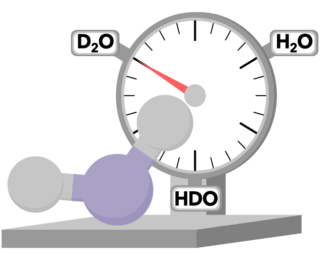
Heavy Water with Heavy Implications
Astronomers have observed the abundance of heavy water (D2O) in the V883 Ori disc, providing a crucial insight into the history of water – with some implications for Earth’s water and maybe more…
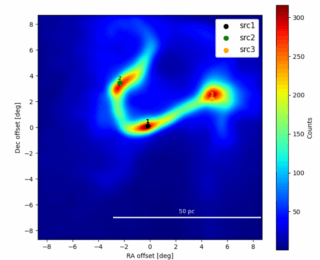
How One Pulsar Can Look Like Three: Cosmic-Ray Mirage Halos in the Gamma-Ray Sky
Cosmic rays don’t always reveal their origins honestly—magnetic fields can bend their paths and create “mirage halos” that look like real gamma-ray sources. New simulations show how a single pulsar can masquerade as three, reshaping how we interpret TeV observations.

A Planetary Hit-and-Run?
Was Venus involved in a catastrophic hit-and-run? Read this astrobite to find out!
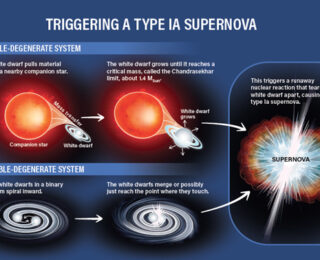
Does the Hubble tension arise from heterogeneity in Type-Ia supernovae?
How standardizable of a candle are Type-1a supernovae? Learn how differing initial conditions causing a white dwarf to exceed the Chandrasekhar limit and explode might reconcile independent measurements of the Universe’s expansion rate and history.
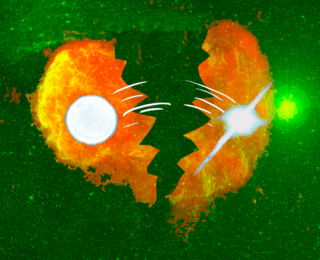
It’s not you, it’s me. I just need several parsec of space.
What does a stellar breakup look like? So dramatic that the stars can’t wait to get away from each other! Today’s authors use physics to search for the one who got away.
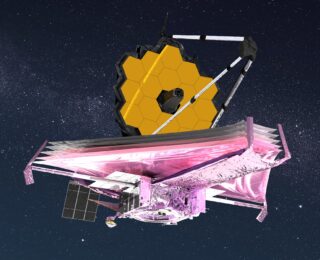
UR: Data-Driven Analysis of Galactical Evolution
In the latest of our #UndergradResearch series, discover how to estimate the metallicities of early galaxies using line ratios from JWST with Vidit Bhandari.
Beyond astro-ph
Astronomy beyond the research
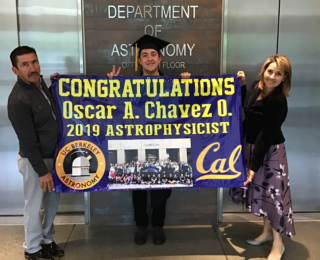
Undocumented in Academia: DACA’s Role in My Astronomy Ph.D. Journey
In today’s beyond Astrobite Óscar shares how the DACA program enabled him to pursue his Ph.D. in Astronomy, but leaves the astronomy community with questions about how we can create the same experiences for undocumented students if DACA is abolished.
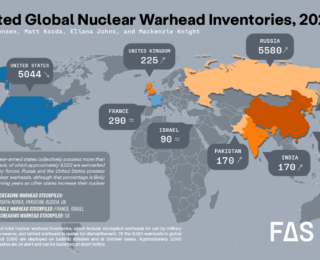
Scientists’ Role in Nuclear Disarmament: A Conversation with Dr. Curtis Asplund
I sat down with Dr. Curtis Asplund to discuss the current landscape of nuclear weapons, and why the scientific community should work together to prevent them from ever being used again.
Bringing the Stars in the Sky to Stars on Hawai’i Island: The tradition of a yearly outreach event
Today’s bite features an annual tradition in astronomy outreach in Hawai’i with excerpts of personal experiences of the author.
Navigating careers in astronomy
Career advice
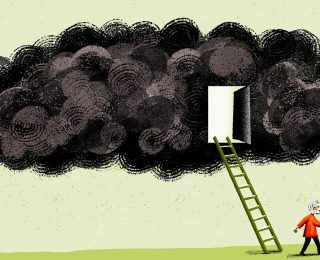
Quitting a PhD
Mental health among PhD students has been an issue for a long time. The fear of failure is a well-known companion to most. What do you do when you’ve reached your limit?
Meet the AAS Keynote Speakers: Dr. Daniel Stern
Have you ever wondered what NuSTAR is or the science it’s helped to discover? Dr. Daniel Stern will tell you all about it at his plenary lecture at #AAS238!
Meet the AAS Keynote Speakers: Dr. Roberta Humphreys
Ever wondered what is the upper limit to massives stars’ luminosities? Or are you curious about how to become a successful woman in astronomy? Find out reading the AAS238 interview with Dr. Roberta Humphreys!