
The Undergraduate Research series is where we feature the research that you’re doing. If you are an undergraduate that took part in an REU or similar astro research project and would like to share this on Astrobites, please check out our submission page for more details. We would also love to hear about your more general research experience!
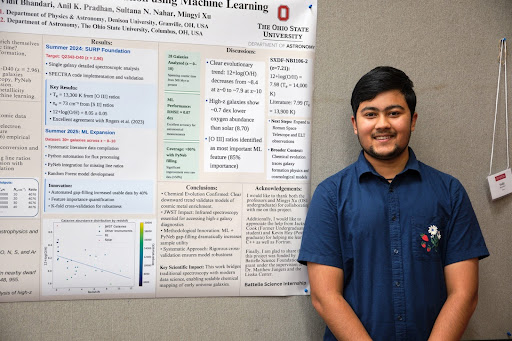
Vidit Bhandari is a senior at Denison University pursuing Physics & Data Analytics. This research was conducted at The Ohio State University under the Battelle Science Internship, supervised by Dr. Anil K. Pradhan and Dr. Sultana N. Nahar. The work combines spectroscopic analysis with computational methods to understand early universe galaxies. His main astronomy research interests are stellar evolution, galaxy evolution, and cosmology. When he is not doing astronomy, he loves playing cricket and enjoying the outdoors. He hopes to pursue more research experience (if possible!) before pursuing a PhD in Physics/Astronomy after he graduates.
Introduction
The James Webb Space Telescope (JWST) is revolutionizing our understanding of the early universe, capturing detailed infrared spectra of galaxies formed just a few billion years after the Big Bang. How did the first galaxies form and evolve? What were their chemical compositions? These questions have puzzled astronomers for decades. Now, with the revolutionary capabilities of JWST, we can peer back to when the universe was just 2.18 billion years old – less than 16% of its current age.
Our research focuses on the gas in star-forming regions of the galaxy Q2343-D40, nicknamed the “Cecilia Galaxy,” located at a redshift of z = 2.96. At this distance, we’re observing the galaxy during a crucial period of cosmic history when galaxy formation was at its peak. Using the unprecedented infrared sensitivity of JWST’s Near Infrared Spectrograph (NIRSpec), we can now detect and analyze spectral lines that were previously invisible to us.
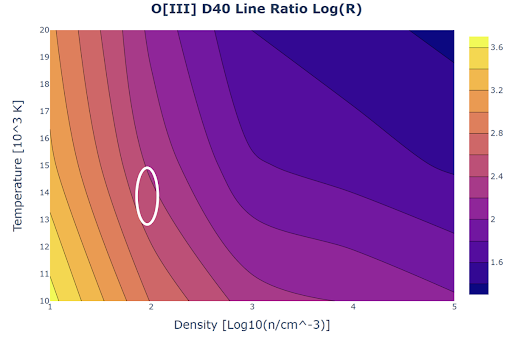
The key to understanding this ancient galaxy lies in its spectral fingerprints. Using our own collisional–radiative–recombination modelling code that characterizes various physical features using line ratios, called SPECTRA, we analyzed the emission lines from S II and O III. Think of these emission lines as cosmic DNA: they reveal the galaxy’s physical conditions and chemical makeup. The ratio of S II lines (6717 Å/6731 Å) indicated that the gas temperature was between 10,000-20,000 K and the density was around 300 cm-3. To identify the exact temperature, we created a 3D ionization balancing model of temperature, density, and O III line ratio (50007 Å/4363 Å). Given the known density and O III line ratio of 2.5, we constrained the gas temperature to be approximately 13,000 K, as is demonstrated in Figure 1.
Last Summer: One Galaxy, Many Details
In summer 2024, my research centered on the Cecilia Galaxy. This was one of the widely studied galaxies and was the only good candidate in 2024 which is why we decided to use that as a test case scenario. Using the SPECTRA code, I measured its electron temperature Te from the [O III] λ5007/λ4363 line ratio and electron density from the [S II] λ6717/λ6731 ratio. From these, I derived an oxygen abundance of 12 + log(O/H) ≈ 8.05, in agreement with previous studies.
The “direct method” (or Te-based method) is considered the gold standard for measuring chemical composition in galaxies. Here’s how it works:
The [O III] λ4363 line is extremely temperature-sensitive but very faint, while λ5007 is bright but less sensitive to conditions. Their ratio directly reveals the electron temperature of the ionized gas. Similarly, the [S II] doublet ratio tells us the gas density. With these physical conditions in hand, we can accurately convert emission line strengths into chemical abundances—specifically, how much oxygen (our proxy for overall metallicity) exists relative to hydrogen.
This method is “direct” because it doesn’t rely on calibrations or assumptions—we’re measuring the actual physics of the gas. However, it requires detecting that faint λ4363 line, which is why it’s traditionally been limited to bright, nearby galaxies or those with very active star formation.
This Summer: Scaling Up with JWST and Machine Learning
In summer 2025, I expanded the project to a dataset of over 30 galaxies, many from JWST observations. The challenge? Many spectra were missing key line ratios like S II. To address this, I used PyNeb to simulate missing ratios based on known electron temperatures. This expanded the usable dataset to over 90% of the sample.
With this enriched dataset, I trained a random forest model to predict metallicity from the [O III] and [S II] ratios. A random forest model trains multiple decision trees on different subsets of your data and takes an average of the outputs to generate a final numerical result. The model achieved a root-mean-squared error of RMSE ≈ 0.07 dex. Feature importance analysis confirmed that the [O III] ratio is the dominant predictor, with [S II] contributing valuable density information.
Looking Ahead: Senior Research
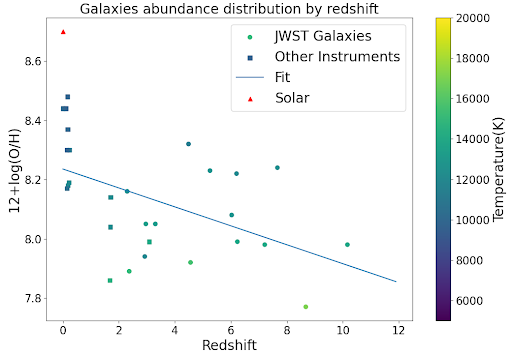
For my senior research, I plan to automate the collection of JWST spectra using publicly available templates, extend diagnostics to other ions ([N II], [S III], and [Ar III]), and experiment with neural networks for simultaneous prediction of temperature, density, and metallicity. The ultimate goal is to map the metallicity-redshift relation up to z ~ 9 and make the results publicly available. Some preliminary results are shown in Figure 2, which shows an increase in oxygen abundance as redshift decreases. This behavior is expected as stars produce more metals like oxygen as the universe ages.
Why It Matters
Understanding metallicity evolution is crucial for piecing together the timeline of star formation and galaxy growth in the early universe. By combining traditional spectral diagnostics with machine learning, this project sets the stage for high-volume, precise measurements that will keep pace with JWST’s growing data stream.
Acknowledgments
This work was supported by the Batelle Science Internship and the Lisska Center. Vidit thanks Prof. Anil Pradhan, Prof. Sultana Nahar, and his collaborators Jackson Cook and Kevin Hoy for their guidance. Vidit would also like to thank Mingyi Xu for collaborating with him on this project.
Astrobite edited by Brandon Pries
Featured image credit: NASA

WORKING HARD .