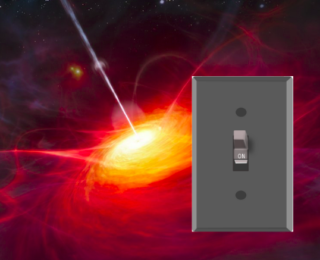
Tracking Down the Quasar Light Switch
We’re still not sure what causes quasars, some of the brightest objects in the universe, to switch on. Today’s authors present a compelling case for galaxy mergers being the culprit!

We’re still not sure what causes quasars, some of the brightest objects in the universe, to switch on. Today’s authors present a compelling case for galaxy mergers being the culprit!
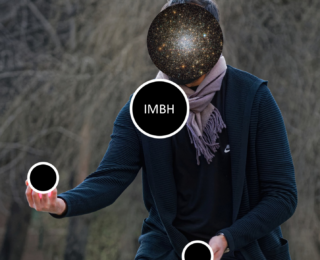
Today’s authors explore a new formation channel for forming intermediate mass black holes!
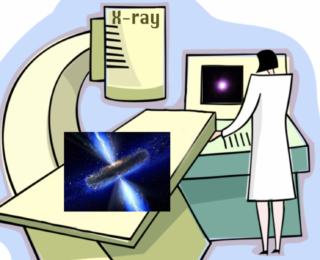
Journey to the distant universe with today’s paper, as we discover what the X-ray emission from high-redshift quasars can tell us about their formation and accretion physics!
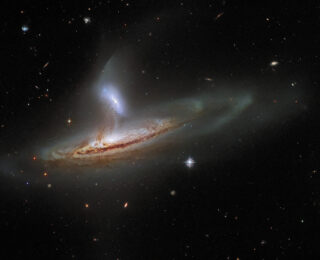
The authors of today’s paper study the distribution of cold gas in a group of galaxies and use that to understand how AGNs are powered.
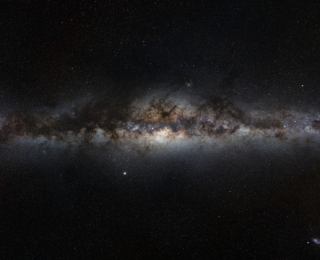
There’s a cluster of stars near the Milky Way’s center whose distribution and age puzzles scientists. Could an intermediate-mass black hole be the light that reveals the mystery?

Today’s authors used JWST/NIRSpec to detect and identify new Jils, galaxy companions, within the vicinity of the QSO LBQS 0302-0019 “Block.”