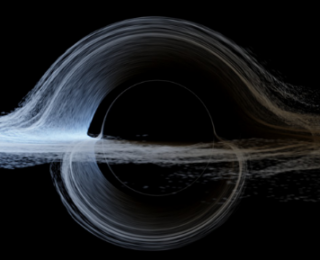
DIY Building Massive Black Holes
Your backyard-style black hole is easily made from a fairly massive star. But how do you get a really massive black hole, maybe even a supermassive one?

Your backyard-style black hole is easily made from a fairly massive star. But how do you get a really massive black hole, maybe even a supermassive one?
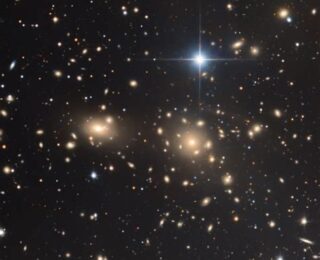
Could dark matter behave similarly to regular matter? If so, could dark matter halos collapse and form structures, like a black hole? In this work we explore the Atomic Dark Matter Model and predicting structure formation in it using simple algebra. We build on the current literature by showing that for certain values of the variables that govern dark matter interactions, we won’t be able to determine if the halo will be able to collapse using methods to track the dark matter number densities and how efficiently the halo can dispose of its initial energy.
With new CMB experiments coming online in the next decade, what are astronomers hoping to find? The answer may surprise you.
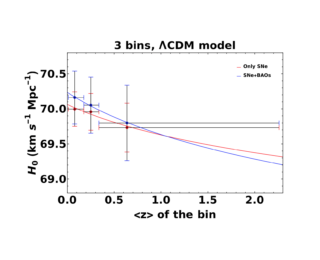
In our latest #UndergradResearch post, Sahil Ugale investigates the rate of expansion of the universe, and specifically the Hubble Constant Tension.

The distribution of galaxies clusters (BAOs) are a beloved tool for cosmological analysis. But what about cosmic voids? Stare into the void, and you might just learn something new!
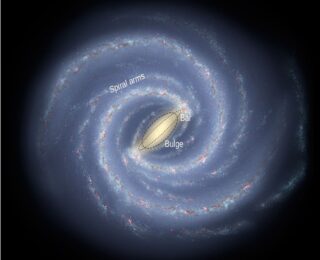
The presence of dark matter particles in barred spiral galaxies should slow down their galactic bars. However, this is not what we observe. Are galactic bars telling us to reconsider the foundations of the standard model?