• RSS
  • Submit a Guest Post
  • Undergraduates: Submit your Research!
  • Suggest a Paper Topic!
astrobites
  • About
    • About Astrobites
    • Meet the Authors
    • Statement of Inclusivity
    • Copyright & Permissions
  • Latest Research
    • Daily Paper Summaries
    • Classics
    • Undergrad Research
    • Physical Review Coverage
  • Beyond astro-ph
    • Beyond astro-ph Library
    • Interviews
    • Career Navigation
    • Personal Experiences
    • Current Events
    • Teaching with Astrobites
  • Guides
    • EM Spectrum
    • Galaxies & AGNs
    • Spectroscopy and Spectral Lines
    • Adaptive Optics
    • Gravitational Waves
    • Transient Astronomy
    • Astrophysical Software
    • Graduate School
    • Writing a personal statement for grad apps
    • First Observing Run
    • …More Guides!
Select Page
Where Did All This Dust Come From?

Where Did All This Dust Come From?

by Natalie Price | May 20, 2026 | Daily Paper Summaries

How did our galaxies get so dusty so fast? Come with us today to do some early-epoch spring cleaning.

The “Rhythm” of the Interstellar Medium

The “Rhythm” of the Interstellar Medium

by Shalini Kurinchi-Vendhan | May 19, 2026 | Daily Paper Summaries

How does the gas in galaxies keep pace with star formation?
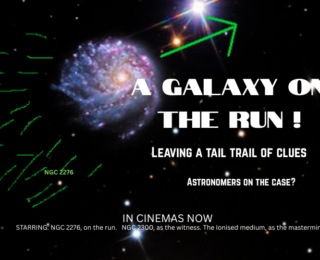
Speeding Under Pressure on the Intergalactic Highway. 

Speeding Under Pressure on the Intergalactic Highway. 

by Neel Kolhe | Apr 22, 2026 | Daily Paper Summaries

Using low frequency radio observations of the galaxy NGC 2276 with the uGMRT and LOFAR telescopes, the authors discover that the galaxy has a trail of gas about 100 kiloparsecs long! As the galaxy moves through the local ionised medium, the pressure exerted on it removes gas from it’s disk.
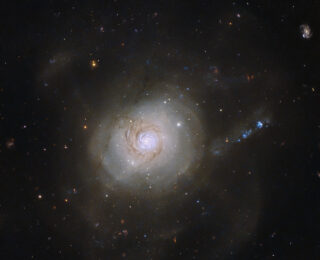
Guest: If you give a galaxy a starburst, it’ll probably quench the gas away

Guest: If you give a galaxy a starburst, it’ll probably quench the gas away

by Guest | Apr 20, 2026 | Daily Paper Summaries

The distribution of post-starburst regions within galaxies is linked to diverse quenching pathways that are likely driven by mergers. Guest author, Emmy Wisz, explains how different star formation histories could be the key to understanding quenching mechanisms.

Dawn of the Red Monsters

Dawn of the Red Monsters

by Madison VanWyngarden | Apr 14, 2026 | Daily Paper Summaries

Today’s bite reports the discovery of the most distant red galaxy ever confirmed!

Too Massive, Too Early… and Still Not Massive Enough?

Too Massive, Too Early… and Still Not Massive Enough?

by Niloofar Sharei | Apr 7, 2026 | Daily Paper Summaries

What if JWST’s early massive galaxies are not overestimated, but underestimated? A bottom-heavy IMF could hide tons of mass in faint stars.

« Older Entries
Next Entries »

Loading

Follow our socials

  • Bluesky
  • Facebook
  • Instagram
  • RSS Feed

More Posts About

AAS AGN astronomy astrophysics binary stars black holes cosmology dark matter dwarf galaxies exoplanets galaxies galaxy evolution gravitational waves habitability JWST Kepler Milky Way observations planetary science planet formation protoplanetary disks radio astronomy simulations solar system spectroscopy star formation stars stellar evolution supernovae theory

Posts by Category

  • Accessibility
  • Applications
  • Beyond
  • Book Reviews
  • Career Navigation
  • Classics
  • Climate Change
  • Course Assignments
  • Crossposts
  • Current Events
  • Daily Paper Summaries
  • Game Reviews
  • Guides
  • Historical Astronomy
  • Instrumentation
  • Interviews
  • Outreach
  • Personal Experiences
  • PRJ
  • Quick Notes
  • Satellites
  • Teaching
  • Undergraduate Research

More Astronomy

  • AAS
  • AAS Nova
  • astro-ph
  • AstroBetter
  • APOD

Read Astrobites in Other Languages

  • Astrobitos (Spanish)
  • Astropontos (Portuguese)
  • staryab (Farsi)

Listen to Astrobites

  • astro[sound]bites

Discover More Incredible Science

  • ScienceBites Network
  • RSS

© 2026 Astrobites | All Rights Reserved | Supported by AAS | Designed by Elegant Themes | Powered by WordPress