by Allison Strom | Nov 18, 2011 | Daily Paper Summaries
Modica et al. and the GOALS team use multiwavelength observations to investigate star formation and nuclear activity in a nearby luminous infrared galaxy.
by Nathan Goldbaum | Nov 13, 2011 | Daily Paper Summaries
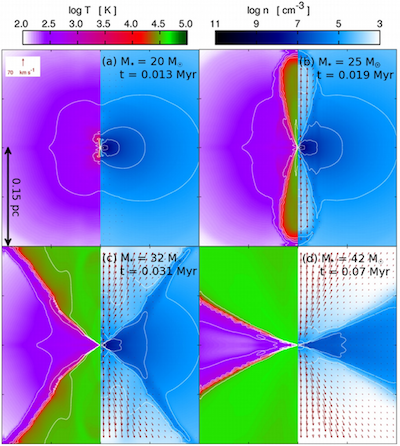
Paper title: Protostellar Feedback Halts the Growth of the First Stars in the Universe Authors: Takashi Hosokawa, Kazuyuki Omukai, Naoki Yoshida, Harold W. Yorke Author’s Affiliation: Jet Propulsion Laboratory; Department of Physics, Kyoto UniversityThe problem of understanding the formation and evolution of the first to form stars in the universe lies at the intersection of many fields of astrophysics. Since the first stars could only have formed once their host dark matter halos had begun to collapse, one must understand the formation of these stars in a cosmological context, tracking gas from extremely low intergalactic densities (~10-27 g cm-3), to extremely high, stellar densities (~1 g cm-3). Since all the metal content of the universe had not yet been synthesized in the cores of stars, the gas that collapsed to form the first stars would have been metal-free and thus possessed very different thermal properties compared to the interstellar and intergalactic gas in the local universe that can cool via metal line emission.Many studies of first star formation have focused on the cosmological piece of the puzzle: starting with a simulation of cold dark matter and gas in a ΛCDM cosmology, they look for the first ~106 solar mass dark matter halo to collapse, and then follow the collapse of first the dark matter and then the gas to very high densities. Due to the extremely large dynamic range in these simulations, it becomes prohobitively expensive to reach stellar densities and impossible to directly model the evolution of the first star. For reference, a recent simulation of the formation of the first stars followed the collapse to densities just above 10-8 g cm-3, far below typical stellar...
by Courtney Dressing | Nov 10, 2011 | Daily Paper Summaries
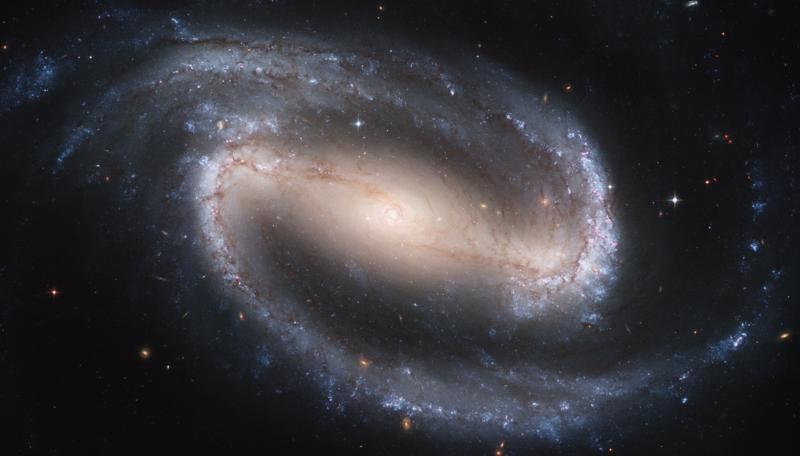
Paper title: Bars rejuvenating bulges? Evidence from stellar population analysis Authors: Paula Coelho and Dimitri A. Gadotti First author’s affiliation:Núcleo de Astrofísica Teórica, Universidade Cruzeiro do Sul, São Paulo, Brasil SummaryAs you may recall from Nathan Sanders’ April post, some spiral galaxies have central bulges with high concentrations of stars. Coelho and Gadotti examine a sample of 575 of these galaxies to investigate whether the presence or absence of a bar (a bar-shaped overdensity of stars) influences the rate of star formation in the central bulge. Astronomers expect to see a higher star formation rate in the bulges of barred galaxies because bars can transport gas from the outer regions of the galaxy into the center and supply fuel for growing stars. Previous detections of star-formation indicators (such as enhanced Hα emission) have indicated that the current star formation rates are higher in barred spirals than in unbarred spirals, but Coelho and Gadotti take the alternative approach of determining the ages of the stellar populations in the bulges. They find that the bulges of barred galaxies are systematically younger than the bulges of unbarred galaxies, which is consistent with the expectation that bars should promote star formation. The Galaxy SampleIn a previous paper, Gadotti derived stellar masses, bulge stellar masses, bar properties, and other parameters for a sample of face-on galaxies observed by Sloan Digital Sky Survey (SDSS). All of the galaxies had stellar masses above 10^10 solar masses and redshifts between 0.02 and 0.07. Selecting face-on galaxies reduced the effect of dust and simplified the process of identifying bars and bulges in the galaxies. In this paper, Coelho...
by Elisabeth Newton | Nov 9, 2011 | Daily Paper Summaries
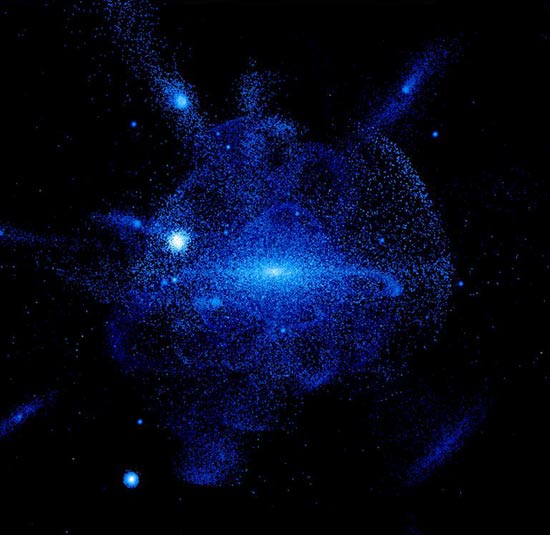
The Milky Way’s stellar halo – a roughly spherical distribution of stars surrounding our spiral galaxy – is a valuable tool for probing the early evolution of our galaxy. The stellar halo contains some of the oldest stars in our galaxy, whose properties reflect that of the environment in which they formed. This paper focuses on using cosmological simulations of galaxy formation to match the observed structure and kinematics (how the stars move) of stars in Milky Way’s halo.
by Adele Plunkett | Oct 14, 2011 | Daily Paper Summaries
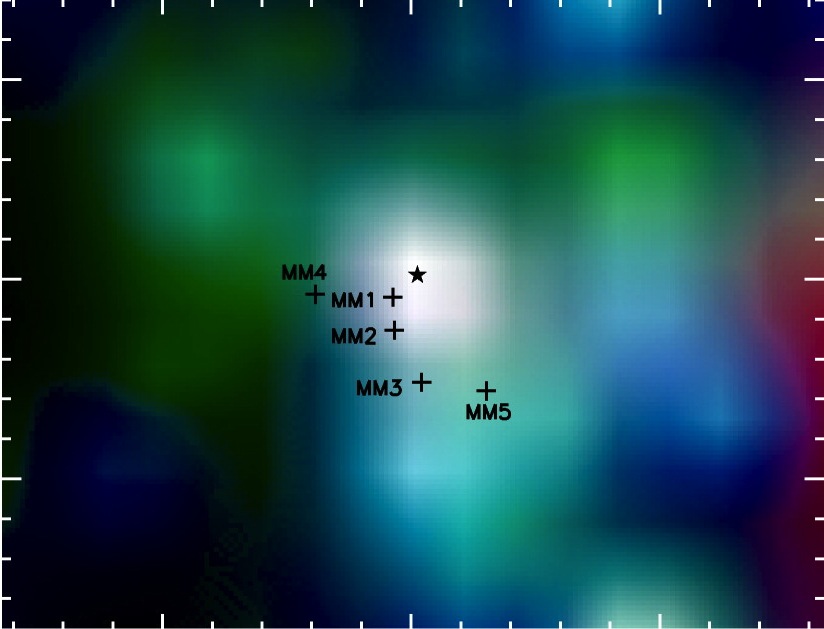
The common picture of star formation includes the gravitational collapse of cores within molecular clouds, with mass accreting either directly or via a disk. An important aspect of the model is that some component must lower the angular momentum of the accreting material. By observing infalling envelopes, especially at different stages of star formation, the mechanism for mass accretion can be studied.
by Elisabeth Newton | Sep 28, 2011 | Daily Paper Summaries
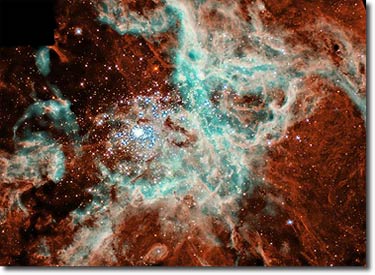
Stars form in environments that are characterized by vastly different densities, pressures and metal content. Yet the sizes of the stars formed don’t vary substantially (as measured by the median mass). Why don’t the properties of the clouds out of which stars fragment have a stronger influence on the result? Why is there a characteristic stellar mass? Why is this mass scale similar to that for nuclear burning (the process that fuels stars)?
(photo: NASA via LANL, https://www.llnl.gov/news/newsreleases/2005/NR-05-11-10.html)
