Meet the AAS Keynote Speakers: Prof. John Peacock
We interview the RAS Gold Medal Lecturer for AAS244, Prof. John Peacock!

We interview the RAS Gold Medal Lecturer for AAS244, Prof. John Peacock!
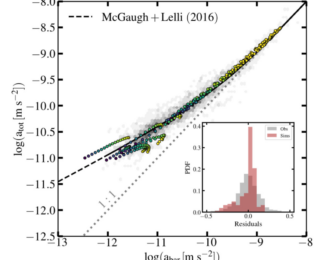
MOND and Dark Matter are both proposed theories to explain the flat rotation curves of galaxies…can we use simulations to tell us more about which might be the better theory?
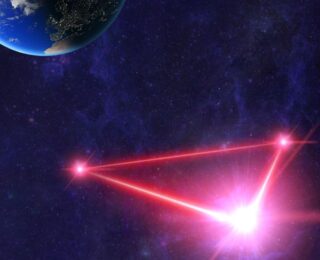
The upcoming LISA mission promises to detect many gravitational wave events, but can it attribute any of them to a host galaxy? Let’s find out!
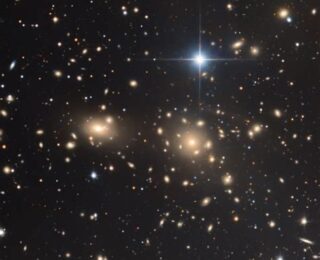
Could dark matter behave similarly to regular matter? If so, could dark matter halos collapse and form structures, like a black hole? In this work we explore the Atomic Dark Matter Model and predicting structure formation in it using simple algebra. We build on the current literature by showing that for certain values of the variables that govern dark matter interactions, we won’t be able to determine if the halo will be able to collapse using methods to track the dark matter number densities and how efficiently the halo can dispose of its initial energy.
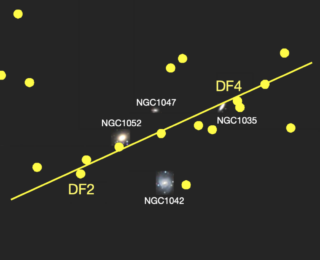
A group of galaxies — some rich in dark matter, and some lacking dark matter completely — could be explained by a violent, destructive event from their past.
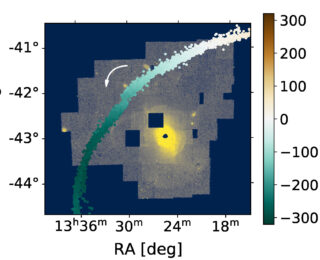
Stellar streams are beautiful structures that trace the dark matter distribution of a galaxy. Today’s paper looks beyond our Milky Way for streams in external galaxies.