archives

observations

This tag is associated with 158 posts

Using General Relativity to Measure Properties of Binary Pulsars

Shapiro time delays are one of the four tests of general relativity possible in the solar system. Astronomers can use these timing delays to measure properties of binary pulsar systems.

Mysterious Gas Clouds between M31 and M33

Seven gas clouds have been found in the region between two galaxies. Are they part of a intergalactic filament or remnants from a past galaxy interaction?

The actual transit is not shown, as its depth would overwhelm much of the structure in the out-of-transit light curve.

Characterizing Planets with BEER

Faigler et al. apply their BEER algorithm to a collection of stars in the Kepler field and find a hot Jupiter missed by the Kepler Science Team, showing a new way to find and characterize planets without follow-up observations.

A New Pulsating, Magnetic, Carbon Atmosphere White Dwarf

The authors present the discovery of a new hot carbon-atmosphere white dwarf with a strong magnetic field. This discovery might help illuminate the origins of a recently found class of white dwarfs.

The Whirlpool Galaxy Like You’ve Never Seen it Before

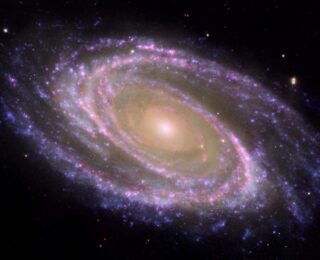
It’s big, it’s active, and it’s only 20 million lightyears away– it is the Whirlpool galaxy, and astronomers are getting a brand new view. Using the Plateau de Bure interferometer, this paper examines the gas in this nearby grand-design spiral galaxy on arcsecond scales, resolving for the first time its individual molecular clouds. What does this tell us about star formation in this galaxy? Stay tuned!

Digging up “red nuggets” in local elliptical galaxies

Huang et al. dig up evidence that distant “red nugget” galaxies grew into the massive ellipticals we see today by consuming smaller, gas-poor galaxies.

Planck and the Hubble constant: how fast are things flying apart, and what does it mean?

A quick discussion of Planck’s new value of the Hubble constant, as part of our series on the Planck results.

DSS = Digital Sky Survey; DENIS = Deep Near IR Survey of the Southern Sky; 2MASS = 2 Micron All Sky Survey

Checking Out Our New Neighbors

A new brown dwarf system has been discovered only 2 parsec away; Gillon et al. analyze its light curve to study clouds on the surfaces of these stars.

Herschel Diagnoses Protoplanetary Dust, Finds it Iron-Deficient

Spectroscopy with Herschel can probe the dust in the heart of protoplanetary disks through the 69 micron feature of forsterite. Examining these features in detail reveals that the dust grains are small, iron poor, and confined to narrow rings.

Morpho-Kinematics of a Galactic Nova

Novae are thermonuclear explosions that occur on the surface of a white dwarf following the accretion of matter from a nearby companion star. The authors seek to understand the geometry and velocity of the ejected material.

Email Subscription

Follow us on Twitter

Like us on Facebook

Archives

Our sister site