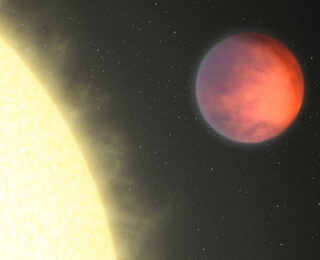
Faigler et al. apply their BEER algorithm to a collection of stars in the Kepler field and find a hot Jupiter missed by the Kepler Science Team, showing a new way to find and characterize planets without follow-up observations.
The census of planets for smaller stars—M dwarfs—is now basically complete. In this paper, Courtney Dressing and Dave Charbonneau use this M dwarf advantage to determine the occurrence rate of small planets around M dwarfs.
By looking for variations in the observed periods for eclipsing binary stars, astronomers have found evidence that a sizable fraction of these systems are actually systems of three or more stars.
The leading theory is that hot Jupiters tend to occur in single planet systems, but Szabo et al. find evidence that some hot Jupiters might reside in multi-planet systems. Are hot Jupiters actually lonely?
Last year, I reported on how the mystery of 55 Cancri e was resolved. In this Letter, Demory et al. observe the secondary eclipses of 55 Cnc e (when the planet passes behind the star), allowing them to determine the planet’s temperature. At 3,800 degrees Fahrenheit: this super Earth is not looking like a good vacation spot. They are also able to explore possible compositions for the planet.
This paper discusses the observed anomalies caused by starspot occultations due to transiting exoplanets. They are useful in determining the obliquity of the star with respect to the orbital plane of the transiting planet.
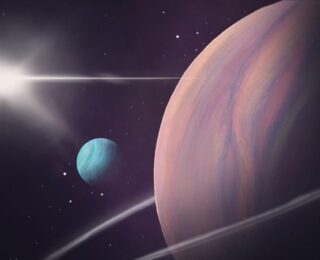
Moons in other solar systems are common in science fiction. Are they common in the universe as well? Kipping et al. are using Kepler data to find out.
Why do we care so much about finding an Earth-like planet? Is our goal to eventually colonize this planet, to make it an outpost from which to explore the rest of our galaxy? Is it pure curiosity about what else is out there? Or is it fueled by human kind’s endless romance with the stars? Exoplanet discoveries don’t usually make me wax philosophical but you’ll have to forgive a momentary lapse before I move on to the science: the discovery of the first Earth-sized exoplanets, Kepler-20e and f.
The First Kepler Science Conference is occurring this week at NASA Ames. Check out this summary of the conference to learn about the exciting results from the Kepler mission.