
Paper Title: Water Ice in the Exo-Kuiper Belt Around HD 181327
Authors: C. Xie, C. H. Chen, C. M. Lisse, D. C. Hines, T. Beck, S. K. Betti, N. Pinilla-Alonso, C. Ingebretsen, K. Worthen, A. Gáspár, S. G. Wolff, B. T. Bolin, L. Pueyo, M. D. Perrin, J. A. Stansberry, and J. M. Leisenring
First-author institution: Johns Hopkins University, 3400 N. Charles Street, Baltimore, MD 21218, USA
Status: Nature, Volume 641, p.516-520 (Open Access)
Is life on Earth unique? Are we alone in the universe? Did I leave the stove on? Some of these questions may have crossed your mind, just as some have crossed the minds of the authors of today’s article. Understanding where and how life on Earth originally formed requires a handle on a bunch of different things – how the planet was formed, where the oceans come from, the conditions of the early Earth – and a team of scientists have helped answer a crucial question in our epic quest of loneliness: frozen water ice is not unique to the solar system.
Whilst we’re one step closer to losing our “Most Unique Star System” award, we’re closer than ever before to getting to grips with how Earth and its oceans may have formed. This requires water to have been around during Earth’s formation, either as a vapour near where Earth formed, or as ice in what is now the Kuiper Belt. Water vapour has previously been detected in forming exoplanet systems, but, until now, water ice had not been found in a Kuiper Belt analogue around another star.
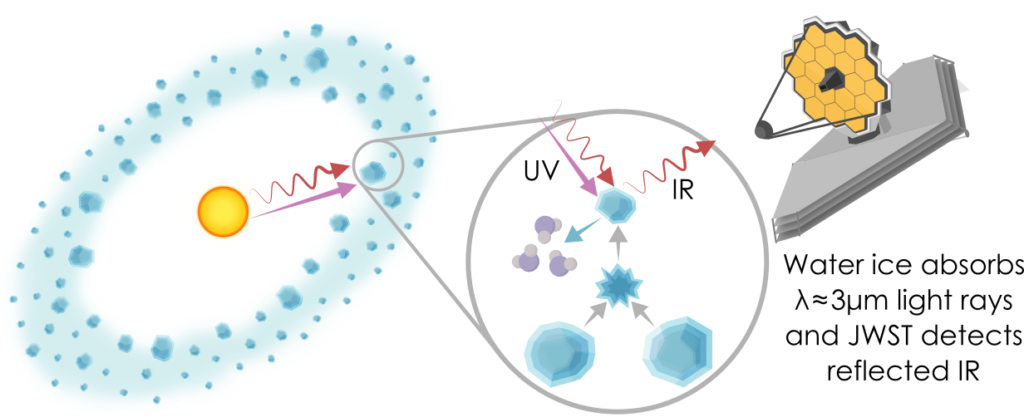
A team of scientists used the Near Infrared Spectrograph (NIRSpec) on the James Webb Space Telescope to observe HD 181327 – a debris disc that contains the leftovers from planet formation, analogous to the Kuiper Belt in our solar system. They were hoping to constrain the size and composition of particles covered in different ices, and ended up finding frozen water within the particles they observed. This incredible detection was achieved by observing the reflectance spectra with NIRSpec’s Integrated Field Unit (IFU): light from the central star reflects off comets and tiny dust grains, and NIRSpec can break this light down into its constituent wavelengths (see Figure 1). The IFU allows NIRSpec to do this for every pixel in the image (like the right-hand side of Figure 2). These are then added up to get the spectra you see on the left of Figure 2.
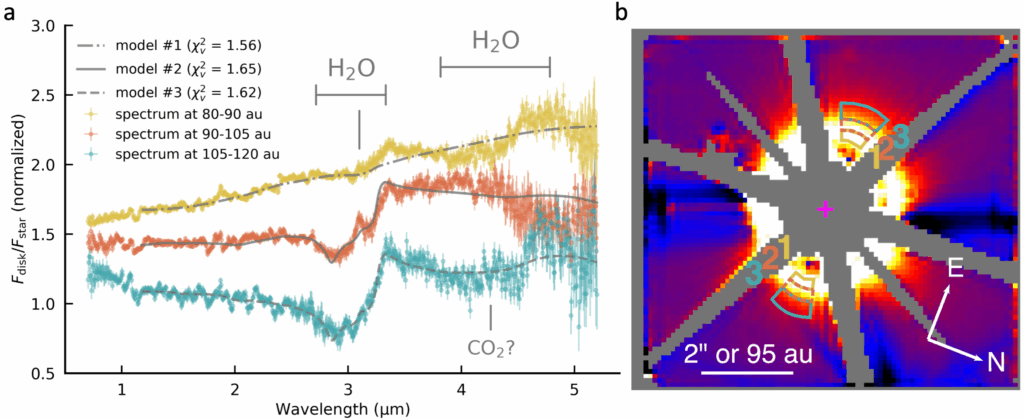
Armed with detailed observations for every pixel of their image, the researchers picked out select regions of the disc to analyse the spectra from them – see regions labelled 1, 2, and 3 from Figure 2. The researchers identified a big bowl-shaped dip in each spectra centered at 3 microns, as well as a distinct peak at 3.1 microns; these shapes have been observed in Saturn’s rings and Kuiper Belt Objects (KBOs), and are characteristic of water. Confident in their data processing, seeing these features in the spectra meant that the researchers had unambiguously detected icy water in a debris disc system for the first time!
But they didn’t stop there: each spectra has a different gradient below 3 microns, which reveals information about the composition of the ices in regions 1, 2, and 3 of the observations. The researcher’s models reveal that ice in region 1 is 0.1% water, and 99.9% other stuff; region 2’s ice is 8.5% water; and region 3 is 13.9%. The authors also believe that the star’s strong ultraviolet rays is photodesorbing the ice – that is, turning the ice to gas. In addition, the authors modelled the size of the dust grains, and their best model found that the smallest dust grains were in the region farthest away from the star.Why is this? It turns out this supports their theory of photodesorption! Smaller grains are more easily destroyed by UV rays, so the tiniest particles in region 1 are destroyed first. But, HD 181327 is super old – about 18 million years – so we would expect all the water ice to have been photodesorbed into vapour by now, so how can JWST detect it? Well, the authors believe that the debris disc is dynamic – there are constant collisions between larger icy bodies that produce these tiny ices which are then photodesorbed. The balance between photodesorption and icy collisions results in a sustained abundance of water ice. How cool is that? (Pun intended)
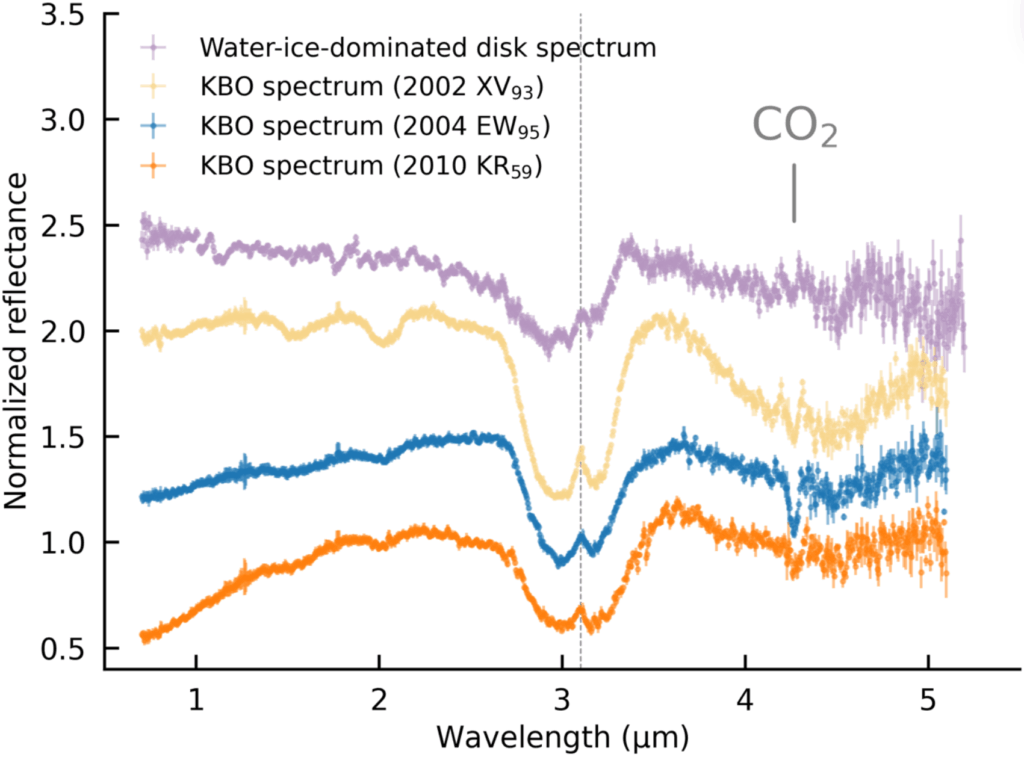
This same process could be what happened in the young Solar System when the eight planets (sorry Pluto) were forming. In fact, the authors compared their reflectance spectra directly against KBOs (see Figure 3), and the similarity is remarkable! There are subtle differences, such as different depths of the water ice feature at 3 μm, possibly due to observing larger-than-average water ice grain sizes in the Solar System, but this is clear evidence that the Solar System’s Kuiper Belt is far from unique. Detecting water ice in another star system is a massive step forward in understanding the origins of life on Earth and will help develop models that might tell us where Earth’s oceans come from.
Astrobite edited by Magnus L’Argent.
Featured image credit: Xie et al. 2025
