
by Yihan Yin

Yihan Yin is a second-year graduate student at Nanjing University, where she also earned her B.S. in Physics. She is interested in time-domain astrophysics, with a focus on high-energy transients, including gamma-ray bursts, magnetar giant flares, and fast X-ray transients. She is actively involved in the discovery and analysis of these events as a transient advocate for Einstein Probe and a member of the GRID Project. She looks forward to continuing her research in this field and contributing to the understanding of stellar explosions, compact objects, and their mergers.
Title: On the Duration of Gamma-Ray Bursts
Authors: Bing Zhang
First Author’s Institution: The Nevada Center for Astrophysics, University of Nevada, Las Vegas, USA
Status: Published in Journal of High Energy Astrophysics [closed access]
For decades, astrophysicists thought that they had gamma-ray bursts (GRBs) neatly sorted: short GRBs came from binary compact star mergers, long GRBs from collapsing stars. At first, this classification seemed to work well, but as more observations rolled in, it became clear that the reality was far more complex. The author of today’s paper argues that GRB duration is not as straightforward as we once thought—and that we need to rethink how to define it.
GRBs are the most powerful explosions in the universe believed to come from the collapse of massive stars or the collision of compact objects like neutron stars. At the heart of a GRB is a central engine, usually a black hole or a fast-spinning magnetar, which generates huge amounts of energy through processes like accretion or magnetic processes. This energy is released by the emitter as highly collimated jets, which produce the intense gamma-ray radiation we observe. After the initial burst of gamma-rays, the explosion’s aftermath, called the “afterglow,” continues to emit light across different wavelengths, from radio to X-rays. Sometimes, in the X-ray range, there’s a plateau phase where the emission remains steady for a while. During the accretion process that powers a GRB, the duration of the GRB is influenced by various factors: how long it takes for material from the progenitor star to fall onto the accretion disk (the free-fall timescale), how long it takes the material to move from outer disk to the central object (the accretion timescale), and how long it takes for the jet to punch through the surrounding material (the jet breakout timescale). The basic idea behind linking the duration of a GRB to its progenitor is that the duration depends on how the jet is powered, with the time it takes for the material to fall onto the central engine being related to the density of the progenitor star.
A Classification That Used to Work (Mostly)
Gamma-ray bursts were first classified into two groups based on their T90 duration—the time during which 5% to 95% of the burst’s total fluence is detected:
- Short GRBs: Less than 2 seconds, associated with compact star mergers (Type I).
- Long GRBs: More than 2 seconds, linked to collapsing massive stars (Type II).
This classification seemed reliable in most cases. It was based on observations from BATSE, a key instrument onboard NASA’s Compton Gamma Ray Observatory in the 1990s. Most bursts fell into one of the two categories, and their presumed origins lined up neatly.
But as GRB detection improved, outliers started appearing. Some long-duration bursts were linked to mergers, and some short bursts came from massive stars. The once-reliable boundary at 2 seconds became increasingly blurry.
Why Does Duration Get Messy?
The author identifies four key factors that influence and modify the observed duration of a GRB, making it a less reliable indicator of its progenitor system.
1. Progenitor-Defined Duration
The link between GRB duration and progenitor type is based on the assumption that GRB jets are powered by accretion. The duration of a GRB is fundamentally shaped by three timescales associated with the progenitor: the free-fall timescale, the accretion timescale, and the jet breakout timescale. In collapsars, the low average progenitor star density leads to dominant free-fall timescale, typically producing long-duration GRBs. In neutron star mergers, the duration is mainly defined by the difference between accretion timescale and jet breakout timescale. Considering an upper limit of around 3 seconds of the accretion timescale derived from typical density parameters, a 1-second typical jet breakout time results in short-duration GRBs. However, variations in accretion efficiency and jet breakout conditions can blur this classification.
2. Engine-Defined Duration
Even with the same progenitor type, the central engine itself plays a crucial role in determining how long the burst lasts. The millisecond magnetar central engine at the heart of the explosion can sustain energy injection over an extended period. A long-lived magnetar could power the internal X-ray plateau in the afterglow. This variability adds another layer of complexity to using duration as a classification tool.
3. Emitter-Defined Duration
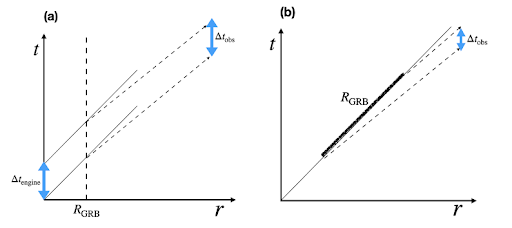
While GRB duration often reflects central engine activity, sometimes the emitter itself radiates for an extended period, making the burst appear longer. For example, if the emitter continues to emit GRB emission over a large range of radii, even if the central engine duration is instantaneous, the observer could still observe a duration (Figure 1). In such cases, smooth, broad pulses form at large distances. If a GRB has only one broad pulse, its duration may be misleading because it could have been significantly modified (lengthened) by the emitter.
4. Geometry-Defined Duration
Finally, the observer’s viewing angle can stretch the perceived duration of a GRB. GRBs are highly collimated jets, and if we see them slightly off-axis, the emission appears weaker and more prolonged due to relativistic effects. A burst that is truly short when viewed head-on might appear much longer if observed from an off-center angle. This means that even two identical explosions can have vastly different durations simply based on their orientation relative to Earth.
When Classification Falls Apart
Accumulating samples of peculiar GRBs have demolished the hope for a tidy connection between old classifications based on duration and progenitor type. The duration of some GRBs is significantly influenced by various factors that unravel the once-clear link with progenitor type (short = Type I, long = Type II):
- GRB 200826A: A short (~ 1 s) Type II GRB, likely due to a short-lived engine that lasted only slightly longer than the jet breakout time.
- GRB 230307A: A long (~ 42 s) Type I GRB from a compact star merger, with its duration primarily set by the emitter rather than the progenitor or engine. A magnetar-driven Poynting-flux wind likely powered a broad pulse with rapid variability.
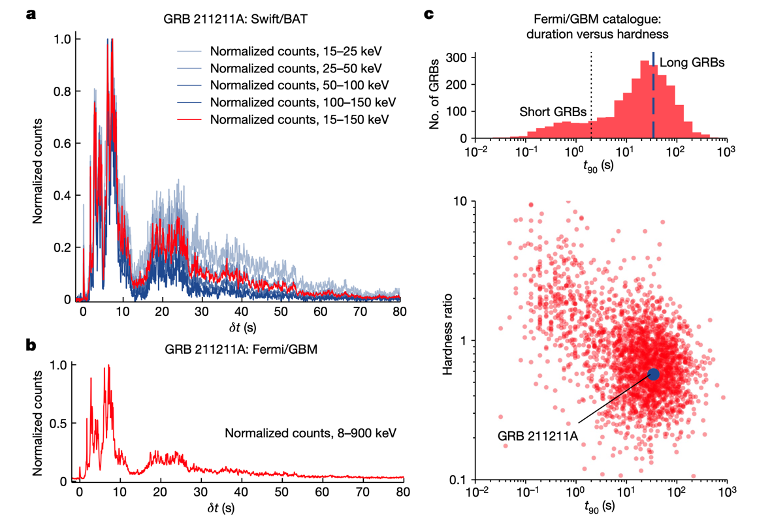
- GRB 211211A: A long (~ 68 s) Type I GRB with kilonova emission. Multiple emission features suggest a neutron star-white dwarf merger with a magnetar central engine.
These cases prove that duration alone is not enough to determine a GRB’s progenitor origin. Instead, astrophysicists need to consider additional clues, such as afterglow properties, host galaxy type, and multiwavelength observations.
Future Directions in GRB Duration Research
This paper challenges the idea that GRBs can be classified by duration alone. With ongoing and upcoming observations, new data will shed light on their true nature. Missions like Einstein Probe and SVOM are already detecting early soft X-ray signals, offering insights into central engine activity and jet structures. Next-generation gamma-ray observatories will capture faint extended emissions, uncovering hidden components of short GRBs. Meanwhile, multi-messenger astronomy, particularly gravitational wave detections, will provide direct confirmation of neutron star mergers, helping refine the connection between duration and progenitor systems.
Rethinking GRB Classification
The next time a GRB is detected, the first question should not be “How long is it?” but rather “What does its duration actually tell us?”
The universe, as always, refuses to fit into neat categories—and our job as astrophysicists is to keep up.
Astrobite edited by Annelia Anderson
Featured image credit: NASA-JPL/Caltech

The author wrote it very well, I benefited a lot from it!