
Title: Comparing extragalactic megahertz-peaked spectrum and gigahertz-peaked spectrum sources
Authors: F. J. Ballieux, J. R. Callingham, H. J. A. Röttgering, and M. M. Slob
First author institution: Leiden Observatory, Leiden University
Status: Published in Astronomy & Astrophysics (open access)
Most of us have watched kids or pets grow up, but how many of us can say we’ve done the same with a radio-light emitting and galaxy-eating supermassive black hole? Unfortunately, none of us, since these special types of black holes, known as radio-loud active galactic nuclei (AGN), age too slowly for this to be feasible on human timescales. Instead, we can study the relationships between the many different types of extragalactic radio sources we see to understand the life cycle of a radio-loud AGN. Luckily, this is an endeavour that’s been undertaken for decades, and we have a host of interesting sources suspected to be part of the radio-loud AGN life cycle. These include compact sources with tiny (mere kilo-parsecs across or less!) regions of radio emission; flashy AGN with distinctive hourglass-shaped radio jets extending from their centers; and galaxies with extended blobs of radio emission, possibly the remnants of jets which the the central black hole stopped fueling long ago.
Peaked-spectrum sources: adolescent radio galaxies?
Today’s authors are primarily interested in a subset of the compact sources: the creatively named peaked-spectrum sources (PS sources), which are characterized by a rainbow-shaped relationship between their flux and frequency (known as a spectrum). More specifically, the flux peaks at the turnover frequency, and on either side of the peak, flux is proportional to frequency raised to some power, the spectral index (for short, a power law). An example is shown in Figure 1. Most photons with frequencies greater than the turnover frequency produced in a PS source are able to escape unscathed and make their way into our radio telescopes. However, photons with frequencies less than the turnover frequency are not so lucky; they are absorbed shortly after they are created, and we never see them. As a result, the observed flux of photons from the source drops off sharply below the turnover frequency.
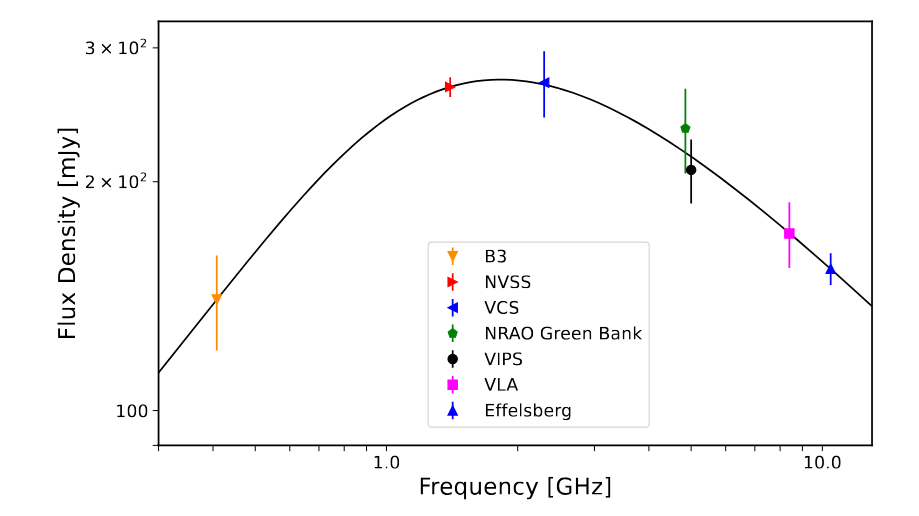
Figure 1: The characteristic rainbow-shaped spectrum of a peaked-spectrum (PS) source. The flux from the source increases exponentially with decreasing flux until the turnover frequency, below which, the photons cannot escape the source before being absorbed. Adapted from Figure 4 in Ballieux (2024).
PS sources can be further divided into three categories, based the value of their turnover frequency: sources with the highest turnover frequencies (>5GHz) are designated as high-frequency peaked (HFP) sources; sources with the lowest turnover frequencies (<1GHz) as megahertz-peaked (MPS) sources; and sources in between as gigahertz-peaked (GPS) sources. Interestingly, HFP sources are the smallest in physical size, and MPS sources the largest, suggesting that HFP sources are the youngest of the bunch, and as they expand into GPS and then MPS sources, their turnover frequency shifts lower.
Does a peaked-spectrum imply youth, frustration, or both?
What is less clear, however, is what causes the low-frequency absorption in the first place, although there are two main theories: either the PS sources are young, or they are frustrated. In the first theory, PS sources are very young and will someday evolve into radio AGN and radio galaxies. Their radio emission is created by interactions between powerful magnetic fields and relativistic electrons, which is known as synchrotron radiation. The second theory is that the PS sources are surrounded by dense gas and dust, which prevents their jets from growing, leaving them ‘frustrated’. In this case, the radio emission is created by interactions between the source and its environment, in a process known as Bremsstrahlung radiation. At low frequencies, both Bremsstrahlung and synchrotron radiation become opaque to themselves, as electrons are able to quickly reabsorb the emitted photons. Recent work suggests the young-source theory is more likely, so today’s authors assume this to be the case for their sources. However, in reality, it is probable that some PS sources are the Holden Caulfield versions of AGN: both young and frustrated.
Looking for gigahertz-peaked and megahertz-peaked sources
Today’s authors are interested not in why PS sources have peaked spectra, but in what the relationship between the PS source subtypes is. They first create two new catalogs of GPS and MPS sources, and then compare their abundances with that of fully-grown AGN to infer information about the relative lifetimes of each. To classify sources as MPS or GPS, our authors need flux measurements at three different frequencies in the MHz-GHz range. They can then reconstruct the spectra by fitting one power law to the measurements below the central frequency, and another to the measurements above it. If the low-frequency fit has a positive spectral index and the high-frequency fit has a negative spectral index, then the source has a peaked-spectrum with a turnover frequency equal to that central frequency.
Our authors choose to search for candidates in four highly sensitive radio surveys, each with a different frequency: LoLSS (54MHz), LoTSS (144MHz), NVSS (1GHz), and VLASS (3GHz) (at least one letter in each of these acronyms represents another acronym, likely a very un-creatively named telescope; it is left to the reader to investigate the full expanded survey name if interested). They construct two catalogs of PS candidates. The first is a low-frequency (LF) catalog, consisting of compact sources detected in LoLSS, LoTSS, and NVSS, which will reveal any sources with spectral peaks around 144MHz (in other words, MPS sources). Similarly, the high-frequency (HF) catalog contains compact sources detected in LoTSS, NVSS, and VLASS, in which the authors can look for GPS sources with spectral peaks around 1GHz.
Selecting compact radio sources as PS candidates
However, before our authors can embark on any spectral fitting, they need to ensure all sources in the LF and HF catalogs are compact. They require three criteria for any sources wanting admission to the compact source club. First, they must appear as an unresolved source in each survey, indicating that any substructure is only on very small scales. Second, their radio emission must be concentrated in one point, ruling out any diffusely emitting imposters. Lastly, they must be isolated, since any nearby radio sources could contaminate the flux measurements (however, an exemption was made for very bright sources which were at least 10 times as bright as their neighbors, since these ‘neighbors’ are likely noise introduced by the data reduction process). These cuts result in an initial catalog of 12,962 LF sources and an initial catalog of 108,473 HF sources.
Once the compact source catalogs are established, our authors determine the low-frequency best-fit spectral index (using the LoLSS and LoTSS measurements (LF) or the LoTSS and NVSS measurements (HF)); they then repeat this for the high-frequency measurements (LoTSS and NVSS (LF) or NVSS and VLASS (HF)). The distribution of the spectral indices found is shown in Figure 2.
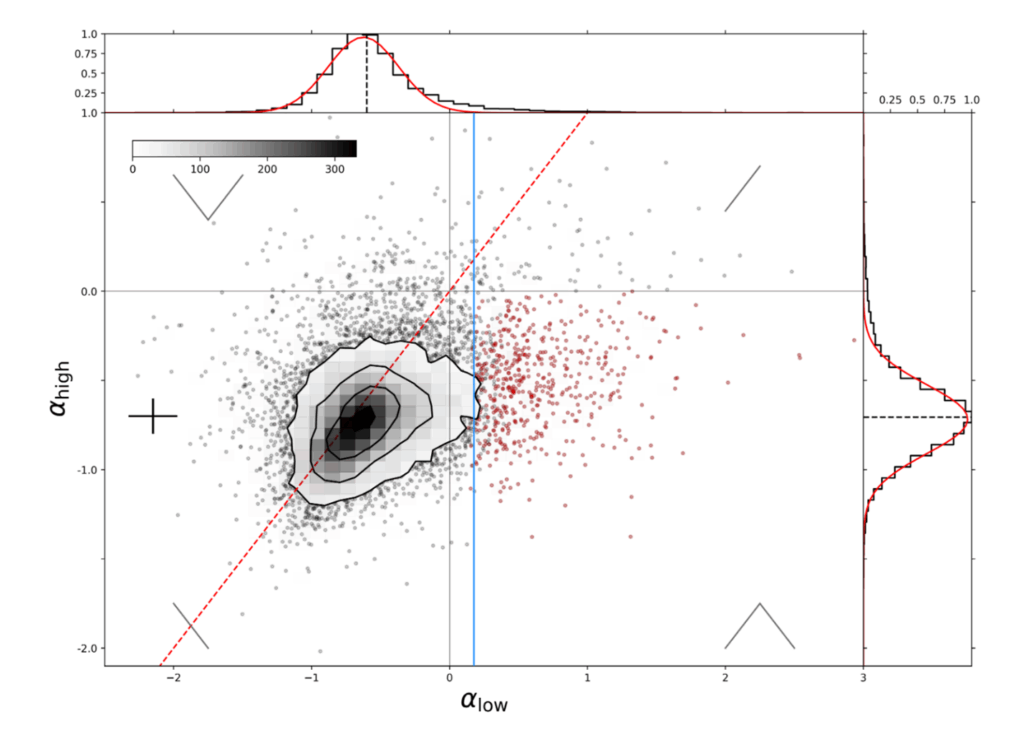
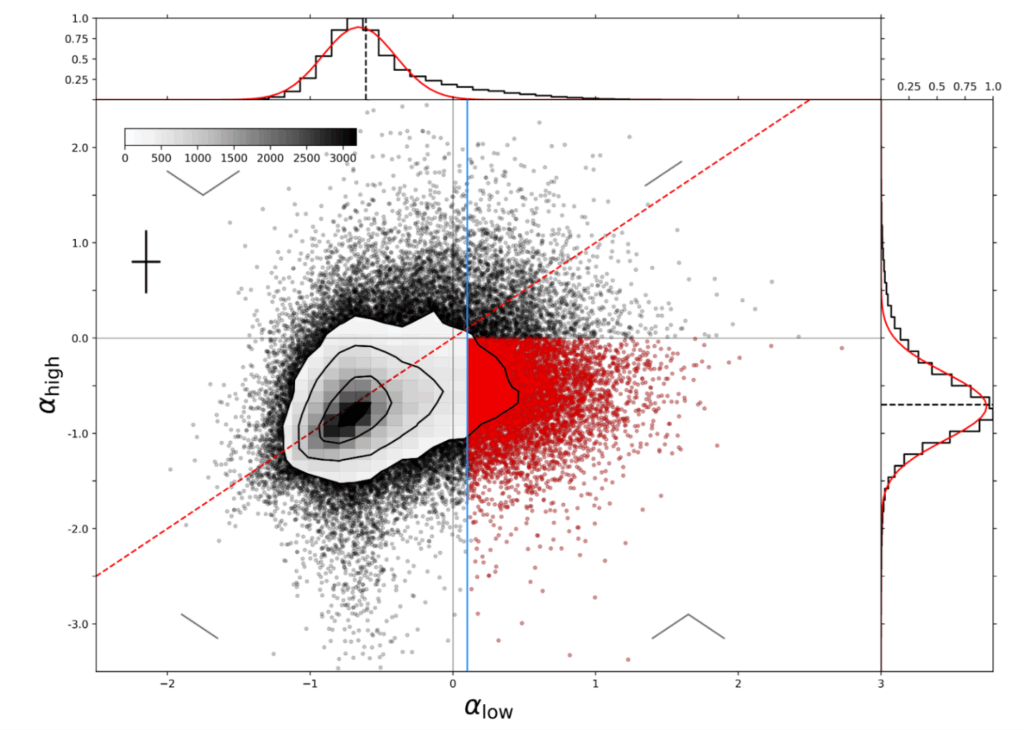
Figure 2: The distribution of the spectral indices for the sources in the LF (left panel) and HF (right panel) catalogs. Red LF sources are MPS sources, and red HF sources are GPS sources. Sources in the upper right quadrant (with a positive spectral index at all frequencies) are likely also PS sources, but we are only seeing the absorption. Their turnover frequencies are greater than 3GHz, placing them mostly in the HFP category. Adapted from Figures 2 and 3 in Ballieux (2024).
The final MPS and GPS source catalogs
As can be seen in Figure 2, our authors are successful in their quest to find MPS and GPS sources. They identify 506 MPS sources (3.9% of the LF compact sources) and 8032 GPS sources (7.4% of the HF compact sources). Both samples are unprecedented in number; this MPS sample is the largest of its kind, and the GPS sample is larger than any other PS catalog. Furthermore, HF sources with positive spectral indices in both frequency ranges are likely HFP sources, and we see only the absorption-dominated half of the peak, with the turnover falling in a higher frequency band.
Four young and frustrated radio AGN?
Even more interesting, three of the MPS sources and one GPS source have an unusually steep flux drop off below the turnover, indicating a rate of absorption which cannot be explained by the young-AGN theory alone. Further investigation is needed to determine which other absorption mechanisms are contributing.
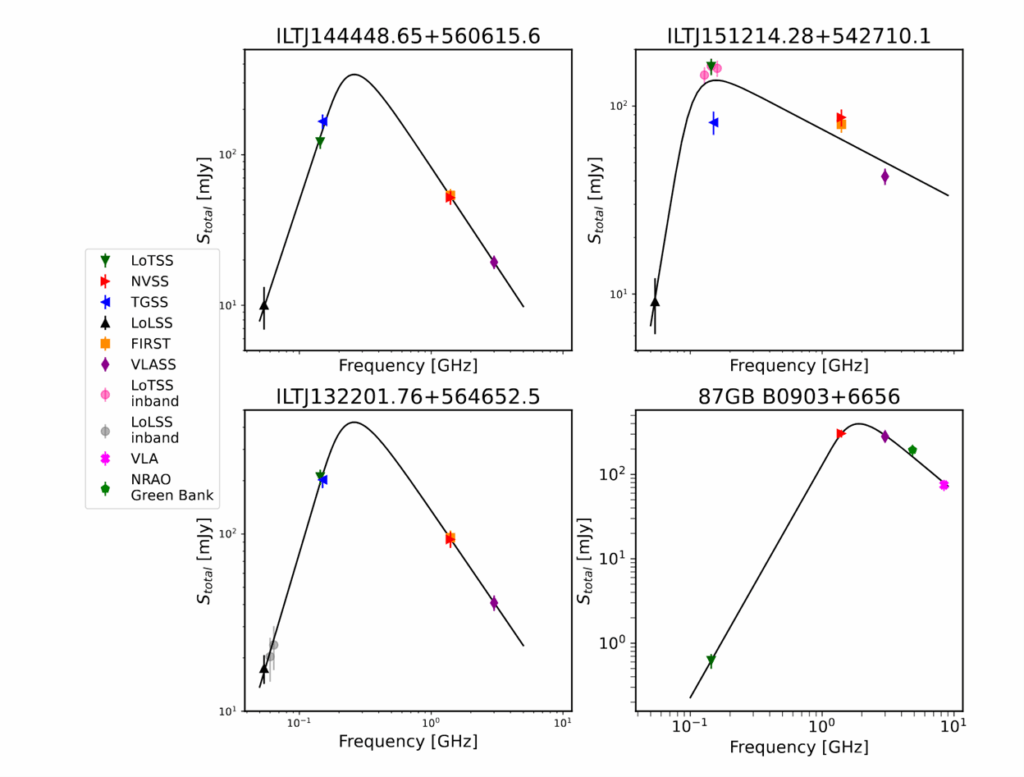
Figure 3: The spectra of the four PS sources with extreme absorption effects, seen in their steep low-frequency slopes. These spectra cannot be explained by the young AGN theory alone, so follow-up observations are needed to explore what other physics is at play. Figure 5 in Ballieux (2024).
New AGN and PS source population statistics
Lastly, our authors compare the relative abundances of their MPS and GPS sources to all compact sources, and to the adult radio-AGN population. They conclude 2.22% of extragalactic sources with 144MHz radio emission are MPS sources and 3.4% of extragalactic sources with 1400MHz emission are GPS sources, indicating that these young AGN are rare (and, equivalently, short lived). They conclude that GPS sources (the younger PS subtype) are slightly longer lived than MPS sources, which have 1.6 times shorter lifespans. Compared to fully grown radio AGN, however, neither have very impressively long lifetimes; GPS lifetimes are 28 times shorter, and MPS lifetimes are a whopping 44 times shorter! Don’t get too excited though; they are both still too long for you and I to hang around and watch any of these PS sources grow up.
Edited by Abbe Whitford
Feature image: A radio image from LoTSS of a peaked-spectrum source. Adapted from Figure 4 in Ballieux (2024).

