
Title: The “Dark-Matter Dominated” Galaxy Segue 1 Modeled with a Black Hole and no Dark Matter
Authors: Lujan, D., Gebhardt, K., Anantua, R., Chase, O., Debski, M. H., Finley, C., Gomez, L. V., Gupta, O., Lawson, A. J., Marron, I., Martinez, Z., Painter, C. A., Sklansky, Y., & West, H.
First Author’s Institution: Department of Physics & Astronomy, The University of Texas at San Antonio, One UTSA Circle, San Antonio, TX 78249, USA
Status: Submitted to ApJ Letters [open access]
Decades of astronomical evidence has shown us that the universe contains more than “ordinary” matter. For example, stars orbit within their galaxies at speeds much higher than we’d expect, given the amount of matter we can directly see within a galaxy. Similarly, galaxies in clusters are moving much faster than they would be if only visible matter was contributing to the mass of the cluster. But even though there’s plenty of evidence telling us that this dark matter is out there in the universe, and is about six times more abundant than ordinary matter, we still don’t know what exactly it is.
One way of characterising the behaviour of dark matter is to study its effect on dwarf galaxies. Dwarf galaxies contain far fewer stars than large galaxies like the Milky Way and Andromeda, and it’s thought that some of them might have very high ratios of dark matter to ordinary matter. As a result, the motions of stars within dwarf galaxies might be more strongly affected by dark matter.
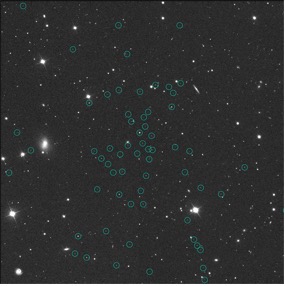
Segue 1 is a dwarf spheroidal galaxy and a satellite galaxy of the Milky Way. Careful measurements of the velocities of individual stars within Segue 1 suggested that its mass might be dominated by dark matter, making it a promising candidate for further study. But studying Segue 1 is no easy feat. The galaxy is extremely faint and diffuse; Figure 1 is an image of Segue 1 with some of its stars circled in green. You can imagine that without those circles to guide your eye, it would be virtually impossible to pick out Segue 1 from a field of background stars. If that weren’t difficult enough, Segue 1 is also being tidally stripped by the much stronger gravitational potential of the Milky Way, ripping some stars away from the galaxy. The motion of tidally stripped stars is no longer being determined by the gravitational potential (and therefore the dark matter halo) of Segue 1, so in order to study only the stars that still belong to Segue 1, we need to exclude tidally stripped stars.
Today’s authors take on the challenge of studying Segue 1 and use the dynamics of stars in the galaxy to estimate the mass of a central black hole and dark matter halo. A better estimate of the dark matter halo mass could help constrain different models of dark matter, as well as provide clues about the origin of Segue 1.
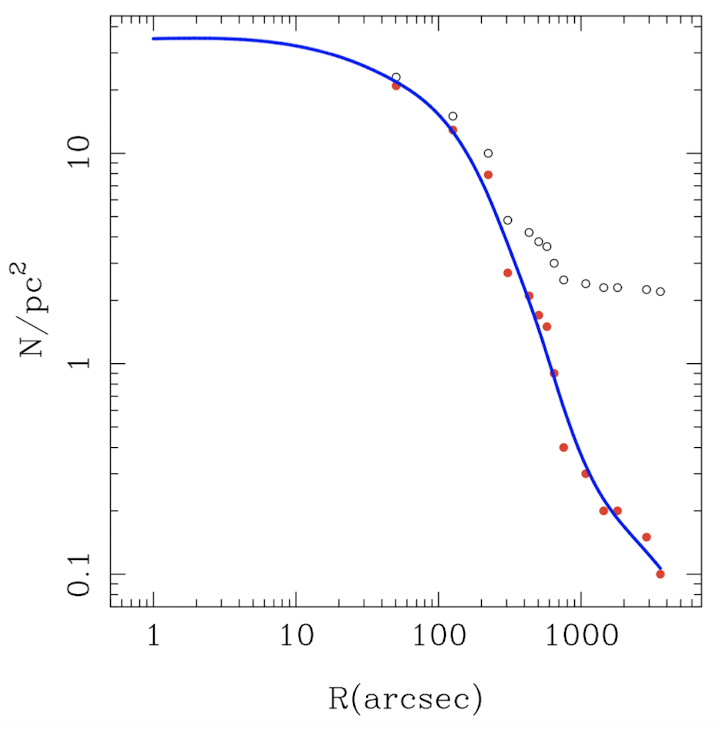
The first step in the analysis is to model the observed motions of stars in Segue 1. To remove tidally stripped stars, the authors assume that the density of stripped stars is roughly constant across the galaxy, and that the vast majority of stars in the outskirts of the galaxy are tidally stripped. They measure the number density of stars in the outer region of the galaxy, and then subtract this same number density from more central regions. This method allows today’s authors to measure the number density of stars in Segue 1 (y-axis of Figure 2) at different radii (x-axis of Figure 2). The black, unfilled circles in Segue 1 show the raw number density at different radii, without subtracting tidally stripped stars. The red circles show the number density of stars that are actually gravitationally bound to Segue 1, and the blue curve is a fit to the data. You can see that correcting for tidal stripping has a big effect on the assumed stellar density profile, especially at large radii.
Next, they use pre-existing measurement of the motions of Segue 1 stars to create a rotational velocity profile. The authors divide up Segue 1 into a series of concentric rings, each containing either 21 stars (at larger radii) or 15 stars (at smaller radii). In each ring, they fit a velocity profile to the observed stellar velocities, and then infer the rotational velocity at that radius. Figure 3 plots rotational velocity against radius, and you can see that the velocity increases sharply towards the innermost regions of the galaxy.

With the stellar density and rotational velocity profiles in hand, the authors can finally estimate the amount of unseen matter in Segue 1. They construct a series of models, each of which varies according to four different parameters: the ratio of stellar mass to light, the mass of a central black hole, the circular velocity of the dark matter halo (analogous to the mass of the halo), and the scale radius of the dark matter halo, where a smaller scale radius suggests that the dark matter is more concentrated towards the center of the galaxy. For each model, they sample the kinds of stellar orbits you would expect, given the specific gravitational potential, and then evaluate how well the model fits the data using a chi-squared test.
Contrary to what previous results might have suggested, the authors find that the kinematics of Segue 1 can be reproduced without any dark matter halo. In fact, the most important factor in determining whether a model fits the data well was the mass of the central black hole. The best-fitting models assumed a black hole mass around 400,000 times the mass of the Sun, which is equal to just over ten times the mass of all the stars in Segue 1, combined! While models with a dark matter halo and black hole produced a better fit than models with just a black hole, the authors weren’t able to constrain the properties of the dark matter halo very well, suggesting that the black hole is influencing the kinematics of Segue 1 more strongly than the dark matter halo is.
The large estimated black hole mass is particularly intriguing. Typically, in a galaxy, the mass of a black hole at its center doesn’t exceed the total mass of stars. The fact that Segue 1’s black hole has ten times more mass than all the stars in Segue 1 makes it an atypical case. The overly massive black hole may be an indication that Segue 1 used to be a much larger galaxy, with many more stars such that the stellar mass would have dwarfed the black hole’s mass. Perhaps this galaxy was ripped apart by the Milky Way, causing Segue 1 to lose most of its stars, and all we’re seeing now are the remnants. Alternatively, Segue 1 could be similar to an exciting, newly discovered class of galaxies known as Little Red Dots (LRDs). LRDs have only been found in the distant universe, at high redshifts, and their exact nature is still an open question. Some astronomers have suggested that LRDs are galaxies with extremely overmassive black holes and a small stellar population.
The results of today’s paper show that models of dark matter in Segue 1 should take into account the effect of the central black hole. A better understanding of how mass is distributed within Segue 1 opens the door for more accurate modeling of its dark matter halo, and potential insights on the nature of dark matter. For now, Segue 1 remains a fascinating little galaxy that gives us a glimpse into the very smallest scales of galaxy structure.
Astrobite edited by Bình Nguyễn
Featured image credit: Marla Geha
