
Title: A search for extremely-high-energy neutrinos and first constraints on the ultra-high-energy cosmic-ray proton fraction with IceCube
Authors: IceCube Collaboration
Status: Accepted to Physical Review Letters
This bite was written and published as part of Astrobites’s new partnership with the American Physical Society (APS). As part of this partnership, we cover selected articles from the Physical Review Journals, APS’s premier publications covering all aspects of physics. For more coverage as part of this partnership, see our other PRJ posts.
For most of human history, we have learned about outer space from only one kind of particle (or wave, depending on your perspective): photons, also known as light. Recent innovations in astronomy have opened up new avenues to learn about space. The authors of today’s paper use multi-messenger astronomy (or astronomy using information other than light) to learn about some of the most extreme environments in the Universe.
Multi-messenger astronomy
Multi-messenger astronomy is the use of particles and waves other than light to understand the Universe around us. These “messengers” include neutrinos, cosmic rays, and gravitational waves. The focus of today’s paper is on neutrinos and cosmic rays.
Neutrinos are neutral particles with an extremely small rest mass. They only interact via gravity and the weak interaction and are produced by radioactive decay, including in astrophysical environments like supernovae. Cosmic rays are high-energy particles or bundles of particles from space—usually protons or bundles of protons and neutrons. They’re produced by the Sun, supernovae, and active galactic nuclei.
Of particular interest are ultra high-energy cosmic rays, or UHECRs. These are cosmic rays with an energy greater than \(10^{18}\) eV, and we think they come from extreme environments like neutron stars, active galactic nuclei, supernova remnants, or gamma ray bursts. We can use their chemical composition to distinguish between these environments and learn more about their origins.
Cosmic rays interact with light and matter inside their sources to produce neutrinos. These neutrinos can be extremely energetic and can be used to constrain the energy, composition, and time evolution of UHECR sources. Today’s paper uses 12.6 years of data from the IceCube neutrino observatory to get an upper limit on the UHECR flux to further constrain their sources.
IceCube Neutrino Observatory
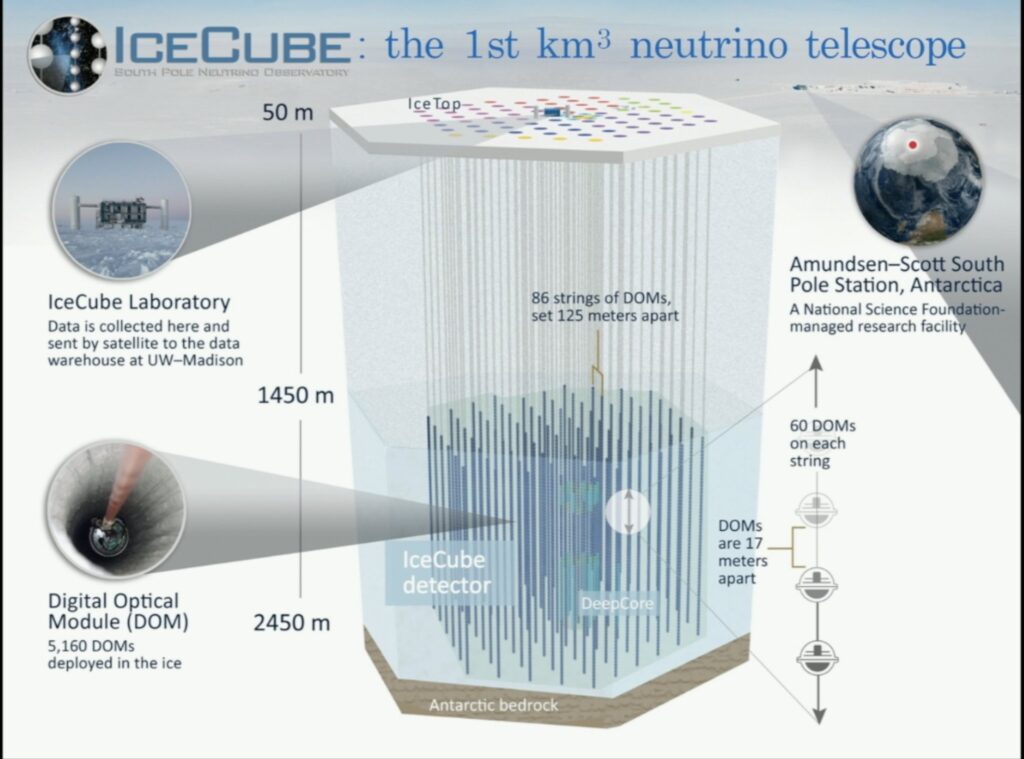
You can’t detect neutrinos with a telescope like you can for regular light, but that’s where IceCube comes in. IceCube is a neutrino detector at the South Pole which uses a cubic kilometer of Antarctic ice as a detector (Figure 1). When neutrinos hit ice, they interact with water via the charged-current interaction, giving off charged electrons, muons, or tau particles. These particles are moving extremely quickly due to the kinetic energy of these high-energy neutrinos—so quickly, they’re faster than the speed of light in ice. When particles move through a medium faster than the speed of light in that medium, they emit Cherenkov Radiation, the same thing that causes the blue glow characteristic of radioactivity. IceCube is filled with detectors that look for this radiation as the neutrino moves through the ice. It uses the neutrino’s path and energy to figure out what “flavor,” or type, of neutrino it’s seeing as well as the direction it came from.
Methods
The authors of today’s paper are interested in only extremely high-energy particles coming from outer space. This means they first have to remove any detections of low-energy neutrinos and anything that enters the ice from below or sideways. After this filtering, they find three events in 12.6 years.
To compare to models of UHECR production, they simulate a bunch of experiments assuming different models, which each predict different background neutrino fluxes and energy distributions. They add in some errors due to instrumental uncertainties (i.e. the efficiency of the detectors in IceCube) and astrophysical uncertainties (including uncertainties on the neutrino cross-section, how neutrinos collide, and the flux of particles from the atmosphere). They compare the results of these simulated experiments to the three events they detected to determine which models work best to explain their observations.
Results
The authors are able to use the three measured events to set an upper limit on the neutrino flux. They compare this upper limit to the predictions of a couple of theories. While this upper limit is informative, the information it gives us is about two quantities that are “degenerate” with each other, or which depend on one another—this means that we can learn about one quantity or the other, but not both. (Consider an equation like 12 = x*y; in this equation, x and y are degenerate, and we can only learn the value of y if we assume a value of x.) The upper limit set by this study can inform either our understanding of the proton fraction of cosmic rays OR the evolution of cosmic ray production over time.
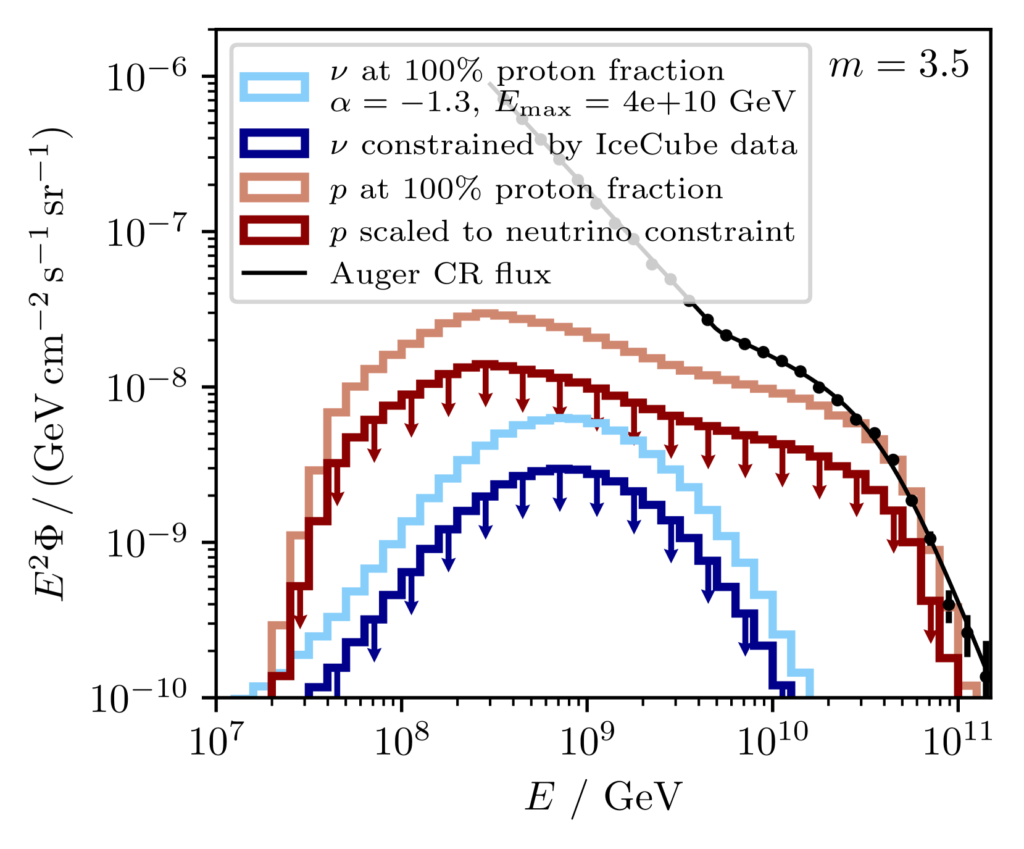
In Figure 2, the authors demonstrate that their calculated upper limit means that only 70% of UHECRs can be made solely of protons if the production of UHECRs evolves at the same rate as the cosmic star formation rate, used as a tracer of matter production in the Universe. (On the other hand, if 100% of UHECRs were protons, their production must not evolve with the cosmic star formation rate; this is disfavored by other observations.)
The 70% upper limit on the proton fraction of UHECRs and the upper limits on the UHECR flux from this neutrino data help to disfavor a couple of popular models of UHECR production. In particular, the authors point out that this work makes it unlikely that UHECRs are produced in the jets of active galactic nuclei.
What it means for cosmic rays
So why is it important that UHECRs aren’t 100% protons?
Extragalactic high-energy cosmic rays should be suppressed as they interact with the cosmic microwave background. These interactions slow down the cosmic ray by removing energy. Importantly, this process, called “Greisen–Zatsepin–Kuzmin suppression,” is specific to protons, so it could be ruled out by proving that the highest energy cosmic rays are made entirely of protons. Instead, today’s paper showed that UHECRs (the exact cosmic rays which should be experiencing this suppression) are NOT made entirely of protons, which may explain why they’re able to stay so energetic as they travel between galaxies.
This paper placed the strongest constraints so far on the number of neutrinos from high-energy cosmic rays hitting the Earth’s surface. It also placed the strongest constraints on the proton fraction of UHECRs so far, as long as UHECRs evolve at the roughly same rate as the cosmic star formation rate. Future work with neutrino detectors like IceCube will be needed to keep constraining the source and chemistry of UHECRs and will give us a glimpse into some of the most extreme environments in the Universe.
Astrobite edited by Diana Solano-Oropeza
Featured image credit: Christopher Michel
