
This week, the official president’s budget requests for NASA and the NSF were released, and the proposed cuts would be absolutely devastating for astronomy in the U.S. and around the world. Astrobites has already covered the threat posed by the less detailed request released last month, but with the agency-specific reports, we can now see exactly what would happen to the programs and missions that make astrophysics research possible. Here I will summarize the damage these cuts would do. But it’s important to remember that these are still proposals, and it is Congress that will ultimately draft the budget for FY 2026. There is still time to fight these cuts, and everyone, whether you are in the field of astronomy or not, has the power to make their voice heard (more on this at the end).
Although this summary focuses on the impacts for astrophysics specifically, it’s worth noting that both NASA and the NSF support many other scientific fields that are all facing equally devastating cuts, including several that are very intrinsically connected to astrophysics such as geology, climate science and education research.
NASA

NASA astrophysics research division is facing a 44% cut, which severely reduces the budget for several major missions and outright cancels many others. Figure 1 shows the difference between the allocated amount in 2024 and the proposed budget for FY 2026 for a selection of missions included in the NASA Astrophysics Fleet. While the budget request touts the importance of all these missions and claims ‘continued support’, many of these cuts would be absolutely devastating, severely reducing the quality and quantity of science we’ve been able to extract from these missions so far.
The presidential budget request also contains a vast graveyard of defunded missions, such as Mars Sample Return, Mars Odyssey, and Mars Atmosphere and Volatile EvolutioN (MAVEN). It also ends funding for Juno, New Horizons, and OSIRIS-APEX. It stops support for Keck Observatory operations, the Fermi Gamma-ray Space Telescope, and the Chandra X-Ray Observatory. It ends development of the The Compton Spectrometer and Imager (COSI), the Ultraviolet Explorer (UVEX) and the Ultraviolet Transient Astronomy Satellite (ULTRASAT). And it ceases support for several European Space Agency-led missions that NASA and U.S. astronomers participate in, including Mars Express, EUCLID, and the Laser Interferometer Space Antenna (LISA). This is just a selection of cancelled missions related to the topics Astrobites readers are interested in, but overall, the budget request cancels a whopping 41 projects. It’s worth noting that some of these, like EUCLID and LISA, do have other sources of funding besides NASA and thus might not be fully dead in the water. However, the loss of this financial support would undoubtedly cause problems for the missions, and this step back from international collaboration could severely damage the U.S.’s reputation.
Many of these missions, like UVEX and Mars Sample Return, are still largely in the development phase, but we’ve already spent billions of dollars on them that would be flushed down the drain with their cancellation. OSIRIS-APEX has already launched and is en route to study two asteroids, including one that is potentially hazardous to Earth. Many others are still providing extremely useful and important science results, and shutting them down prematurely will severely hamper the research we can do in coming years. Juno has been in orbit around Jupiter for 9 years and continues to operate, providing groundbreaking data on Jupiter’s weather, interior, magnetic field, and moons. Fermi studies gamma-ray bursts, the highest energy events in the universe–something that we still understand very little about. Chandra still has over a decade’s worth of fuel left and is the highest resolution X-ray imager in operation, playing a crucial role in probing the high-energy universe and complementing the data we get at other wavelengths from other major telescopes like Hubble and JWST. The NASA Senior review is expected to go public shortly, and colleagues have shared privately with Astrobites that the report stresses each of these missions produces its best science when used in conjunction with other ongoing missions. Missions like Chandra are still perfectly capable of producing excellent, cost-effective science, and its data significantly strengthens the results from other observatories. And this is just the impact on some major astrophysics missions. Figure 2 shows how all the missions in the NASA fleet would be affected by these proposed cuts.

The damages of these budget cuts go beyond specific spacecraft and telescopes. This budget request includes a cut from 116.7 to 48.7 million for NASA Astrophysics Research and Analysis, and a cut from 52 to 2 million for Science Activation. All money going towards STEM engagement ($143 million in FY24) is cut. These extreme cuts will mean a huge reduction in the amount of astrophysics science and outreach that can happen in the U.S..
NSF
Now we turn to the NSF, where things are equally dire. The proposed budget completely defunds the Astronomy and Astrophysics Postdoctoral Fellowships program and reduces the Graduate Research Fellowship Program (GRFP) by over 50%, from 284.52 million in FY 2024 to 127.29 million in 2026. These cuts specifically target early-career scientists, which would make it incredibly difficult for many of us to stay in the field going forward.
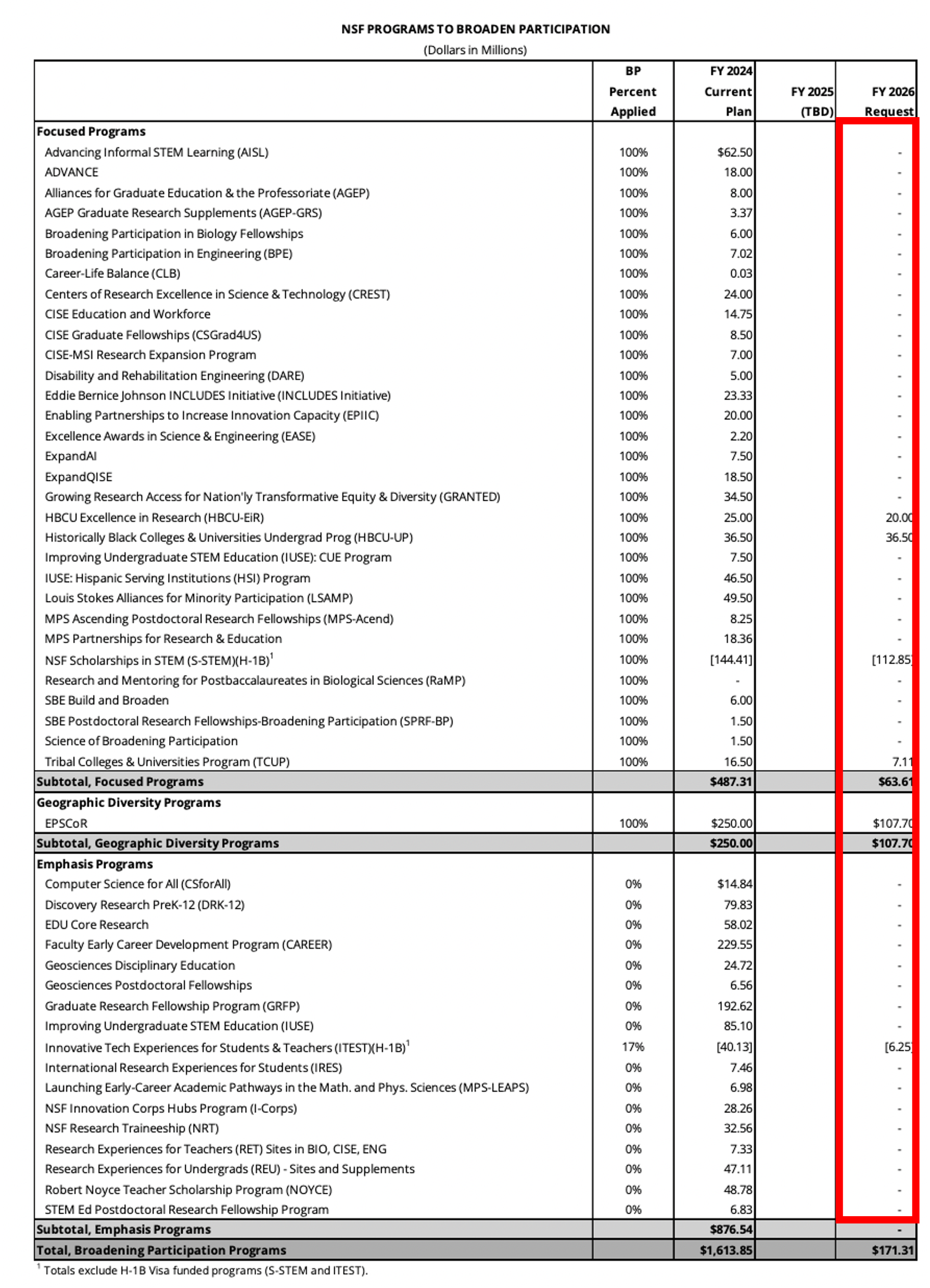
Additionally, almost all of the programs designed to broaden participation in science would be defunded entirely. Figure 3 shows the NSF programs connected to broadening participation; as you can see, almost every single one would be cut. Funding for education research is cut by 75%. By the budget request’s own admission, the cuts across all divisions would reduce the number of people involved in NSF science from over 330,000 to just 90,000, and the funding rate (the percent of research grant proposals awarded money) would drop from 24% to 6%. This means people losing jobs, which will no doubt have ripple effects in the economy. This means well-qualified people having to leave their scientific fields, losing a generation of STEM talent and crushing the long-held dreams of many (who were, at one point, just like the kids that the budget request claims to still want to inspire into STEM fields).
And you may not realize it, but many important astrophysics observatories and programs are funded not by NASA, but by the NSF. Figure 4 shows the cuts to some of the biggest. Of particular note is the Laser Interferometer Gravitational-Wave Observatory (LIGO), which operates two locations in the U.S., one in Washington and the other in Louisiana. LIGO found the first detection of gravitational waves, opening up a whole new era of multi-messenger astronomy. This budget request would shut down one of these two locations, which drastically reduces the usefulness of the observatory. Having two detectors makes it much easier to separate out signals from the noise, and having more than one detector allows us to place the region in the sky where the signal could be coming from.
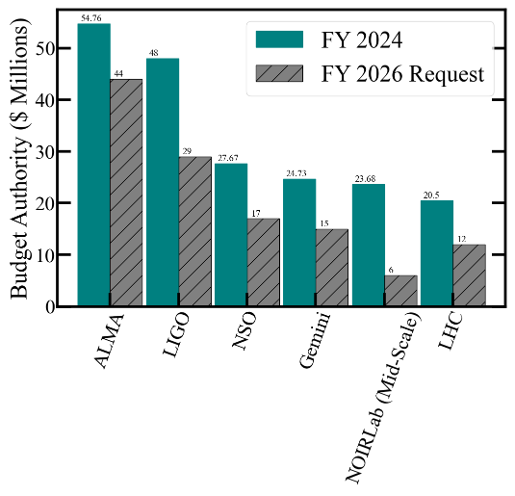
Many NSF observatories are run out of the National Optical-Infrared Astronomy Research Laboratory (NOIRLab), which faces huge cuts. The Gemini observatory has two locations, one in Hawaii and one in Chile, and has some of the most advanced optical and infrared ground-based telescopes, but this budget will reduce their operations to ~50% capacity. Access to Kitt Peak National Observatory (Arizona) and Cerro Tololo Inter-American Observatory (northern Chile), will be “phased-out”, with the NSF stating an intention of transferring ownership of these observatories to other agencies or academic institutions. These observatories are the foundation of many people’s entire research careers, covering topics ranging from exoplanet atmospheres to dark energy detection.
While the Vera C. Rubin observatory budget does go up relative to FY24 from 17.71 to 32 million dollars, this is because the observatory is transitioning into its operations phase and was anticipating a budget increase. However, the $32 million amount is a double-digit cut from what was expected from the NSF, representing yet another dangerous reduction for an observatory just entering the beginnings of its operations.
Call to Action
Overall, these proposed budgets represent the largest threat astrophysics research in the U.S. has ever seen. This will have huge impacts for those of us in the field, but cuts this extreme are bad for everyone. Astronomical research has practical benefits for society and creates many jobs that would be destroyed by these proposals. Astrophysics strives to answer some of humanity’s most fundamental questions, and provides a huge source of inspiration that brings many people into the sciences. This article discusses the many benefits of NASA science specifically more in-depth.
Plus, these budget requests don’t even make fiscal sense; NASA accounts for 0.36% of all federal spending, and the NSF only 0.1%, and these cuts will harm the economy by eliminating jobs and reducing the economic benefits agencies like NASA provide. While the current administration is trying to justify sweeping cuts like these because they will reduce the deficit, their “Big Beautiful Bill” is forecasted by some to add trillions to the deficit, making the cut of a few billion from NASA and NSF largely pointless. Suffice it to say these cuts are wasteful, tragic, and career-ending for many. They will damage a whole generation of scientists, provide no benefits to the economy, and severely weaken the U.S.’ position as a scientific powerhouse.
The good news is: these budget request documents are still just proposals. Congress will now write an Appropriations Bill, and this often looks quite different from the White House’s proposed budget. However, we need to make strong appeals to Congress to prevent these cuts from happening. The last section of this post contains a series of action items you can follow. The Planetary Society has created a petition that can be signed by anyone around the world to show support for NASA science. You can use this link to find emails for your representatives, or use 5 Calls to call their offices quickly and easily. We still have time to stand up for science in this country, but it requires advocacy from everyone, not just those of us in the field. If anything like this proposed budget is passed, it will devastate astronomy, not just in the U.S. but around the world. Join us in fighting for this field that we all love so much!
Note: This version was edited on June 4, 2025, with updated information on how the budget cuts would impact the Vera C. Rubin observatory provided to the author by a colleague.
Edited by: Lindsey Gordon, Storm Colloms, William Lamb, Bill Smith, Briley Lewis
Featured image credit: NSF/NASA

To Congress, please do not implement these cuts to NASA. They are extreme and Will limit considerably, our ability to continue space exploration as we have known it. We must remain the leaders in space