

Ananyo Bhattacharya
University of Michigan
This guest post was written by Ananyo Bhattacharya. Ananyo is a final-year doctoral student at the University of Michigan’s Department of Climate and Space Sciences and Engineering. His doctoral research focused on the analysis of Juno Microwave Radiometer observations to understand Jupiter’s atmosphere and aurora. He is originally from India, and he completed his undergraduate studies in Mechanical Engineering from SVNIT Surat. Beyond his academic research, he likes writing poems and traveling to experience different cultures.
Paper 1 Title: MWR: Microwave Radiometer for the Juno Mission to Jupiter
Authors: M.A. Janssen, J.E. Oswald, S.T. Brown, S. Gulkis, S.M. Levin, S.J. Bolton, M.D. Allison, S.K. Atreya, D. Gautier, A.P. Ingersoll, J.I. Lunine, G.S. Orton, T.C. Owen, P.G. Steffes, V. Adumitroaie, A. Bellotti, L.A. Jewell, C. Li, L. Li, S. Misra, F.A. Oyafuso, D. Santos-Costa, E. Sarkissian, R. Williamson, J.K. Arballo, A. Kitiyakara, A. Ulloa-Severino, J.C. Chen, F.W. Maiwald, A.S. Sahakian, P.J. Pingree, K.A. Lee, A.S. Mazer, R. Redick, R.E. Hodges, R.C. Hughes, G. Bedrosian, D.E. Dawson, W.A. Hatch, D.S. Russell, N.F. Chamberlain, M.S. Zawadski, B. Khayatian, B.R. Franklin, H.A. Conley, J.G. Kempenaar, M.S. Loo, E.T. Sunada, V. Vorperion and C.C. Wang
First Author Institution: Jet Propulsion Laboratory, California Institute of Technology, USA
Status: Published in Space Science Reviews [open access]
The Jupiter System
Jupiter is one of the most interesting celestial bodies in our night sky. It has a great cultural significance and has been a harbinger of scientific renaissance through the discovery and understanding of planetary satellites other than our Moon. Its immense internal heat continuously drives large-scale atmospheric circulation processes, which sometimes manifest as cyclonic features often imaged at visible wavelengths such as the Great Red Spot. A deeper understanding of Jupiter’s atmospheric composition and temperature provides us with valuable insights into its present-day atmospheric processes.
The distribution of both rock and ice-forming elements is essential to understanding Jupiter’s formation and evolution. For example, oxygen is stored as water that exists as liquid and ice clouds on Jupiter. The proportion of oxygen in Jupiter can be connected to its water ice inventory during planetary formation. As one goes radially away from a star in a protoplanetary disk, a frisbee-like accumulation of dust and gas from which planets are born, temperatures drop to levels where water condenses to form ice. Thus, an oxygen abundance greater than that of the Sun indicates the formation of Jupiter around the distance where the phase transition occurs in the disk, also known as the ice line.
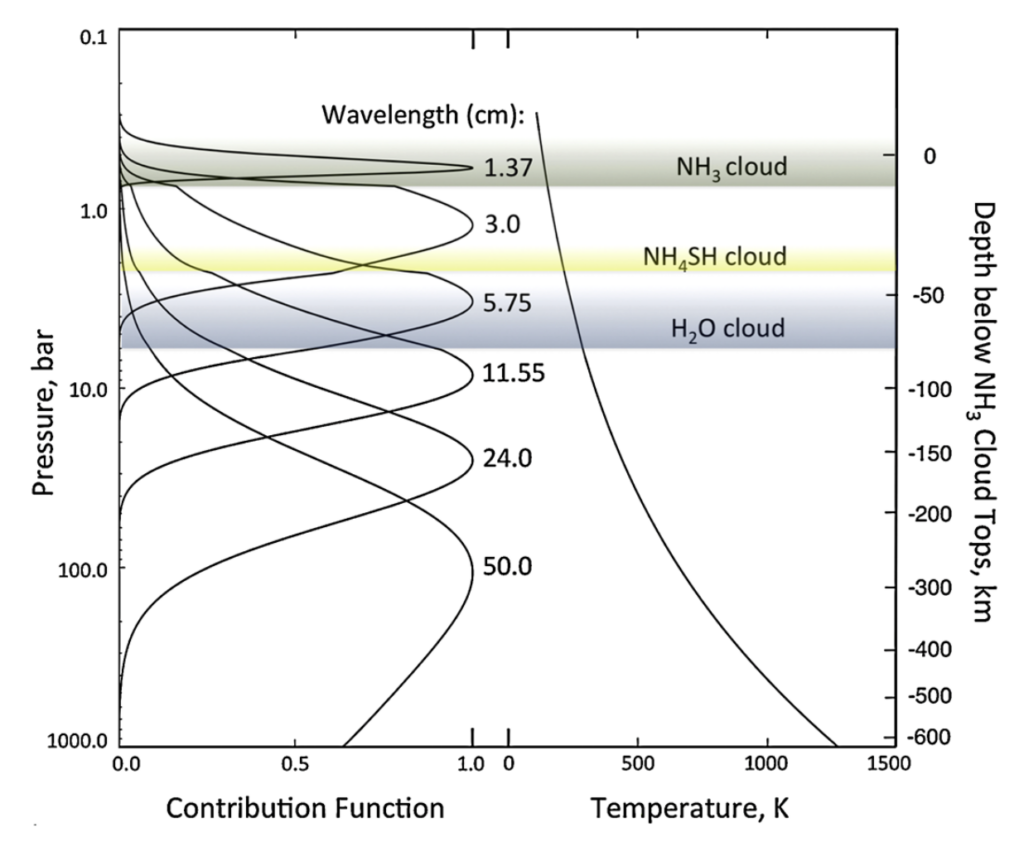
Earth-based radio telescope facilities like the Very Large Array telescope in New Mexico have applied radio interferometry to map the structures in Jupiter’s atmosphere. Each microwave frequency is sensitive to a given pressure region defined by its weighting function, which describes the atmospheric temperature and concentration of microwave opacity sources. Many atmospheric constituents of Jupiter, namely ammonia (NH3), hydrogen sulfide (H2S), phosphine (PH3), and water (H2O) provide absorption in the microwave spectrum, and thus the emanating atmospheric microwave emission allows one to probe the concentration of these absorbers according to the contribution function in Figure 1. However, Earth-based radio telescopes cannot probe at pressure levels deeper than 20 bar, as Jupiter has energetic electrons in its space environment that emit radiation at the same microwave frequency.
Juno Mission and Microwave Radiometer Instrument
Juno is a polar-orbiting spacecraft around Jupiter. It surveys the energetic electrons and ions in Jupiter’s magnetosphere to investigate the activity of Jovian satellites, polar aurora, and its connection to magnetosphere-ionosphere coupling. Juno has a Microwave Radiometer (MWR) instrument consisting of six different frequency bands from 0.6 to 22 GHz that probe the planet between 0.6 to 1000 bar i.e. 600 km deep into the atmosphere relative to ammonia clouds. As Juno spins during its orbit, the MWR instrument measures both the synchrotron radiation and atmospheric thermal emission from Jupiter. MWR measures brightness temperature, which represents the amount of radiation emitted by a black body at the same temperature. Here are some interesting scientific results from the MWR instrument:
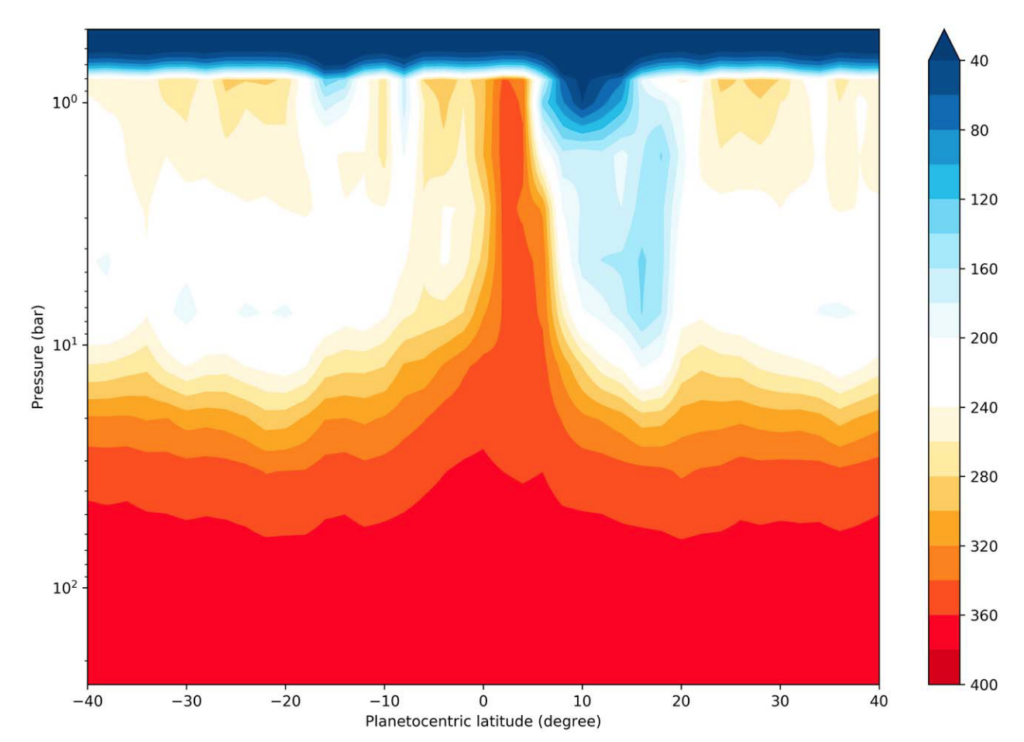
Processing the MWR data reveals a sharp gradient in ammonia mixing near the equator region, seen as the red protrusion in Figure 2, which shows the ammonia concentration inferred from Juno MWR as a function of pressure and planetocentric latitude. However, at deeper levels, there is uniform mixing [2]. The information about ammonia distribution has posed new questions about the mixing processes and microphysics of cloud particles in Jupiter’s weather layer.
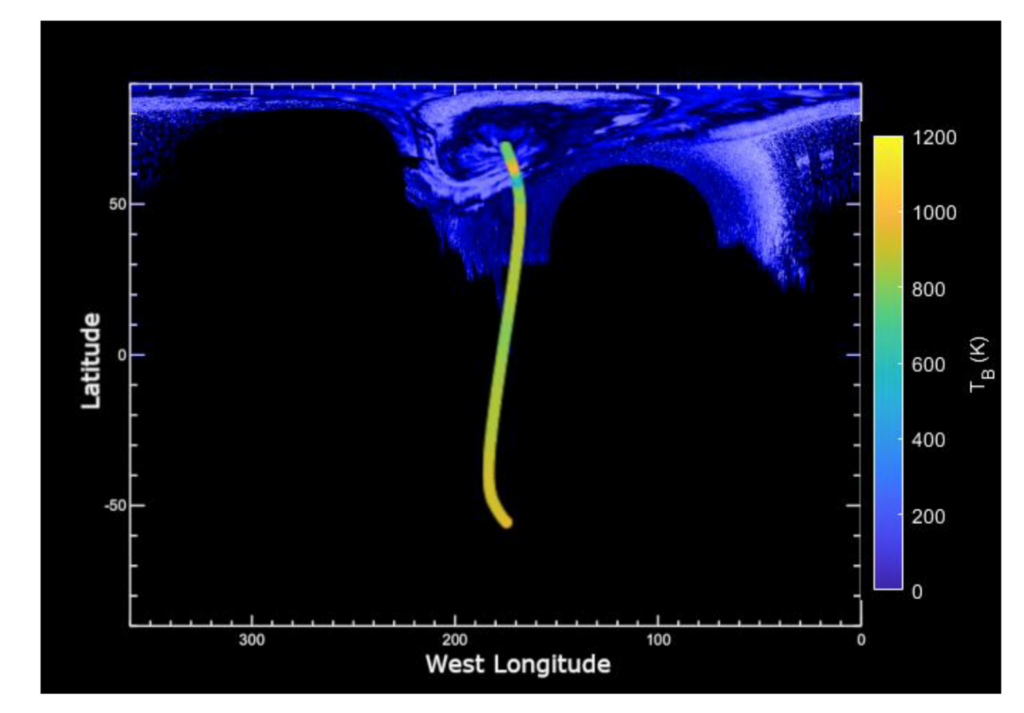
During the polar passes over the North Pole, MWR measured temperatures to be colder than atmospheric thermal emission. Generally, aurora or northern lights appear to be emissions much brighter or hotter than atmospheric thermal emissions. However, at microwave frequencies, ionospheric electrons absorb and reflect some of the atmospheric radiation to reduce the amount of microwave radiation escaping to outer space. Therefore, microwave instruments like the MWR observe these auroral regions to be colder than the background atmosphere. We know that these cold spots are due to aurora as they match with the ultraviolet emissions from the Northern Aurora of Jupiter as seen in Figure 3. A follow-up investigation reported MWR to observe certain cold spot features to vary every 10 – 30 seconds, connected to real-time changes in ionospheric electron densities at Jupiter’s aurora. Applying theoretical models of atmospheric chemistry, it can be concluded that atmospheric ionization and reactions involving electrons occur at fast time scales between 2 and 20 seconds [4].
Every orbit of Juno measures the synchrotron radiation at multiple wavelengths to provide insight into the distribution of electrons with speeds close to the speed of light in Jovian radiation belts [5]. The trajectory of Juno provides helpful information about the geometry of these radiation belts as it maps the radiation belts from both the inner and outer sides. Measurement of antenna temperature by Juno MWR reveals the presence of different regions of intense radiation emanating from radiation belts near the equator and high latitudes, as seen in Figure 4.

The MWR instrument observations indicate complex dynamic processes driving the mixing of ammonia in the atmosphere. The elemental inventories of oxygen [6], and alkali metals [7] provide new clues to the evolution of Jupiter. Microwave radiometry provides a complementary perspective on the energy balance and chemistry of Jupiter’s aurora. It captures the effects of high-energy electron precipitation at the poles, previously underestimated by theoretical models. Imaging the radiation belts through the mission also explains the influence of different plasma sources on Jupiter’s radiation belts. Moving forward, insights from these results will continue to shape our understanding of present-day physical and chemical processes in Jupiter. These lessons can be helpful to investigate other giant planets using a microwave radiometer on future space missions.
Astrobite edited by: Sonja Panjkov
Featured image credit: NASA Jet Propulsion Laboratory
References
[1] Janssen, M. A., J. E. Oswald, S. T. Brown, S. Gulkis, S. M. Levin, S. J. Bolton, M. D. Allison et al. “MWR: Microwave radiometer for the Juno mission to Jupiter.” Space Science Reviews 213 (2017): 139-185.
[2] Li, Cheng, Andrew Ingersoll, Michael Janssen, Steven Levin, Scott Bolton, Virgil Adumitroaie, Michael Allison et al. “The distribution of ammonia on Jupiter from a preliminary inversion of Juno microwave radiometer data.” Geophysical Research Letters 44, no. 11 (2017): 5317-5325.
[3] Hodges, Amorée, Paul Steffes, Amadeo Bellotti, J. Hunter Waite, Shannon Brown, Fabiano Oyafuso, Glenn Orton et al. “Observations and electron density retrievals of Jupiter’s discrete auroral arcs using the Juno Microwave Radiometer.” Journal of Geophysical Research: Planets 125, no. 9 (2020): e2019JE006293.
[4] Bhattacharya, Ananyo, J. Hunter Waite, Steven M. Levin, Fabiano A. Oyafuso, Paul G. Steffes, Yue Lu, G. Randall Gladstone et al. “Jupiter’s Auroral ionosphere: Juno Microwave Radiometer observations of energetic electron precipitation events.” Journal of Geophysical Research: Space Physics 130, no. 2 (2025): e2024JA033431.
[5] Santos‐Costa, D., V. Adumitroaie, A. Ingersoll, S. Gulkis, M. A. Janssen, S. M. Levin, F. Oyafuso et al. “First look at Jupiter’s synchrotron emission from Juno’s perspective.” Geophysical research letters 44, no. 17 (2017): 8676-8684.
[6] Li, Cheng, Andrew Ingersoll, Scott Bolton, Steven Levin, Michael Janssen, Sushil Atreya, Jonathan Lunine et al. “The water abundance in Jupiter’s equatorial zone.” Nature Astronomy 4, no. 6 (2020): 609-616.
[7] Bhattacharya, Ananyo, Cheng Li, Sushil K. Atreya, Paul G. Steffes, Steven M. Levin, Scott J. Bolton, Tristan Guillot et al. “Highly depleted alkali metals in Jupiter’s deep atmosphere.” The Astrophysical Journal Letters 952, no. 2 (2023): L27.
