
In this series of posts, we sit down with a few keynote speakers of the 246th AAS meeting to learn more about them and their research. You can see a full schedule of their talks here and read our other interviews here!
Massive stars often end their lives in a spectacular explosion that we observe as supernovae. These brilliant cosmic fireworks can briefly outshine entire galaxies, enrich the interstellar medium with heavy elements and even affect the process of star formation. Although supernovae strongly impact their surroundings, we still have a lot to learn about the explosion itself! What are the properties of the star that exploded? What are the mechanisms of the actual explosion? How does the outflowing material interact with the circumstellar medium (CSM)? These are just some of the questions that Dr Milisavljevic has been at the forefront of deciphering for more than a decade.
Danny Milisavljevic is an Associate Professor of Physics & Astronomy at Purdue University, where he leads a research group dedicated to studying astronomical transients, especially supernovae, in trying to understand their explosion mechanism and progenitor stars using a variety of observational and theoretical tools.
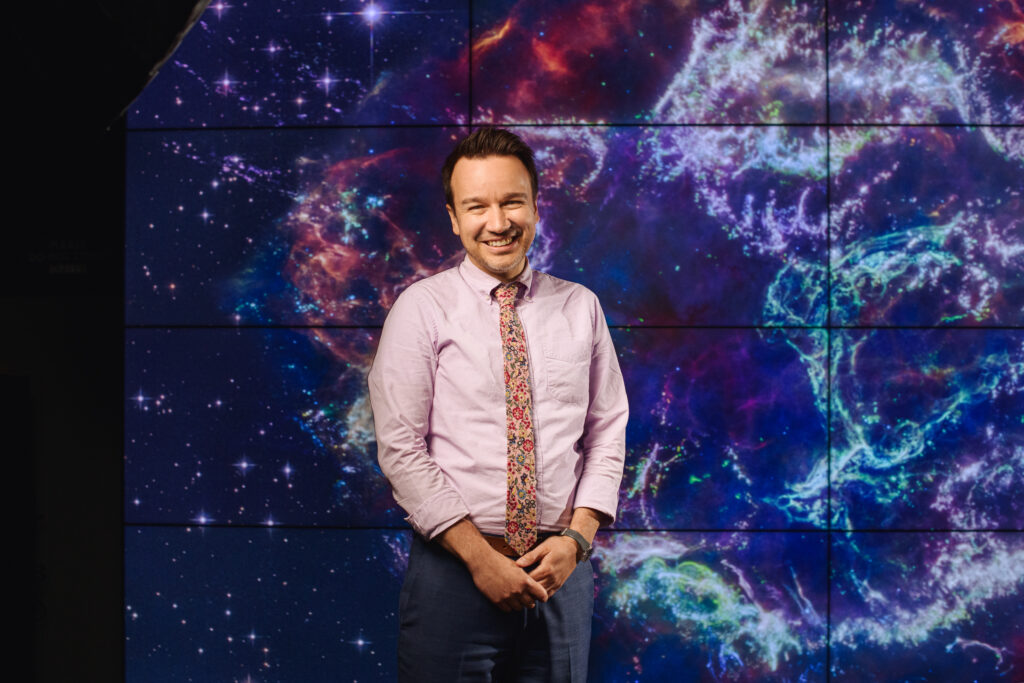
Growing up, Dr Milisavljevic had always been fascinated by things beyond our planet Earth. As an undergraduate student, he worked on a program to hunt for Kuiper Belt objects and moons around the outer planets, and even discovered and named the moon “Ferdinand” around Uranus! This was followed by a brief detour studying philosophy of science for his masters in London. Subsequently, Dr Milisavljevic joined the graduate program at Dartmouth College, where he dabbled in cosmology and condensed matter physics before being drawn towards studying supernovae. He fondly recalls his first observing experience at the 1.3 meter MDM telescope on Kitt Peak where they were looking at the location where a supernova had occurred 10 years ago. He says, “It reminded me of the first time I looked at a microscope. I prepared the slide and I saw bees wings with all this detail I’d never seen before. Now the microscope was pointed at the sky and I was seeing the universe like I’d never seen.” Dr Milisavljevic spent over 150 nights during his PhD observing supernova and supernova remnants, aiming to create three-dimensional reconstructions of these relics of stellar deaths to try and answer questions such as what type of star seeded the explosion, and what kind of environment did it run into?
During his postdoctoral stint at Harvard, Dr Milisavljevic switched gears to utilize the rich dataset of the many thousands of extragalactic supernovae that were being discovered every year. Although these unresolved point sources are quite unlike the high resolution images of galactic supernova remnants, the large sample size and fast discovery allows one to better constrain the characteristics of exploding stars, the physics of core-collapse, and even draw connections to the late time supernova remnants that we can study in detail in the nearby universe.
Interestingly, after starting a faculty position at Purdue, Dr Milisavljevic has put a foot back in the detailed study of supernova remnants, largely thanks to the power of JWST. “It turns out that the near-to-mid infrared has a lot of emission”, he said, while speaking about using the MIRI instrument to study the emission of ejecta interacting with the CSM in the supernova remnant Cassiopeia A.

Dr Milisavljevic and his group also play a leading role in developing an early warning system for supernovae (SNEWS) in alliance with neutrino observatories and amateur astronomers, so as to catch the rare event of a star exploding in our own galaxy as soon as possible, to better understand the immediate early time features of the explosion mechanism and the expanding shock that are severely unconstrained as of today.
Dr Milisavljevic is also a strong advocate for public outreach, and believes that as scientists funded by taxpayer money, it is our responsibility to share all the excitement behind the research that we do, as well as find ways to communicate it meaningfully for the general public. He says, “I think we’re lucky as astronomers because it’s space. It’s not that hard to get excited,” and that communicating results must go beyond press releases, whether it is through speaking at local schools or even retirement communities!
Advice for undergraduate and graduate students
Dr Milisavljevic feels that it is important to find what someone is interested in and do it to their best ability. Drawing from his past experiences, he says, “And so whether it was philosophy or astrophysics, I really pursued it with as much heart and dedication as possible to get the most reward out of it.” As he always tells his own students, it is important that whatever work they are doing is fun and enjoyable. Although there will be rough and frustrating days, it should be a net positive and the enthusiasm and enjoyment should not fade away.
Dr Milisavljevic’s plenary talk at AAS246 will delve deeper into what we have learned about the fascinating deaths of massive stars by studying their resultant supernova, both through multiwavelength observations of nearby supernova remnants, to the thousands of distant extragalactic supernovae being discovered each year (soon to be hundreds of thousands with the start of surveys such as LSST!).
To hear more about supernovae and their remnants, tune into Danny Milisavljevic’s Plenary Lecture at 4:40pm AKDT on Monday, June 9 at #AAS246!
Edited by: Margaret Verrico
Featured Image Credit: AAS
