
In this series of posts, we sit down with a few of the keynote speakers of the 246th AAS meeting to learn more about them and their research. You can see a full schedule of their talks here, and read our other interviews here!
At the heart of many galaxies lie powerful engines, supermassive black holes that can shape their host galaxies in surprising ways. When these black holes actively accrete matter, they become what astronomers call active galactic nuclei (AGNs), releasing enormous amounts of energy. This activity can drive outflows, streams of gas pushed outward into the galaxy, influencing star formation, gas dynamics, and ultimately how the galaxy evolves. But how do these outflows start, and why do they look so different from galaxy to galaxy?
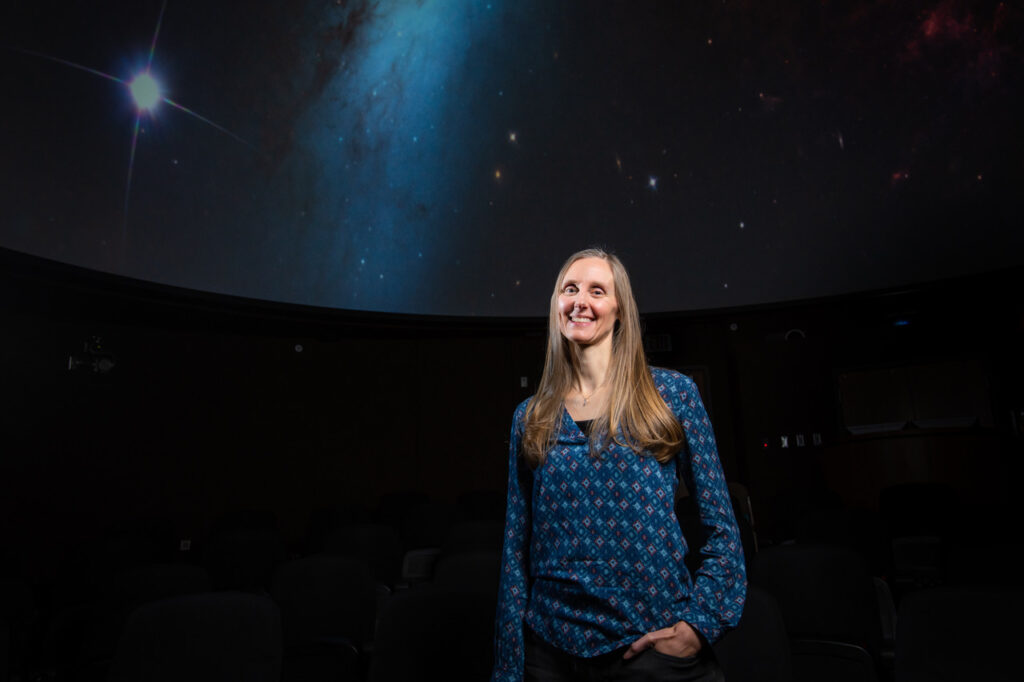
These are some of the questions that drive Dr. Erin Hicks, an professor at the University of Alaska Anchorage, whose research zooms in on the central regions of AGN-hosting galaxies to understand how black holes influence their neighborhoods. Ahead of her plenary talk at the 246th meeting of the American Astronomical Society (AAS), we spoke to Dr. Hicks about her career path, what excites her about her work, and the advice she has for young astronomers.
Astronomy captured her imagination early on, and never let go. “I honestly don’t remember wanting to be anything other than an astronomer,” she said, recalling how a childhood encounter with a neighbor’s telescope lit the spark. “I had the privilege of looking through a telescope at a very young age, and I was pretty much hooked from that point onward.”
Dr. Hicks path to studying AGNs and feedback wasn’t a straight line from the start. Early research experiences with stars and galaxies sparked a fascination with the big, open questions surrounding galaxy evolution. But it was a summer research project that truly steered her toward AGNs. “It had such big ramifications,” she said. The appeal? Digging deep into one corner of astrophysics, directly connecting to some of the universe’s biggest mysteries.
Today, Dr. Hicks research zeroes in on one of the most energetic and complex regions in a galaxy: the very center of an AGN, spanning just a few hundred parsecs. “I’ve focused a lot on understanding the dynamics of what’s happening in the central region,” she explained. A key goal is to uncover what triggers powerful outflows from these galactic cores and what physical processes are behind them. To do that, a single view won’t cut it. “We can’t just look, for example, at one gas phase and pretend we’ve answered it all,” she said. Instead, her work uses a multi-wavelength approach, probing cold, warm, and hot gas, as well as radio jets, to piece together how feedback works.
But uncovering what drives these outflows is only part of the puzzle; the bigger question is why they vary so much. “We recognise that every galaxy has a unique story,” Dr. Hicks said. That inconsistency suggests there’s more at play than just how bright or active the AGN appears. Understanding those underlying factors is crucial for grasping how feedback from AGNs truly influences the galaxies they live in.
Early work focused on one galaxy at a time, but as larger samples and better data became available, patterns grew more complex rather than clearer. However, recognizing that every galaxy tells its unique story has made it challenging to draw big-picture conclusions. Now, their work is shifting toward studying larger samples to tease out the common threads, what truly drives these dramatic processes across the population.
The James Webb Space Telescope (JWST) has opened a new chapter in the research on AGNs and outflows. “It’s been fantastic,” she said, primarily through their involvement in the GATOS collaboration, short for Galaxy Activity, Torus and Outflow Survey. The collaboration has secured observation time, giving them access to imaging and spectroscopy, revealing details never seen before. JWST’s sensitivity and range are allowing Dr. Hicks and her collaborators to study things like dust in polar regions and the heating of molecular gas. “We’ve been able to do science that we’ve been waiting to do… answering questions we haven’t been able to get answers for before.” And the best part? There’s still so much more to uncover.
Dr. Hicks shares that upcoming 30-meter-class telescopes like the ELT are especially promising, offering the power to zoom into galaxy centers with unprecedented detail. She also mentioned the Habitable Worlds Observatory, a mission in development that could open up high-resolution studies at wavelengths we’ve never explored in such detail before. Closer to the present, the field is already seeing the benefits of high-resolution observations from ALMA and interferometric tools like GRAVITY on the VLT.
Her advice for astrophysics undergraduates is to stay determined and not let challenges or others discourage them. She emphasized the importance of perseverance, believing in yourself, and advocating for your needs to succeed in the field. Regarding skills, coding is essential across nearly all areas of astronomy, so becoming comfortable with it is crucial. Additionally, communication and collaboration play a significant role, since research today often requires working with experts in different areas. Building good relationships and clearly sharing ideas are key skills for tackling complex problems.
She also encourages students to embrace taking risks, even when fear of failure makes it tempting to hold back. “Things are not going your way 100% of the time,” she explained, especially when writing telescope or funding proposals. Learning to roll with setbacks and try different approaches is part of the journey. That willingness to take chances often leads to the best opportunities.
In her plenary talk, she will present a new understanding of the obscuring structure at the centers of active galaxies. Instead of the old, simple “donut” model around the black hole, recent observations show that this structure is far more dynamic. It involves material flowing inward to feed the black hole and powerful outflows pushing back into the galaxy. She describes it as a cycle of inflows and outflows happening within this central region, which was once thought to be static. This evolving picture reveals that the structure is closely connected to the black hole’s feeding and its impact on the host galaxy, marking an exciting change in how we understand these cosmic powerhouses.
Despite all the progress, the core question of how AGN shape galaxies remains wide open. “We’re making progress, but there’s still so much we don’t know. And that’s what makes it fun.”
Learn about the evolving picture of AGNs at Dr. Erin Hicks Plenary Lecture on Tuesday, June 10, at 4:40 PM AKDT at AAS246!
Edited by: Maggie Verrico
Featured Image Credit: AAS
