
Welcome to the summer American Astronomical Society (AAS) meeting in Anchorage, AK! Astrobites is attending the conference as usual, and we will report highlights from each day here. You can also follow us on Bluesky at astrobites.bsky.social for more meeting content. We’ll be posting once a day during the meeting, so be sure to visit the site often to catch all the news!
Table of Contents:
- Laboratory Astrophysics Division Plenary Lecture: Icy Ocean Worlds, Europa Clipper, and the Search for a Second Genesis, William McKinnon (Washington University in St. Louis)
- Press Conference: Planets, Exoplanets, and Brown Dwarfs
- Plenary Lecture: The Missing Link: Planet Formation from Millions to Billions of Years, Meredith Hughes (Wesleyan University)
- Press Conference: New Views and Insights into the Sun and Its Surroundings
- Plenary Lecture: Exoplanets in Multi-Star Systems, David Ciardi (NASA Exoplanet Science Institute-Caltech-IPAC)
- Plenary Lecture: Unraveling AGN Feeding and Feedback: JWST, ALMA, and Integral Field Spectrometers to the Rescue, Erin Hicks (University of Alaska Anchorage)
- SPD Plenary: González Hernández Prize Lecture: Solar Connections: Reflecting and Leaning Forward, Holly R. Gilbert
Laboratory Astrophysics Division Plenary Lecture: Icy Ocean Worlds, Europa Clipper, and the Search for a Second Genesis, William McKinnon (Washington University in St. Louis)
In this talk, Dr. William McKinnon gave a detailed overview of the Europa Clipper mission and the science that is expected from this mission. The mission will fly by Europa, a moon of Jupiter. Dr. McKinnon started by comparing the Europa Clipper mission to the Cassini mission. The Cassini mission flew by Saturn during 2004–2017, learning about both Saturn and its many moons.
Europa is somewhat like a “smaller Earth,” with a large ocean and a cooler (~100 Kelvin) surface. JWST has found solid carbon dioxide on its surface. The clipper is meant to be a comprehensive mission that studies the ice, composition of the moon, and geology of the moon. Europa is expected to have many of the ingredients for life:
- Water | Europa has much more water than all of Earth’s oceans
- Essential elements | Elements like hydrogen, carbon, nitrogen, and oxygen would have been present from formation and were likely also added to Europa from impacts and collisions
- Chemical energy | Though the surface is likely too cold for life, there would be sources of energy both from Jupiter’s emission and from deep-sea vents.
Because Europa Clipper is meant to study many aspects of the physics of Europa, it has many instruments, as seen in Figure 1.

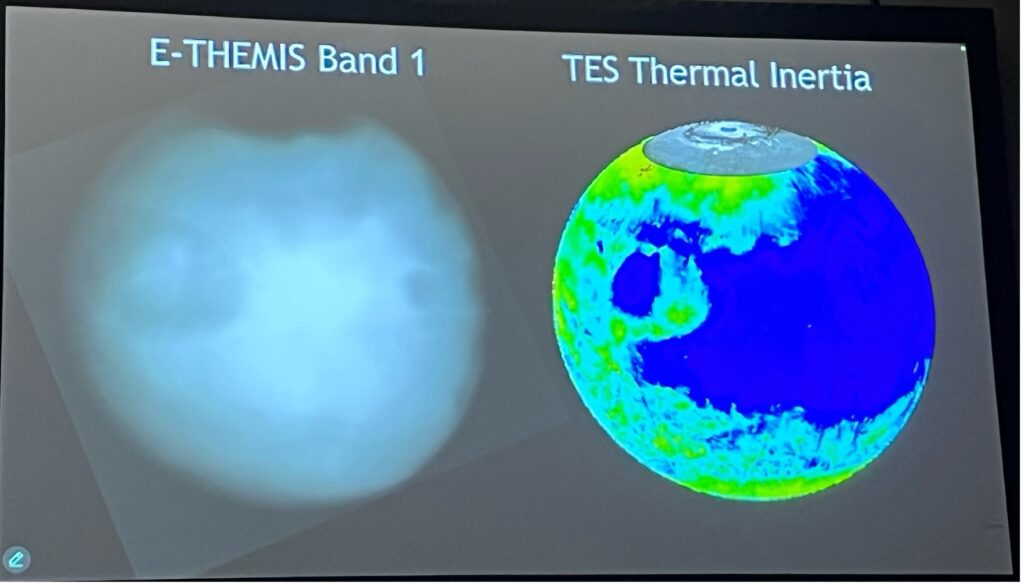
Dr. McKinnon then went on to describe the Clipper mission in detail. It launched in October 2024 and will enter Jupiter orbit in early 2031. During that period, it will orbit around Jupiter for several years. The Clipper already has flown past Mars and taken a thermal image of the surface of Mars (see Figure 2).
Dr. McKinnon also emphasized that at least two other missions will overlap with the Clipper while in Jupiter’s orbit. Both Juice, a European Space Agency mission, and Tianwen-4, a Chinese mission, will overlap in Jupiter orbit, potentially allowing for synergies in science.
Dr. McKinnon finished by emphasizing that planned future exploration of the Jupiter systems is going to be very exciting. Three of Jupiter’s moons, Europa, Ganymede, and Callisto, will in particular be well-studied by the three planned missions.
Press Conference: Planets, Exoplanets, and Brown Dwarfs (by Lexi Gault)
Revealing the Classical Uranian Satellites in Ultraviolet – Christian Soto (Space Telescope Science Institute)
With the Hubble Space Telescope, Christian Soto and collaborators obtained ultraviolet spectroscopy of four moons of Uranus — Ariel, Titania, Umbriel, and Oberon — to investigate how Uranus’s magnetosphere affects the surfaces of the moons. This system is particularly interesting to study because Uranus’s axis of rotation is tilted 98 degrees from the plane in which its moons orbit. This extreme tilt causes the magnetic field lines to sweep past the moons frequently, causing charged particles moving along the field lines to interact with the moons. Soto and team hypothesized that since these four moons are tidally locked, meaning that one side of the moon always faces Uranus (“leading” side) and the other always faces away (“trailing” side), interactions with the charged particles trapped in the magnetosphere would primarily hit the trailing sides, causing them to darken. However, their observations revealed that the leading sides of the two outer moons, Titania and Oberon, show evidence of darkening — the opposite of their hypothesis. Instead, the group suggests that dust from irregular satellites orbiting Uranus is hitting the leading sides of these moons, causing them to darken, and interactions with the magnetosphere are actually less influential than previously thought. Upcoming JWST observations of the system will help us to further understand this interesting result. The full press release can be found here.
Off-Polar Hint: Hottest-Star Sub-Saturn Obliquity – Emma Dugan (Indiana University)
The planets in our solar system orbit the Sun in the same direction that it spins, however, in many exoplanet systems, this is not always the case. In particular, Jupiter-mass planets orbiting hot stars tend to be misaligned, while Jupiters around cooler stars tend to be more well aligned. However, recent observations show that smaller sub-Saturn-type planets can be misaligned around cool stars, often with polar orbits — but few observations exist for sub-Saturns around hot stars, limiting our understanding of sub-Saturn formation. Aiming to add to the picture, Emma Dugan and collaborators investigated the spin–orbit alignment of the sub-Saturn TOI-1135 b, which orbits the hottest star with such measurements to date. Using observations obtained with NEID on the WIYN 3.5-meter telescope, the team found that TOI-1135 b has a near-polar orbit, unlike the polar orbits of sub-Saturns around cooler stars. This observation suggests that sub-Saturns orbiting cooler stars may be more misaligned than sub-Saturns orbiting hot stars, the opposite of what is observed for Jupiter-mass planets. Further observations of sub-Saturns will aid in filling out this dataset and understanding the formation mechanism governing sub-Saturns.
JWST Coronagraphic Images of 14 Her c: a Cold Giant Planet in a Dynamically Hot, Multi-Planet System – William Balmer (Johns Hopkins University) & Mark Giovinazzi (Amherst College)
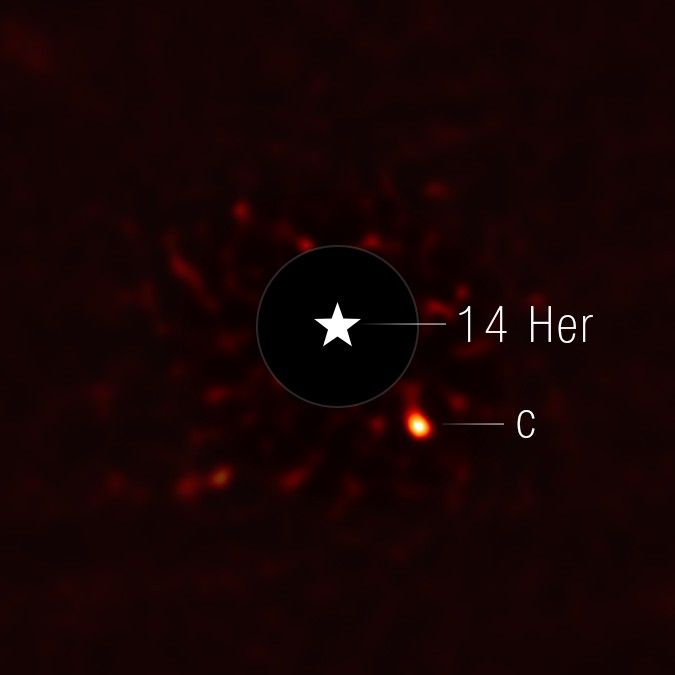
When studying exoplanets, astronomers want to understand how planetary systems form and evolve over time. One of the best ways to understand and characterize exoplanets is through directly imaging them, but this is a difficult task when these planets, especially cold ones, are so faint next to their host stars, hidden within the overpowering bright stellar light. However, with JWST’s great sensitivity to longer wavelengths where cold planets appear brighter, direct imaging becomes a possibility. William Balmer and Mark Giovinazzi presented the first JWST direct image of the cold giant planet 14 Her c, which was one of two planets previously detected through radial velocity measurements of the system. Their observations reveal that 14 Her c was fainter than anticipated based on modeling, which is likely due to updrafts and water-ice clouds in its atmosphere. Additionally, the team refit the orbits of the two planets and determined that 14 Her c was likely scattered out to its current, far-out orbit due to dynamics and interactions with the other planet in the system. See the full press release here.
Detailed JWST Observations of a Multi-Planet System Around a Sun-Like Star – Kielan Hoch (Space Telescope Science Institute)
YSES-1 is an exoplanetary system with multiple planets orbiting a young Sun-like star, only ~16 million years old, that was originally directly imaged in the Young Suns Exoplanet Survey. This system is interesting because it has two planets that are both orbiting very far from the central star — YSES-1 b at 160 times the distance of Earth to the Sun and YSES-1 c at 320 times the distance of Earth to the Sun. With the launch of JWST, Kielan Hoch and her collaborators wanted to directly image these planets again with the high-resolution spectroscopy and imaging of JWST. From their observations, the team was able to detect different molecules in the atmospheres of the two planets. For YSES-1 c, the spectra show evidence of silicate clouds in its atmosphere, demonstrating the strongest absorption feature observed in an exoplanet to date. For YSES-1 b, the team observed a disk around the planet that is likely material that will feed onto the planet. However, such disk-like features are typically only present for planets younger than YSES-1 b, so the team suggests that this may be a second-generation disk of material that is involved in forming a moon. Further observations and modeling will reveal more information and clues into the formation history of these planets. See the full press release here.
Plenary Lecture: The Missing Link: Planet Formation from Millions to Billions of Years, Meredith Hughes (Wesleyan University) (by Karthik Yadavalli)
In her talk, Dr. Meredith Hughes (Wesleyan University) presented results from the ALMA survey to resolve exoKuiper belt structure (ARKS). She started by emphasizing how rapidly the field of exoplanet observations has evolved in the past two decades, and that we now know that on average every star in the galaxy likely has at least one planet. As such, it is now possible to ask detailed questions about how planets are formed around stars. When a star forms from a large dust cloud, a protoplanetary disk also forms alongside it. Planets will eventually form in this disk. Protoplanetary disks only last about ~10 million years after the star forms, whereas the planets we detect are expected to have ages of ~billions of years. As such, the evolution stages in between the protoplanetary disk and the full-fledged planet have not been observationally mapped out.
Dr. Hughes focuses on trying to find systems that are in between these two stages. With ALMA, Dr. Hughes has been able to take very detailed images of the “debris disk”, the intermediate stage between the protoplanetary disk and fully-formed planets. The Solar System’s Kuiper Belt is the analog of a debris disk. ALMA is now sensitive enough to take detailed images of debris disks. In particular, the ARKS survey has obtained 18 new high-resolution observations of previously not observed debris disks.
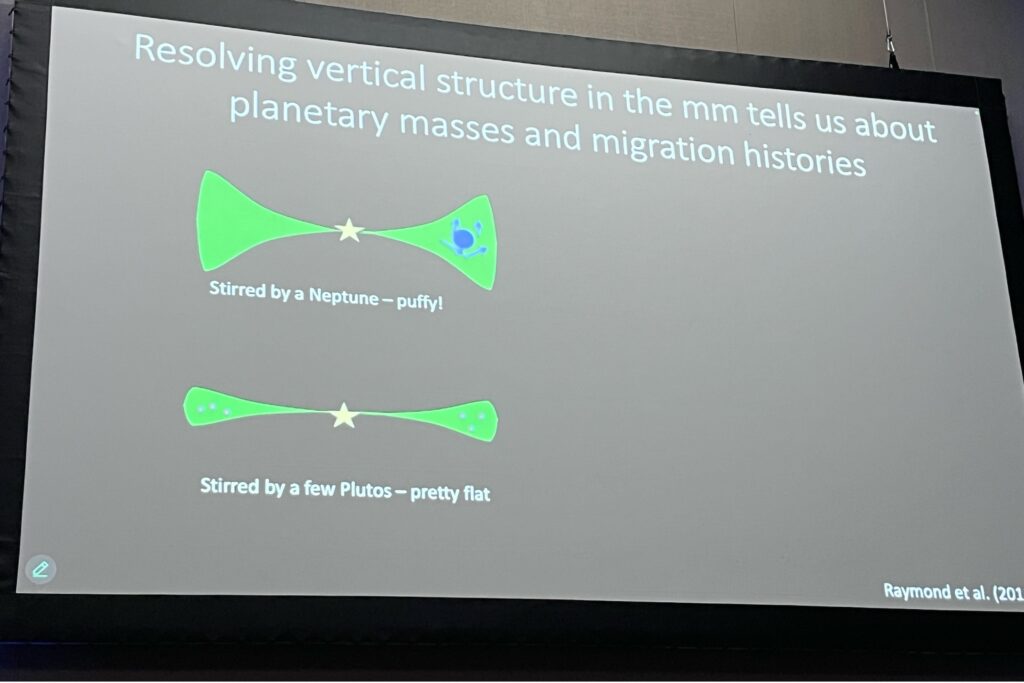
Dr. Hughes went into detail about three findings about the debris disks from the ARKS survey: 1) finding substructure, 2) studying the vertical extent of debris disks (see Figure 1), and 3) finding gas content in the debris disks. With the increased sensitivity of the ARKS survey, much more substructure of debris disks is visible. Sensitivity to substructure allows for detailed study specifically of planet-disk interactions. Studying the vertical extent of debris disks allows for better constraints on the mass of the observed planet.
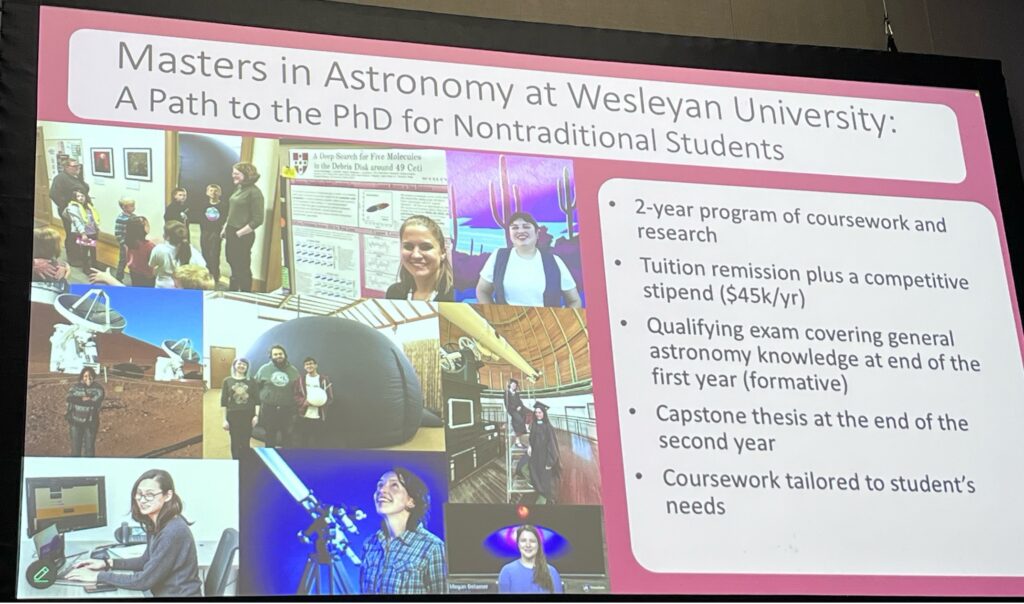
Dr. Hughes concluded by briefly describing the institution at which she works, Wesleyan University. Wesleyan is primarily an undergraduate institution and therefore the research at the university is primarily done by younger students, rather than by postdocs and PhD students. It also offers a path to an Astronomy PhD for nontraditional students, including those who have not started their academic careers in Astronomy (see Figure 2).
Press Conference: New Views and Insights into the Sun and Its Surroundings (by Lucas Brown)
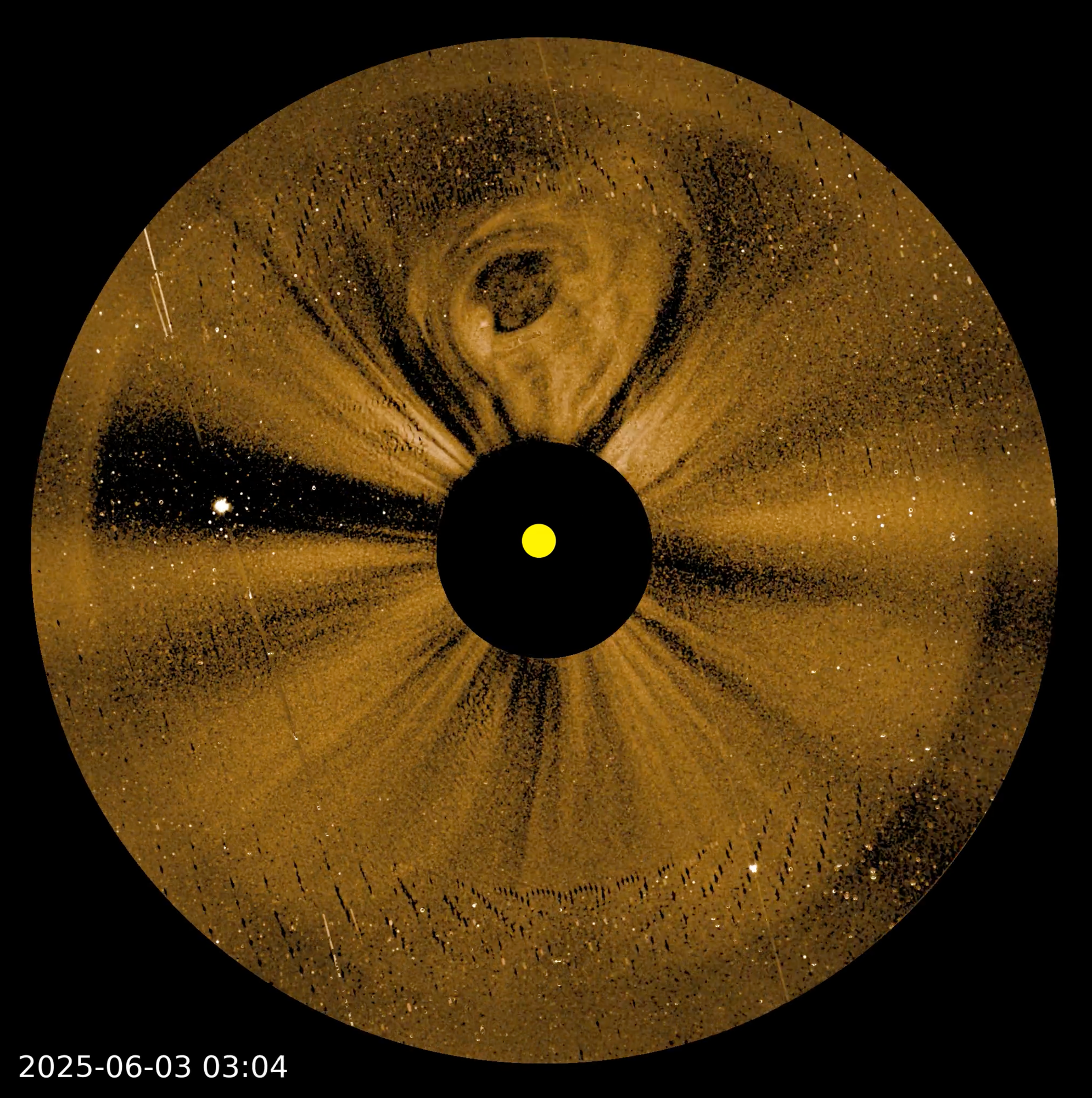
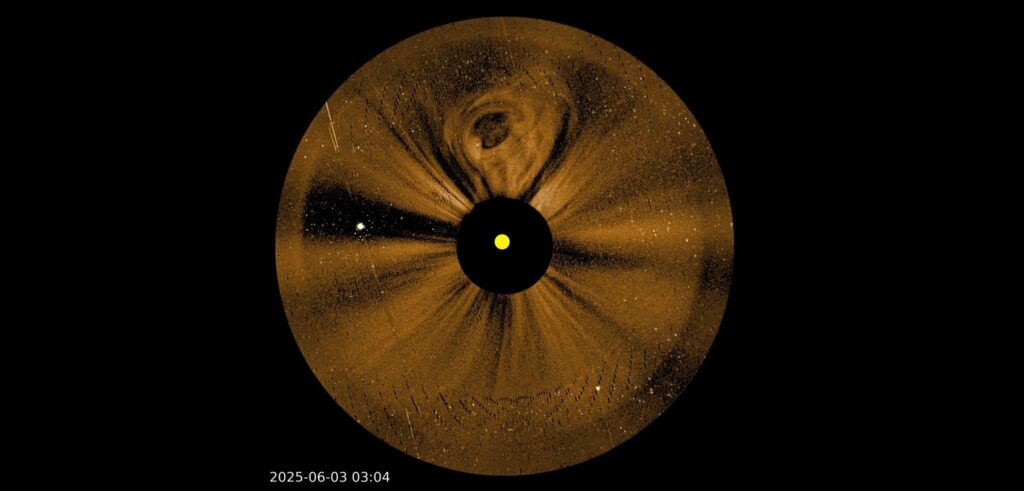
Our second press conference of Day 2 was all about the sun—from the dynamics right at its surface to the solar corona and all the way out into deep interplanetary space. First up, we heard “Polarimeter to Unify the Corona and Heliosphere (PUNCH): Mission Overview and First Light” from Craig DeForest of the Southwest Research Institute. This briefing provided updates on the PUNCH mission which launched in March of this year. DeForest described the mission as providing a look at “space weather like you’ve never seen before,” referring to the mission’s unique capability of observing the corona and solar wind across a whopping 90 degree field of view. The mission accomplishes this by pulling from data across four satellites evenly spaced throughout a polar orbit oriented to enable constant views of the sun. While the mission is still in the commissioning phase and the satellites have not reached their final configuration, DeForest was able to show some amazing preliminary video footage compiled from the satellites for the very first time. The video demonstrated the mission’s ability to track solar coronal behavior from very close to the sun all the way out to Earth—and to produce some incredible footage of space weather like no one has ever seen before! The full press release can be found here.
Second, in “The Coronal Diagnostic Experiment (CODEX): First Light” Nicholeen Viall of NASA Goddard Space Flight Center presented on another new solar physics experiment that has recently been initiated. Whereas PUNCH focused on achieving a wide field of view of the sun, Viall explained that CODEX is all about getting up close and personal with the dynamics of the corona closer near the solar surface. The experiment is mounted on the International Space Station and uses occulting disks to create an artificial eclipse, blocking out light from the disk of the sun in order to view the corona. CODEX features numerous innovative technologies which allow it to measure temperatures and velocities of coronal material better than previous experiments, which will hopefully improve our understanding of the intricate dynamics and flow of energy that occurs within the solar corona. The full press release can be found here.
Third, we heard a briefing on “Cracking the Solar Code: Hybrid Machine Learning for Predicting Hemispheric Bursts and Cycle Trends” given by Juie Shetye of New Mexico State University & Armagh Observatory and Planetarium and Mausumi Dikpati of High Altitude Observatory/NSF-NCAR. Their work focuses on trying to employ mathematical modeling, statistics, and machine learning methods to better predict individual “bursts” of solar activity. Whereas solar cycles are periodic and fairly predictable, understanding when solar activity is going to suddenly rise on short timescales to produce things like coronal mass ejections is very difficult. Their team hopes that through synthesizing physics-informed models and advanced machine learning techniques, they can improve our ability to predict these events and therefore minimize the damage they cause here on Earth.

Continuing the theme of predicting solar behavior, our final presentation of the day was “A Near-Real-Time Data-Assimilative Model of the Solar Corona” given by Jon Linker of Predictive Science Inc. Linker spoke about the work his team has been doing to work towards solar corona models that are informed by near real-time solar observations. They used custom magnetohydrodynamics code which, informed by real measurements of the sun’s magnetic field, can model the behavior of magnetic field lines in different regions of the sun and subsequently predict the general structure of the corona and its evolution through time. The team demonstrated their model’s capabilities by running it with real-time input for 32 days leading up to the April 2024 total solar eclipse and showing that they were indeed able to predict many of the overall features of the corona during totality. Linker hopes that this sort of modeling will become more common, mirroring how weather prediction on Earth relies on real-time data inputs from satellites.
Plenary Lecture: Exoplanets in Multi-Star Systems, David Ciardi (NASA Exoplanet Science Institute-Caltech-IPAC) (by Kerry Hensley)
The first of three back-to-back plenary sessions was given by David Ciardi, the deputy director of the NASA Exoplanet Science Institute. Ciardi described what we’ve learned about the properties of planets in multi-star systems and compared them to single-star systems.
Though our solar system contains only one star, many stars have companions: essentially all stars with spectral types O, B, and A have companions, as do 50% of F, G, and K stars and 25% of M stars. On average, every star also has a planet, which means that a rather large number of planets must occupy systems with more than one star.
As Ciardi explained, the presence of stellar companions affects how we detect and characterize planets. Many exoplanets are discovered via the transit method, in which a planet blocks some of the light from its host star as seen from our perspective. If the host star has an unknown companion, the planet radius derived from the transit method can be underestimated by a factor of two or more — and the planet might even orbit the unseen star instead of the star that’s being studied!
Using transit fitting, researchers have developed ways to determine which star in a binary or multiple system a planet is orbiting. These methods suggest that most planets orbit the primary star in the system. This is likely a result of observational bias, because primary stars are typically brighter, and it’s easier to detect a planet around a brighter star. However, a nonzero fraction of planets have been found to orbit the secondary stars of their systems, with more waiting to be found.
In terms of how binarity affects the likelihood of a star hosting planets, studies have shown that roughly 20% of single stars host giant planets, compared to just 10–12% of binary stars. However, wide binaries (orbital separations greater than 100 AU) host giant planets at essentially the same rate as single stars, while close binaries host giant planets at a greatly reduced rate. In contrast, research suggests that wide and close binaries might host small planets at approximately the same rate.
Researchers have also discovered a small but growing number of planets in extremely close binary systems that are orbiting both stars at once. Estimates suggest that 10–40% of close binaries might have circumbinary planets, but this number is still uncertain. Recent findings suggest that essentially all of these systems are aligned, with the orbit of the planet in the same plane as the orbits of the stars.
Finally, Ciardi noted that while finding small planets is already difficult, the presence of a stellar companion makes it even more difficult. Research shows that we’re likely sensitive to only about 50% of Neptune-size planets in binary systems and scarcely any Earth-size planets. Combining this information with existing observations suggests that there are likely 10–30% more small planets in our galaxy than previous estimates that don’t account for binarity have suggested.
Plenary Lecture: Unraveling AGN Feeding and Feedback: JWST, ALMA, and Integral Field Spectrometers to the Rescue, Erin Hicks (University of Alaska Anchorage) (by Maggie Verrico)
Professor Erin Hicks from the University of Alaska Anchorage gave the second plenary talk of the session. She highlighted several recent results by the Galaxy Activity, Torus, and Outflow Survey (GATOS) collaboration on AGN fueling and feedback mechanisms that were made possible by high-resolution instruments like ALMA and JWST.
We think all massive galaxies host central supermassive black holes, some of which are actively accreting material—so-called “active galactic nuclei,” or AGN. These AGN are connected to their host galaxies by a complex fueling structure that funnels gas in the galaxy down to the supermassive black hole’s accretion disk. Under the “unified theory of AGN,” that accretion disk is surrounded by a donut-shaped structure called the “dusty torus” that can obstruct certain sightlines toward the AGN. Professor Hicks’ work has been to complicate our model of the dusty torus; instead of a small, donut-shaped dusty structure, the work she highlighted has revealed that the torus is a large and dynamically complex interface between the AGN and the nucleus of its host galaxy. She emphasized the importance of the torus as both a site of AGN fueling by gas inflows and where AGN feedback drives gas outflows that can have a huge impact on the AGN host.
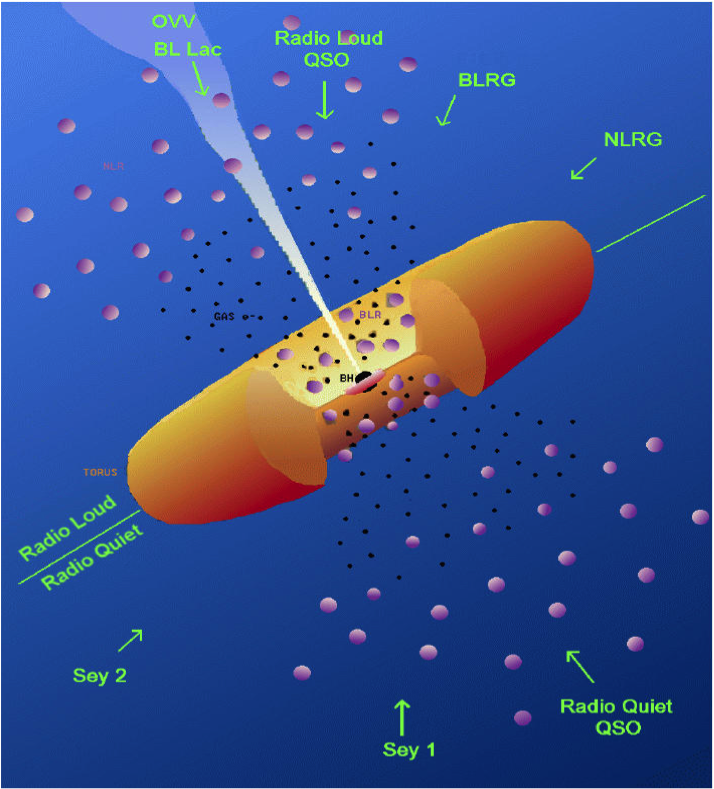
Professor Hicks first highlighted several studies of individual AGN hosts in the nearby Universe to demonstrate that AGN can have very different relationships with their host galaxies, even when they are similar in luminosity. In particular, she discussed how the relative orientation between the AGN torus and the host galaxy is crucial for understanding AGN feedback. When the AGN torus is aligned with the host galaxy, the AGN drives outflows perpendicular to the plane of the galactic disk, sometimes inducing star formation outside the galactic disk (so-called “positive AGN feedback”; seen in this work by GATOS collaborator Laura Hermosa Muñoz). On the other hand, when the torus is perpendicular to the plane of the disk, the AGN drives outflows that deplete the molecular gas in the central region of the galaxy. In theory, this should drive “negative AGN feedback,” a process by which the AGN limits star formation in its host.
Professor Hicks hinted at future work regarding this AGN-host galaxy coupling, particularly in finding ways to test how well-coupled the AGN system is with the host galaxy molecular gas reservoir. She highlighted a recently submitted work by her graduate student Lulu Zhang studying different ionized emission lines as a tracer of the chemical and physical qualities of gas in the nucleus around AGN. She also discussed the need for population studies that can reveal larger patterns in AGN behavior, like this paper by Santiago Garcia-Burillo that uses decades of ALMA observations to find evidence of AGN feedback in the central 50 parsecs of high-luminosity AGN hosts. These high-resolution datasets will be crucial for understanding the complex relationship between AGN, their dusty tori, and the galaxies in which they live.
SPD Plenary: González Hernández Prize Lecture: Solar Connections: Reflecting and Leaning Forward, Holly R. Gilbert (by Lexi Gault)
Dr. Holly R. Gilbert was awarded the inaugural Irene González Hernández Prize, which recognizes mid-career scientists for their outstanding contributions to the field of solar physics. This award, as Dr. Gilbert began her talk acknowledging, honors the memory of Irene González Hernández, a solar physicist remembered for her significant contributions and dedication to the solar physics community.
Following this recognition, Dr. Gilbert provided an overview of her career path that she fondly referred to as a “random walk.” Having originally planned to become a concert cellist, Gilbert was drawn to astronomy and decided to pursue a career as a solar physicist. Interested and inspired by images of the Sun, she wanted to understand how it worked and what mechanisms were behind this extremely close star.
In particular, Dr. Gilbert was interested in understanding how prominences worked. Solar prominences are bright filaments of material extending from the surface of the Sun into the corona that follow along the Sun’s magnetic field. During the earlier stages of her career, she used observations of solar prominences to guide new physical insights about these features. Along with collaborators, Gilbert modeled and measured the mass of material involved in observed prominences, finding that down flow of neutral hydrogen and helium leads to mass loss within the structures. These processes can impact the evolution of prominences and show that the Sun’s magnetic field governs interactions of the solar surface and in the corona.
From here, Dr. Gilbert discussed the importance of continuing to study the Sun’s magnetic field and how understanding the corona and solar surface will allow for better predictions and monitoring of solar weather. She highlighted a number of proposed missions including the Chromospheric Magnetism Explorer (CMEx), the Coronal Solar Magnetism Observatory (COSMO), and the Next Generation Global Oscillations Network Group (ngGONG), which would all aid in understanding space weather, unlocking huge discoveries and advancing the field of solar physics. However, Gilbert acknowledged that looking toward the future in the current climate is hard. All of these planned missions and hopes for advanced science are at risk, but she charged the community to stay resilient and work together in order to continue doing the impactful and critical science we are passionate about.
