
In this series of posts, we sit down with a few of the keynote speakers of the 246th AAS meeting to learn more about them and their research. You can see a full schedule of their talks here, and read our other interviews here!
At the 246th meeting of the American Astronomical Society in Anchorage, Alaska, the Historical Astronomy Division is honoring Dr. Seb Falk, a historian of medieval science at Girton College, Cambridge, has won the 2025 Donald E. Osterbrock Book Prize for his popular book “The Light Ages: The Surprising Story of Medieval Science”. In it, he tells the story of John of Westwyk, a 14th-century monk who was also an astronomer, showing how ideas in astronomy, math, and engineering thrived in medieval monasteries. Ahead of his plenary talk, we spoke with Dr. Falk about his academic journey, the thrill of archival discoveries, and what today’s students and scientists can learn from the long arc of astronomical history.
Thinking About Thinking
While teaching history and a subject called “Theory of Knowledge” in Canada, he started thinking deeply about big questions: How do we know what we know? What makes something a reliable explanation in science or history?. “How is a drug approved in medicine, versus how does a theory become widely accepted in astronomy? These are different kinds of questions. That really interested me.” Curious to explore these ideas further, he returned to the UK and signed up for a master’s degree in the history and philosophy of science, a field that brought together his interest in science, his love of history, and his passion for understanding how knowledge is built.
He enjoyed it so much that he stayed on to do a PhD at Cambridge, where he focused on how scientific ideas developed in medieval Europe. What fascinated him most was how ideas traveled between cultures. “We find Christian scholars learning from Jews and Muslims, as well as from India and even China,” he explains.
Now, Dr. Falk shares that historical perspective with scientists, hoping to help them think more clearly about their own work. He believes the way we talk about science can shape how it develops. “When people used to compare the brain to a pump, or later a battery, and now a computer, that’s not just a metaphor,” he says. “It actually changes how we understand the brain.” In today’s world, where misinformation spreads easily and new technologies like AI rapidly change how we interact with information, Dr. Falk sees history as more relevant than ever. “In the world that we live in, the world of fake news and AI, it’s so important to develop those critical thinking skills,” he says. For Dr. Falk, history isn’t just about the past; it’s a tool that helps us ask better questions and think more carefully about the present.
Regarding his current research, Dr. Falk asks big-picture questions about how people learn and use science: not just how discoveries happen, but how knowledge spreads and takes root. “I’m particularly interested in how people learn to do different kinds of science and how they practice those skills,” he says. Rather than focusing only on breakthroughs, Dr. Falk is curious about why some techniques became widely used while others didn’t, and how long it took for certain ideas to gain acceptance.
He also digs into what motivated people to study science in the first place. Were they hoping to earn money, seeking religious fulfillment, or simply driven by curiosity? Dr. Falk’s work explores how people have always juggled different reasons for asking questions about the world, and how those reasons shaped what they discovered.
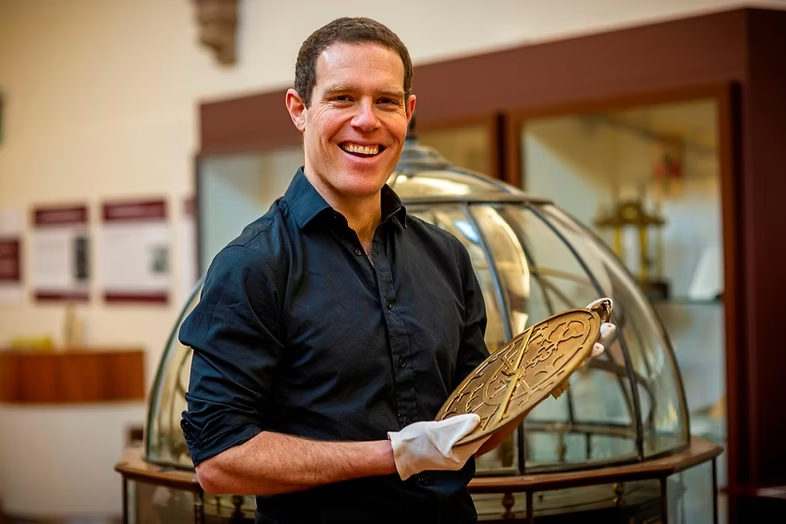
For Dr. Falk, the magic of astronomical instruments isn’t just in their craftsmanship; it’s in what they reveal about how people once saw the world. Holding a centuries-old instrument lets him step into the mindset of someone from a completely different time, someone who might be using it to tell the time, track the planets, or figure out when to pray. What fascinates him is that even though these tools were built within a geocentric worldview, many still work, but they asked different questions in the past.
Dr. Falk lights up when he talks about the physical experience of interacting with the past: touching a 1000-year-old instrument, flipping through a handwritten book made from animal skin, or finding doodles left by students hundreds of years ago. These objects remind him that science isn’t just about abstract ideas but real people. “If you think of the history of science just as theories, it’s so boring,” he laughs. “But when you see the people behind it, it comes alive.”
Lighting up the Dark Ages
What inspired Dr. Falk to write his book was the idea that history lovers should also be curious about the history of science. After all, science has always been a part of what people in the past did. While working on his Ph.D., he realized he had some fascinating stories to share about the Middle Ages, a period that many people, even history enthusiasts, often misunderstand. For example, the myth that everyone in the Middle Ages thought the Earth was flat is false. Dr Falk wanted to challenge several common myths about the history of science. One big misconception is that science advances mainly through a handful of genius individuals, usually men, who make breakthroughs, while everyone else follows. In reality, science has always been a collaborative effort, shaped by working communities. Sometimes science even takes a step backward or explores unexpected paths before moving forward.
His goal was to show that the Dark Middle Ages was actually a time of impressive scientific progress; that what we might think of as “errors” or “misunderstandings” can be interesting and important; and that the history of science is full of contributions from many people, not just the famous names like Leonardo da Vinci or Galileo, but countless others who played their parts in small and big ways.
One of the biggest challenges in writing the book was balancing the technical details of the science with making it accessible to a general audience. Some books claim past science was impressive, but don’t explain why or how. Others dive deep into technical details, but it can be hard for non-experts to follow. To solve this, Dr. Falk made the book technical enough so readers could understand what made the scientific advances special and different from what came before, while also being approachable. A key strategy was to frame the story as a biography of a medieval monk: not a famous genius, but an everyday figure about whom we know little. This choice gave the book a personal narrative, making the history come alive.
Say yes, say no!
Dr. Falk advises young researchers to slow down and not rush through life or studies. He suggests students explore different opportunities, even if they don’t seem like a perfect fit right now. Sometimes the best paths come from saying “yes” to unexpected chances. This isn’t a setback, but a valuable experience that brought new perspectives. He also encourages students to gain experience outside the lab or classroom. Taking a year or two to figure out what you want is worth it, especially since careers today are longer and more flexible than in the past.
At the same time, Dr. Falk emphasizes the importance of learning to say “no.” Graduate students especially need to protect their time and energy, focusing on what truly matters to them instead of trying to please everyone else.
Another key piece of advice is to share your work beyond just the scientific community. Dr. Falk notes that brilliant research won’t automatically reach or engage people outside your field unless you actively communicate why it matters. Universities often have press offices and communication teams to help with this, so use those resources! Explaining your research in a clear, accessible way is a skill as important as doing the research itself.
Finally, Dr. Falk highlights the value of talking to people in other disciplines. At Cambridge, the college system encourages interactions with scholars from many fields, and he says some of his best ideas have come from conversations outside astronomy and history. Real interdisciplinarity, where experts from different areas learn from each other and find common ground, is rare but powerful. For students and researchers, being open to diverse perspectives can spark creativity and lead to exciting new directions.
Dr. Falk will explore the fascinating connections between astronomy and navigation throughout history in his upcoming plenary talk. It sits at the intersection of Dr. Falk’s award-winning book and their upcoming one. The focus will be on how astronomy has played a crucial role in navigation and, more broadly, in shaping how humans understand their place on Earth. For example, the concepts of latitude and longitude, fundamental to locating ourselves, are actually based on astronomical observations. The talk will cover the historical development of these ideas, how people figured them out, and how this knowledge was shared across cultures and generations. It promises to shed light on the deep roots of astronomy in everyday life and exploration.
Tune into Dr Seb Falk’s Plenary talk on 11th June 2025 at 3:40 PM AKDT at AAS246, where he reveals the historic ties between stars, navigation, and our understanding of the world.
Edited by: Maggie Verrico
Featured Image Credit: AAS
