
Paper / source list is at the bottom of this post.
Artificial intelligence (AI) is everywhere now, whether we want it or not. Its role in both science and commercial applications is growing, with over $350 billion USD invested in AI. In weather and climate modeling, applications of AI are producing better, faster models that will have real impacts on our ability to predict and prepare for catastrophic weather events. On the other hand, the power usage by AI is enormous, with negative environmental impacts, which will make those good climate models all the more important.
Predicting the weather has always been essential, but as our planet warms, climate events are only getting more extreme. It’s no surprise that many major organizations, from the EU’s Destin-E project to the US’s NOAA Earth Observations to NVIDIA’s Earth-2, are working towards better models. Powering these new climate simulations? High performance computing, GPUs, large volumes of data, and AI models [0].
So, what’s the difference between climate and weather? Research typically defines climate as global-scale systems and weather as local-scale systems. What defines scale as “local” depends on the model. For reference, every order of magnitude in scale (i.e., 100 km scale down to 10 km scale) takes an additional three orders of magnitude in computer processing time – a thousand times more work.
A big goal in climate science is to make models at 1 km resolution at a 1 simulated-year per-day (SYPD) of computing rate. In other words, those are simulations where each pixel represents a kilometer of the earth, and the ability to simulate a full year of time in just one day of computing time. The current state of the art is 10 km scale, which is good at capturing most atmospheric phenomena. However, getting down to 1 km would allow researchers to explicitly model atmospheric fluid dynamics, which cover the ways in which the Earth’s atmosphere fluctuates. It allows them to study small-scale convection and the interaction between flows, which reduces the uncertainties introduced when using approximate models for phenomena like clouds. One-kilometer resolution would bridge the gap between climate models and satellite observations, allow researchers to use more data-driven methods, and give us a better understanding of both short-term weather and long-term climate processes.
While supercomputers are growing in scale, the three orders of magnitude of computing to “see” down to 1 km will essentially eat up that growth. There’s also the challenge of increasingly heterogeneous computer architectures. Computers aren’t just a bunch of CPU units wired together anymore; they now include accelerators like GPUs, which have totally different architectures that can be difficult to migrate existing code bases to.
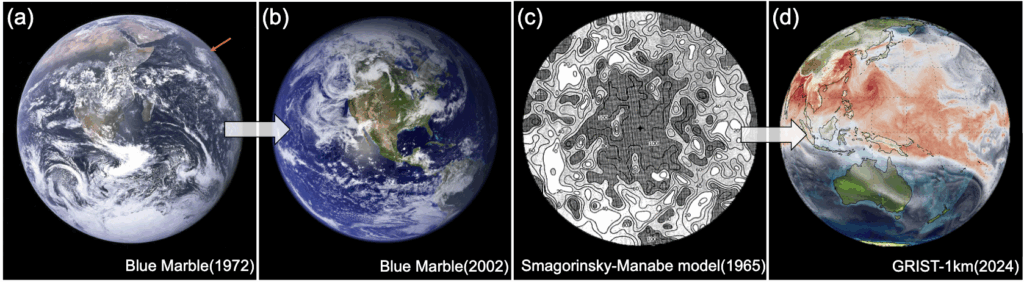
Just this year, Huan+25 [1] optimized the Global-Regional Integrated Forecast System (GRIST), a weather-climate model for the Sunway supercomputer. They were able to model an extreme rainfall event in northern China at 1 km resolution at about a 0.5 SYPD rate on 34 million computer cores.
Critical to their success was the use of an AI physics suite, which was able to improve the performance of the coarse-resolution scale of the simulations. This decreased the computational demand in calculating the temperature and humidity, which allowed them to get these performance results. While they’re not at the 1 SYPD goal yet, this is a huge step forward in effective 1 km resolution climate modeling.
Similarly, Xu+25 [2] developed data-driven limited area models (LAMs) for local weather modeling. Most existing LAMs use numerical weather prediction (NWP) models, which require careful tuning of the boundary conditions (the properties of the borders of the simulated region) to accurately predict the weather. This study used an AI-based LAM called YingLong, which uses real weather data to train and choose the boundary conditions. YingLong is faster than traditional NWPs, and can outperform them at predicting wind speeds. It does underperform in some metrics (temperature and pressure), but this can be improved with better boundary condition picking. This improvement in predicting wind speeds could be critical for wind-based energy production, as well as for predicting major atmospheric events.
But for all the improvements AI can bring to science, it’s predominantly being used in a commercial setting. And the environmental impacts of that commercial use are massive.
AI data centers use an absurd amount of power. Traditional data centers were able to scale efficiently with the rise of the internet and social media, but AI-optimized hardware is especially energy-intensive. As of 2024, 4.4% of the US’s power goes to AI data centers [6], and analysts at McKinsey predict it’ll consume almost 12% of the US’s power by 2030 [3]. As of May 2025, AI data centers may represent some 20% of the globe’s power usage [9]. OpenAI is looking to open 10 new power centers that will each use 5 Gigawatts of power – the equivalent of the power usage in New Hampshire, USA [5]. Data centers have to run 24/7 with no breaks, and are highly reliant on fossil fuels. A paper out of Harvard’s T.H. Chan School of Public Health and UCLA Fielding School of Public Health shows that more than half of data center energy is derived from fossil fuels, and they have 48% more carbon emissions per unit of electricity than the US average [7].
And that’s just the power consumption that’s being reported on. MIT Technology Review has conducted independent research and has found reporting on AI energy consumption to be lacking in completeness and transparency [4]. There’s no incentive for companies to release the details of their power usage, data center holdings, or model details, not least of all because it might not make them look very good. OpenAI’s GPT-4 model likely took 50 gigawatt-hours in its training, enough energy to power San Francisco for 3 days. But training will only amount to 10-20% of the total power usage of these AI models, with the majority coming from inference, the process of generating an output from the model. And as you might expect, as models get bigger and more complex, the amount of energy they need to fulfill requests also gets larger.
Then there’s the water angle. If you’ve ever had your laptop attempt to achieve liftoff via overworked cooling fans, you know how hot computers can get. Data centers can use millions of gallons of fresh, potable (aka drinkable!) water per day to keep their machines cool. This can cause huge strains on local communities, such as the areas in Nevada (already the driest state) where companies are building major data center complexes [10]
The MIT review breaks down an estimate of the energy used to query 15 questions, and generate 10 images and 3 five-second videos. The total? 2.9 kilowatt-hours, or enough to power a microwave for 3.5 hours. Your Hot Pocket doesn’t stand a chance in there, and this estimate is likely an underestimation that fails to consider the power needed for the building, cooling, and other computing beyond the chips the model is on. HuggingFace, a popular AI tools platform, has a public-facing AI Energy Score to rate a model’s energy efficiency, but this is opt-in, and most corporations don’t.
Speaking of corporations: the AI renaissance has led most major tech companies to totally abandon any of their climate/environmental goals, as they’re not compatible with their rising energy needs. This post by Ketan Joshi [8] details how Microsoft has given up on their ‘Moonshot’ climate project, and the unbelievable kickoff of their carbon emissions and energy usage since 2020. His site also collates data on energy usage across major tech companies, and is generally an excellent resource on this subject. Google’s own 2024 climate report [11] indicates their continuing increase in emissions, which they acknowledge is due to AI and, importantly, goes against their prior pledges to be carbon-neutral by 2030.
Most current estimates for model energy usage are under, not overestimates of how much each query actually takes. And as AI gets more complex in its tasks and generated outputs, the amount of energy needed is going to scale up massively. While individual requests may not amount to much in terms of energy, they will add up as AI is integrated into seemingly every aspect of our digital lives, and have major impacts on our energy systems and climate.
Edited by Mckenzie Ferrari
Cover Image – Blue Marble, Apollo 17 Mission
References:
[0] Communications of the ACM – AI is in the Weather Forecast
Authors: Xiaohui Duan, Yi Zhang, Kai Xu, Haohuan Fu, Bin Yang, Yiming Wang, Yilun Han, Siyuan Chen, Zhuangzhuang Zhou, Chenyu Wang, Dongqiang Huang, Huihai An, Xiting Ju, Haopeng Huang, Zhuang Liu, Wei Xue, Weiguo Liu, Bowen Yan, Jianye Hou, Maoxue Yu, Wenguang Chen, Jian Li, Zhao Jing, Hailong Liu, Lixin Wu
First Author Affiliation: School of Software, Shandong University, Jinan, China
Published in: PPoPP ’25: Proceedings of the 30th ACM SIGPLAN Annual Symposium on Principles and Practice of Parallel Programming [open access]
Authors: Pengbo Xu, Xiaogu Zheng, Tianyan Gao, Yu Wang, Junping Yin, Juan Zhang, Xuanze Zhang, San Luo, Zhonglei Wang, Zhimin Zhang, Xiaoguang Hu & Xiaoxu Chen
First Author Affiliation: School of Mathematical Sciences, Key Laboratory of MEA (Ministry of Education), Shanghai Key Laboratory of PMMP, East China Normal University, Shanghai, PR China
Published in: Nature [open access]
[3] AI’s power binge
[4] MIT Technology Review: AI and Climate Landing Page
[5] US Electricity Profile 2023
[6] 2024 United States Data Usage
[7] Title: Environmental Burden of United States Data Centers in the Artificial Intelligence Era
Authors: Gianluca Guidi, Francesca Dominici, Jonathan Gilmour, Kevin Butler, Eric Bell, Scott Delaney, Falco J. Bargagli-Stoffi
First author affiliation: Department of Biostatistics, Harvard T.H. Chan School of Public Health,
Boston, Massachusetts, USA; Department of Computer Science, University of Pisa, Pisa, Italy
Published in: Arxiv Pre-print
[8] Ketan Joshi – Life and Death of Microsoft’s Moonshot
[9] Joule Journal: Artificial intelligence: Supply chain constraints and energy implications
[10] MIT Technology Review: The data center boom in the desert
[11] Google’s 2024 Environmental Report

