
Authors: M. D. Filipovi´c, Z. J. Smeaton, A. C. Bradley, D. Dobie, B. S. Koribalski, R. Kothes, L. Rudnick,
A. Ahmad, R. Z. E. Alsaberi, C. S. Anderson, L. A. Barnes, M. Breuhaus, E. J. Crawford, S. Dai,
Y. A. Gordon, N. Gupta, A. M. Hopkins, D. Leahy, K. J. Luken, N. McClure-Griffiths,
M. J. Michalowski, M. Sasaki, N. F. H. Tothill, G. M. Umana, T. Vernstrom, and J. West
First Author Institution: Western Sydney University
Status: Accepted to ApJ (Open Source)
The scene of the crime
On Galentine’s Day this year, an ultra-high energy (UHE) neutrino attempted to sneak through the Mediterranean Sea, likely expecting she wouldn’t be caught. The odds were in her favor; neutrinos, ghostly particles with no electric charge and infinitesimal mass, only very rarely interact with matter. However, what she failed to account for was the neutrino detector awaiting her under the sea, KM3NeT, and the clever lepton within who would finally notice her. She slammed into the lepton, spewing charged particles everywhere at speeds greater than the speed of light in the water. While no particle can outrun a photon in a vacuum, water slows light down, giving us the familiar effect of refraction; similar to supersonic jets creating a boom when they break the sound barrier, these charged particles produced a distinctive blue light, known as Cherenkov light, exposing the neutrino’s position to astronomers and physicists everywhere. Busted.
The investigation begins
However, the neutrino was only the messenger; of even more interest is the astrophysical object that produced her. It’s not easy to generate such a high-energy particle, and no one can create a neutrino from thermal emission alone, indicating that wherever she originated, something extreme was going on. To date, only three astrophysical sources have been caught emitting neutrinos at all, and none of them extragalactic: the Sun, although this is old news (in the 1960s, detections of solar neutrinos showed definitively that the Sun is powered by nuclear fusion, resolving the issue of how the Sun has burned long enough for life to evolve on Earth); the nearest core-collapse supernova to our galaxy in modern times, SN 1987a; and the galactic plane. Theoretical models predict a much wider variety of objects, including extragalactic sources, to produce neutrinos, usually via cosmic ray production: supernova remnants, star forming galaxies, gamma-ray bursts, supermassive black holes (SMBH, which are found at the center of most galaxies), active galactic nuclei (AGN, a particularly fussy subset of SMBH which are eating their host galaxy), and blazars (an extreme subset of AGN which emit jets of radio light directly at Earth). The reason we have not detected their predicted neutrino emission is that neutrino astronomy is a new field, extragalactic sources are super far away, and neutrinos are both difficult to detect and difficult to trace back to their origin.
Rounding up suspects
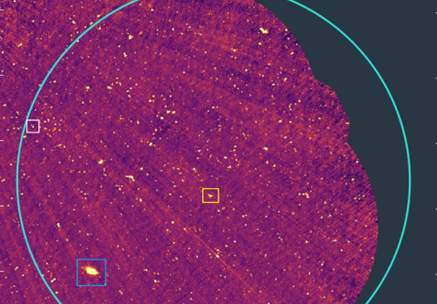
With this in mind, today’s authors embark on a quest to catch the culprit, starting in the radio band. Radio emission, like neutrino emission, is usually an indicator of non-thermal radiative processes, and one such process, synchrotron radiation (emitted by relativistic electrons getting spun around in powerful magnetic fields), can be distinguished from other types of radiation based on its radio characteristics. Conveniently, the region our neutrino hails from is spanned by multiple radio surveys conducted on the Very Large Array (VLA) and the Australian Sub-Kilometer Compact Array Pathfinder (ASKAP), and so our authors use these surveys to round up all the radio riff-raff. Unfortunately, the long wavelengths of radio photons and the scarcity of neutrinos result in reduced resolution for both compared to traditional optical telescopes, and our authors find over a thousand radio emitters in the region. Of course, no one can question that many sources, so our authors limit their investigation to objects with at least two radio brightness measurements, which can be used to calculate the brightness as a function of radio wavelength (the spectral energy distribution (SED), which tells us about what type of radiation we see) and/or as a function of time (a light curve, which tells us if our source is variable). Our authors settle on a lineup of ten likely blazars, any of whom could have emitted our UHE neutrino, as well as a shortlist of prime suspects warranting further investigation: Phaedra, a spiral galaxy; Bebe, a radio galaxy; and Narcissus, an unusual compact radio emitter.
Phaedra, a spiral galaxy with a secret?
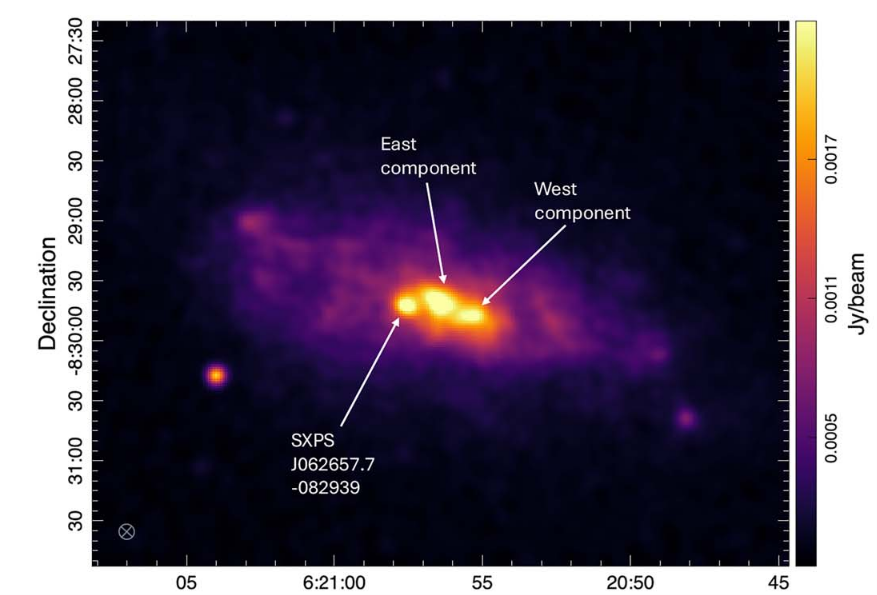
Phaedra, the most radio-luminous in the area, exhibits plenty of behavior typical of a galaxy guilty of neutrino emission. For starters, she has two regions of highly concentrated radio emission, and these regions are offset from her center, making them look suspiciously like AGN jets, which are excellent particle accelerators. Furthermore, infrared observations suggest she is a starburst galaxy, churning out stars faster than a bestselling author with a team of ghostwriters churns out books. This intense star formation could have easily been triggered by jet activity. Even more suspiciously, she is closely associated with an x-ray binary, and where there are high energy photons, there are likely to be other high-energy particles, like neutrinos and cosmic rays. Phaedra’s prospects of beating the neutrino emission allegations are not looking good; these high energy phenomena produce buckets of high-energy particles, and even if they produce only cosmic rays, the cosmic rays are bound to crash into the surrounding dense gas and photons, creating neutrinos anyway.
Hebe, a simple radio galaxy, or something more?
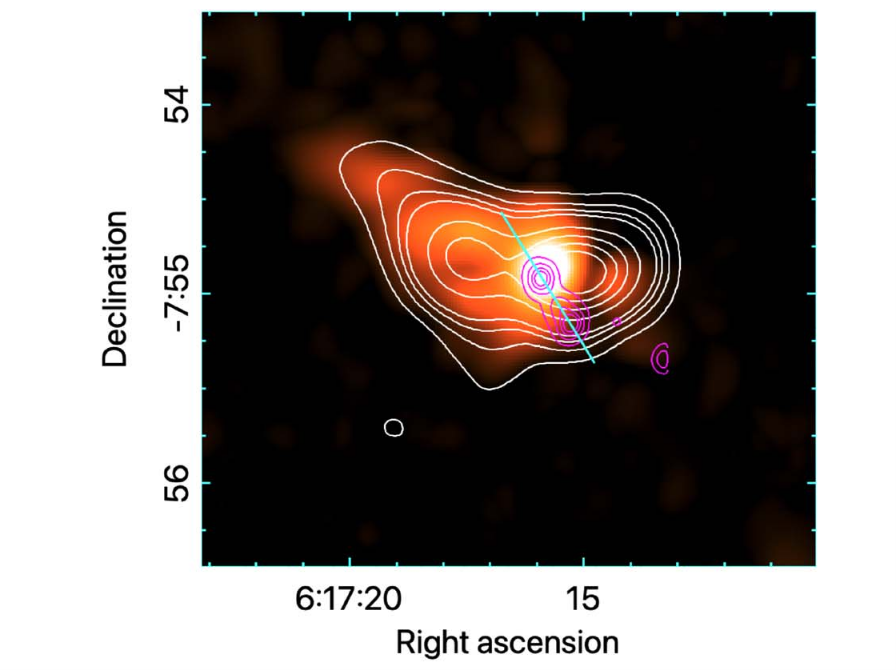
However, Hebe, the nearest extended radio source, isn’t exactly innocent looking either. She is one of a triplet of galaxies sharing a common envelope, like peas in an extragalactic pod. Galaxies, unlike peas, however, are so massive that they can’t help but interact dynamically in such close quarters, causing a commotion that could totally produce UHE neutrinos. She likely also has an AGN jet, giving her the same neutrino-wielding powers as Phaedra.
Narcissus: Double AGN?
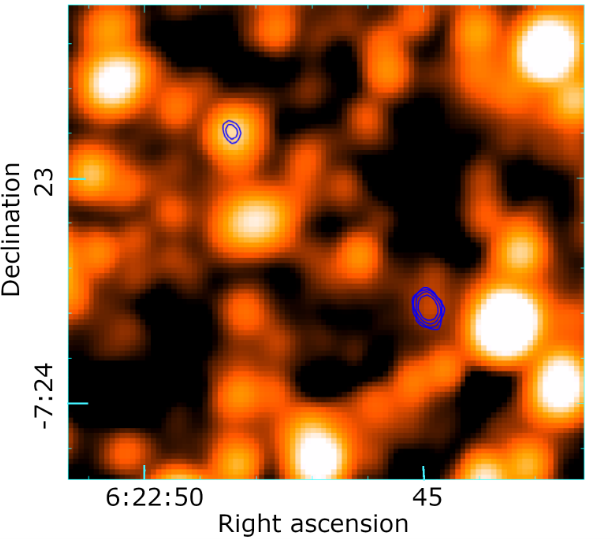
Our final suspect, Narcissus, consists of not one, but two AGN. One appears to exhibit the classic synchrotron SED, and the other is likely a blazar, based on his notable radio variability and infrared observations.
Solving the mystery
So, who really emitted the ultra-high energy neutrino? For now, our authors can’t jump to any firm conclusions – they’d never risk condemning an innocent galaxy – but they will continue to closely monitor the suspects and gather more evidence. In the meantime, Phaedra, Hebe, and Narcissus should find themselves a good defense attorney experienced in neutrino emission cases.
Edited by Sandy Chiu. Featured image is Figure 1 in today’s paper.
