
This guest post was written by Chloe Neufeld. Chloe is a third year PhD student in the Astronomy Department at Yale University. She is interested in studying the baryon cycle of dwarf galaxies through gas emission using ground-based telescopes like Keck and Dragonfly. With a combination of high resolution KCWI data and low surface brightness observations with Dragonfly, she is working towards understanding the connection between galaxies and their circumgalactic media.
Title: It’s a Breeze: The Circumgalactic Medium of a Dwarf Galaxy is Easy to Strip
Authors: Jingyao Zhu, Stephanie Tonnesen, Greg L. Bryan, and Mary E. Putman
First Author’s Institution: Columbia University
Access: accepted to ApJ, available on arXiv [open access]
What’s the difference between a dwarf galaxy that is isolated and a dwarf galaxy that is a satellite? Isolated dwarfs are usually forming stars, while satellite galaxies – those orbiting more massive host galaxies – are typically quenched, with star formation shut off. This is likely due to environmental factors like ram pressure stripping, where the gas bound to a smaller galaxy is removed when its gravitational binding energy is smaller than the drag force pulling it away.
Why does it matter if the smaller galaxy’s gas is stripped away? This gas making up the circumgalactic medium (CGM) of the galaxy is a reservoir for star-forming fuel. So, if this gas disappears, there’s no fuel left for stars to form from!
Gone with the wind (-tunnel simulations)
The authors of this paper investigate how ram pressure stripping affects a satellite galaxy’s CGM using wind tunnel simulations (specifically, the adaptive mesh refinement code Enzo). The simulated 10^7.2 M⊙ mass satellite galaxy is modeled after a well-known dwarf galaxy in the Local Group. The CGM is initially modeled as an isothermal (constant temperature) sphere, extending from 5.2 kpc – the outer boundary of the interstellar medium (ISM) – to 63 kpc, containing a significant portion of the galaxy’s baryonic mass. The authors vary parameters such as the satellite’s orbital velocity and the density of the host galaxy’s surrounding medium to test the effects of ram pressure stripping. They also compare the satellite galaxy’s evolution to a galaxy in isolation and examine scenarios of a satellite with and without a CGM.
The CGM is going, going, gone
Figure 1 shows how the satellite galaxy’s ISM and CGM evolve as it experiences ram pressure stripping after falling into a Milky-Way-mass galaxy’s orbit. Initially, the galaxy evolves in isolation for 2 Gyr — during this time, stars form and supernovae go off, leading to chemical enrichment as metals are injected into the galaxy’s halo. Meanwhile, the CGM also evolves, becoming more turbulent, as outflows from stellar feedback heat the gas and it cools back onto the ISM. In the first panel, at t = 0, the galaxy enters the host’s orbit. At 700 Myr, the CGM begins to strip, and the gas is swept along the direction of the wind, while the ISM remains intact. By 10^50 Myr, most of the CGM is stripped and forms a tail behind the galaxy, but the ISM is just now starting to be stripped. In the final stage at t = 1400 Myr, the CGM is fully removed, and the stripped ISM gas begins contributing to the tail as well.
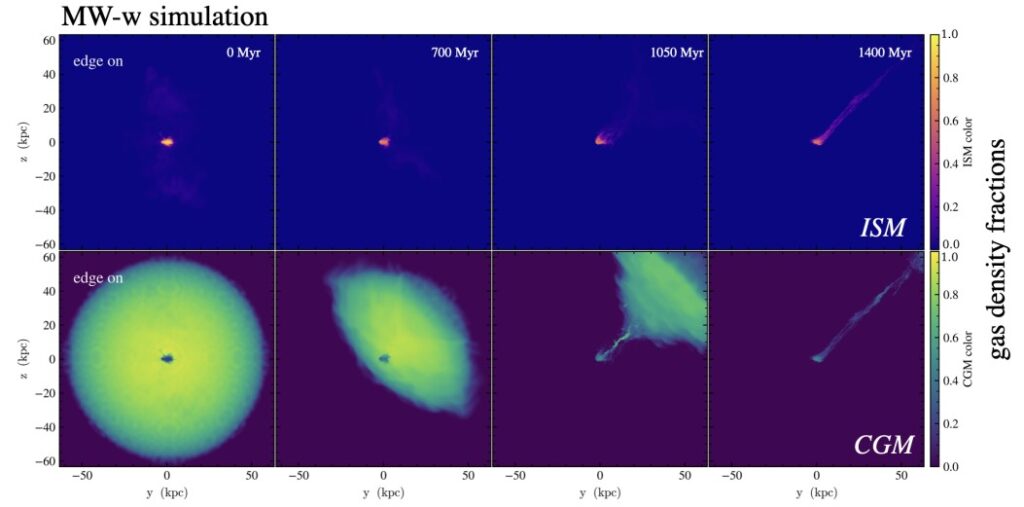
CGM (bottom) at four snapshots in the MW-w simulation (a satellite galaxy with a CGM under
the Milky Way fiducial wind). The CGM is almost entirely removed by ram pressure stripping
before any effect on the ISM. Adapted from Figure 3 in the paper.
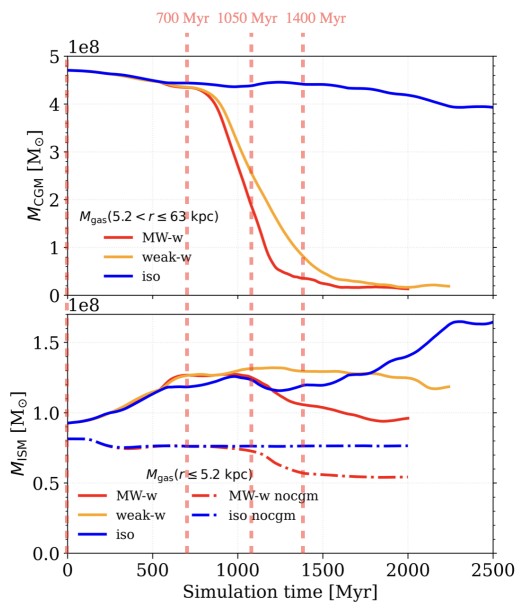
The authors find that, in all simulation runs, CGM stripping is quick and highly effective, removing 95% or more of the CGM within short timescales (∼100 Myr) even in the weakest ram pressure stripping case. This is because the CGM is diffuse with a lower gravitational restoring force, making it susceptible to being stripped away. In contrast, the ISM remains largely intact, with <35% stripped, because it is more tightly bound to the galaxy. The effects of CGM stripping go beyond removing the gas, as seen in the evolution of gas mass in the ISM and CGM in Figure 2. In the isolated case (blue line), the gas reservoir of the CGM continuously replenishes the ISM for further star formation. For the two stripping cases (red and orange solid lines), the replenishment of the ISM is stagnated as the CGM inflows are cut off, even before the ISM begins to be stripped. Interestingly, CGM presence (comparing to the dashed lines) doesn’t affect the rate or amount of ISM stripping, but does influence long-term galaxy evolution.
The fate of satellite galaxies
The results suggest that dwarf satellites in massive host galaxies are unlikely to retain their CGM. Subsequent quenching by ram pressure stripping is thus two-fold: 1) fuel for star formation is stripped, and 2) the reservoir of star formation fuel is no longer replenished. This leads to a gradual decline in star formation, shortening the galaxy’s quenching timescale compared to isolated dwarfs. But there’s hope yet for these galaxies: ram pressure stripping can actually enhance star formation temporarily (see the small peak in ISM mass relative to the isolated case at ∼600-700 Myr in Figure 2), giving the galaxy the opportunity for a last spark before running out of gas.
Astrobite edited by Caroline von Raesfeld
Featured image credit: NASA
