
Title: Inferring the pair-instability mass gap from gravitational wave data using flexible models
Authors: Fabio Antonini, Thomas Callister, Fani Dosopoulou, Isobel Romero-Shaw, Debatri Chattopadhyay
First Author’s Institution: Gravity Exploration Institute, School of Physics and Astronomy, Cardiff University, Cardiff, CF24 3AA, UK
Status: Submitted to Physical Review D. Available on arxiv.
This year marks a decade of gravitational-wave observations by LIGO and Virgo, most of them coming from merging black hole binaries. By analyzing these signals, scientists have measured properties like the black holes’ masses and how they spin. With so many detections, researchers are moving beyond individual systems to study their collective properties. Together, these observations help scientists piece together how stars evolve and die.
Stellar Collapse and the Mass Gap
One well-known way black holes form is through stellar collapse, which occurs when massive stars exhaust their fuel and collapse under their own gravity. If two such stars are in a binary system before collapsing, they can form a black hole binary.
However, theories predict that extremely massive stars meet very different ends. Some explode so violently that they leave nothing behind. Others lose much of their mass in bursts before finally collapsing. These powerful explosions, known as pair-instability supernovae and pulsational pair-instability supernovae, would create a gap in the black hole mass spectrum, making it unlikely for stellar black holes to form with masses roughly between 40 and 130 solar masses.
Identifying a Hidden Subpopulation
The exact boundaries and even the existence of this theoretical gap are uncertain. In fact, black holes in this mass range have been observed in binaries through gravitational waves. Do these disprove the existence of the gap, or are they part of a distinct subpopulation that cannot be explained by stellar collapse alone?
One possible explanation is that these black hole binaries are cut from a different cloth: dynamical capture. This occurs when black holes in dense cosmic environments find one another and pair up. After they merge, the newly formed, heavier black hole can repeat the process, eventually producing black holes heavy enough to fall within the gap.
The key to distinguishing between these binary formation channels lies in how the black holes spin. Black holes born together from a binary star system inherit their spins from those stars, so their spins tend to align with their orbital motion. Meanwhile, black holes born separately and paired up by chance typically have randomly oriented spins.
This study analyzes observed black hole binaries to determine if there’s a relationship between their masses and whether they have randomly oriented spins consistent with dynamical formation.
Methods
The effective spin of a binary black hole is a number from -1 to +1, where +1 means both black holes spin fast in the same direction as their orbit, -1 means they spin fast in the opposite direction, and 0 means they have no net spin. Finding slightly positive effective spins among many binaries would match what we expect from stellar collapse. On the other hand, if the effective spins are evenly spread out around zero, this would favor dynamical capture.
The authors analyze 69 black hole binaries detected by gravitational-wave observatories. They measure how the fraction with random spin orientations changes with the heavier black hole’s mass, aiming to find where the main formation pathway shifts from isolated stellar collapse to dynamical capture.
Earlier studies assumed this change happened suddenly at one specific mass. Here, instead of forcing the data to fit this assumption, the authors use a Gaussian process. This statistical method explores many possible functions that could describe the data to find the most probable ones. Because of this flexibility, it can capture more gradual changes or even multiple shifts in spin properties.
Finding a transition in spin properties
The study finds a clear transition in spin properties at around 46 solar masses, which agrees with the previous studies that had made stricter assumptions. Above this mass, spin directions spread out and center around zero, a sign of black holes born through dynamical processes.
Figure 1 shows how the fraction of black hole binaries with randomly oriented (isotropic) spins, as opposed to mostly aligned spins, changes with mass. Below 5 and above 80 solar masses, there aren’t enough observations to draw conclusions. Between about 10 and 40 solar masses, anywhere from 0% to 15% of binaries might have randomly oriented spins, suggesting all or most of them formed through isolated stellar collapse. But above 40 solar masses, at least 10% have random spins, indicating a different formation process.
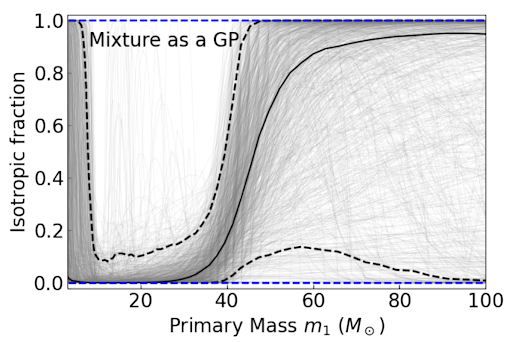
The authors also look at how the effective spins spread out for the heavier black hole pairs and find that the effective spins don’t get much higher than about +0.57. The lower limit isn’t as clear but is likely below zero. This fits with the idea that the spins point in random directions, as that would give an even spread around zero, but it doesn’t confirm it for sure.
Finally, they compare their results to predictions from star cluster models, which describe how black holes might merge in crowded environments. Their inferred spin distribution of black holes in the mass gap agrees well with these models. This strengthens the case that many of the heavy black holes we observe in the gap may come from dynamical formation in clusters.
More detections, better constraints
These results support the existence of the pair-instability mass gap and the idea that it could be filled by black holes formed dynamically in dense environments. But the case isn’t solved yet. More detections of high-mass binaries are crucial to refine the constraints and definitively distinguish between astrophysical formation channels. Each gravitational-wave signal is just one piece of the puzzle, and together, they bring us closer to answering universal questions about stellar evolution.
Astrobite edited by Chloe Klare.
Featured image credit: LIGO/Caltech/MIT/Sonoma State (Aurore Simonnet)
