
Title: Detectable MeV Neutrino Signals from Neutron-Star Common-Envelope Systems
Authors: Ivan Esteban, John F. Beacom, Joachim Kopp
First Author’s Institution: Department of Physics, University of the Basque Country UPV/EHU, PO Box 644, 48080 Bilbao, Spain
Status: Published in Physical Review Letters
This bite was written and published as part of Astrobites’s new partnership with the American Physical Society (APS). As part of this partnership, we cover selected articles from the Physical Review Journals, APS’s premier publications covering all aspects of physics. For more coverage as part of this partnership, see our other PRJ posts.
Imagine a binary system consisting of a star and a neutron star. In certain situations, the two get close enough that they may interact and the star may start transferring mass onto its companion. This mass transfer process can often turn unstable and shrink the orbit, results in the neutron star getting engulfed into the envelope of the star, initiating a process referred to as a common envelope (CE). What follows is a short complex phase consisting of a multitude of messy details that we do not understand well. Broadly, the drag due to the material in the stellar envelope rapidly shrinks the binary orbit while expanding the “common envelope”, and leads to one of two likely end products 1) the envelope is successfully ejected, leaving behind a tight binary 2) the envelope fails to eject and there is a premature merger between the core of the star and the neutron star, which can form a Thorne–Żytkow object (TŻO). Even though a common envelope phase is a key intermediate step in forming a wide range of phenomena such as progenitors of gravitational wave sources, and TZO’s, we have yet to confidently catch a system actively undergoing common envelope evolution. This is partly due to its short timescale and low occurrence rates (0.01-1 per century for CE events in the Milky Way involving a neutron star), but also because of a lack of well-defined observational signatures to look for. Today’s paper suggests one such method for catching them in the act,using our ν-eyes.
Where are the neutrinos coming from?
As the orbit shrinks, the neutron star eventually finds itself inside its companion star’s envelope, it encounters a region of high density (consisting of material in the star’s envelope), and together with its strong gravity, it becomes a site of accretion of material onto its surface. If the mass accretion rate is low (below the Eddington limit), most of the gravitational potential energy is released as photons that have trouble leaking out of the common envelope. However, if the accretion rates can get much higher, the disk may heat up to temperatures high enough that most of the energy loss is not through photons, but neutrinos! In this paper, the authors try to estimate whether such neutrinos would be detectable on Earth.
Initially, the authors make back-of-the-envelope estimates for what the neutrino flux at a detector on Earth would look like? Since these are thermal neutrinos, their energy distribution is decided by the temperature of the accretion disk, which roughly lies in the mega-electron-volt (MeV) range. The energy of the neutrinos along with the cooling rate (the rate at which the disk loses energy through neutrinos) provides the flux emitted from the source. This flux diminishes due to the distance between the source and the detectors on earth. Provided it is located within the galaxy (~10kpc), the authors estimate that a neutrino detector such as the Super Kamiokande (Super-K) should find ~100 events over a few months.
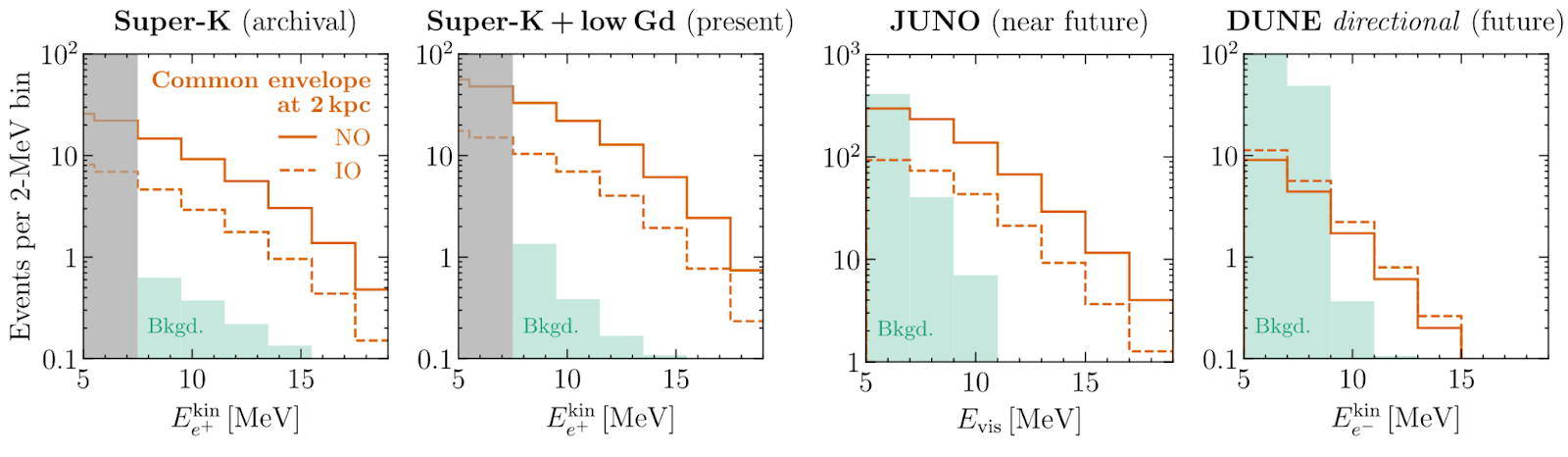
The authors then go on to complement their simple calculations with detailed hydrodynamical simulations. Assuming spherical symmetry, they compute the temperature and density of the accretion flow onto the neutron star, which allows them to calculate the expected neutrino flux from a variety of emission processes. After accounting for the three neutrino flavours, their ordering in mass, the gravitational redshift and absorption of neutrinos by the neutron star, they calculate the expected signal over three months at various current and future detectors. Their results are shown in Fig.1 and it can be clearly seen that a common-envelope signal can be detected over background levels not only in current and future detectors, but perhaps also in existing archival data!
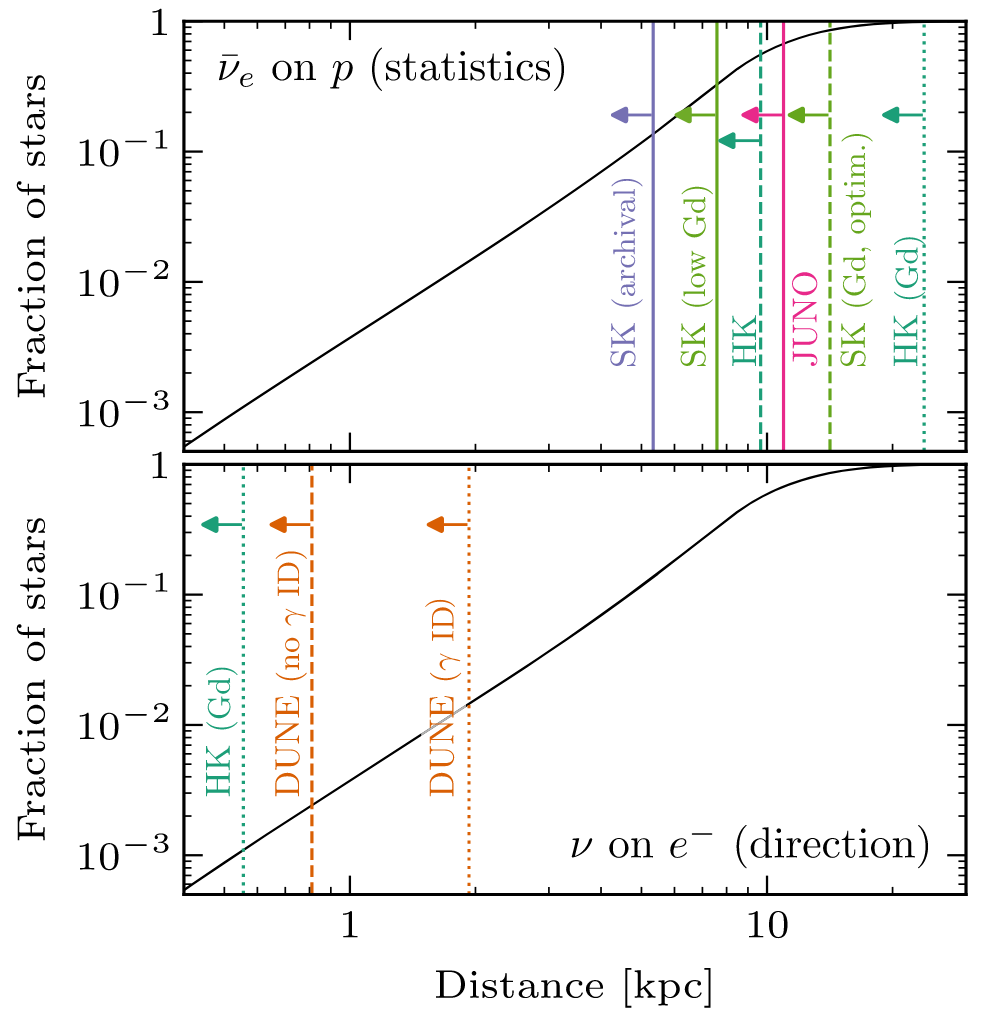
The authors also estimate how far out in distance could such a neutrino signal from a common envelope event be detected? As can be seen in Fig. 2, they find that current and future detectors are sensitive to large swathes of the Milky Way. However, these detections would not be localized to any particular region in the sky, and they find that for well localized events, the detection range significantly drops down to 1-2 kiloparsecs.
The authors emphasize that even though the neutrino signals from common envelope events are above background levels, finding them in the data would require new analyses methods to be developed to look for months-long transient events that have thermal energy spectrum. However, if one is successful and a neutrino signal is indeed confidently found, the data could unravel a treasure trove of interesting details about the poorly understood common envelope phase in binary evolution. Firstly, it would imply that a neutron star is actively being engulfed by a star (which sounds awesome), and also hint towards the presence of accretion occurring at a rate much higher than the Eddington limit. Secondly, measuring the flux and spectrum of neutrinos would directly inform about the conditions at the source such as the accretion disk temperature. Lastly, in this era of multi-messenger astronomy, this could be a third potential low-energy astrophysical neutrino source (besides the Sun and supernovae), and if combined with any associated electromagnetic emission, this could significantly enhance our understanding of common envelope evolution.
Astrobite edited by Kylee Carden
Featured image credit: Wikipedia/Phillip D. Hall (edits by Neev Shah)
