
Title: The origin of the most recently ejected OB runaway star from the R136 cluster
Authors: Simon Portegies Zwart,Mitchel Stoop, Lex Kaper, Alex de Koter, Steven Rieder and Tomer Shenar
First Author’s Institution: Leiden Observatory, Leiden University, Leiden, The Netherlands
Status: Published in Physical Review Letters [closed access]
This bite was written and published as part of Astrobites’s partnership with the American Physical Society (APS). As part of this partnership, we cover selected articles from the Physical Review Journals, APS’s premier publications covering all aspects of physics. For more coverage as part of this partnership, see our other PRJ posts.
Something violent happened here
Just next door to our own Galaxy, the Milky Way, we find the Large Magellanic Cloud – a dwarf galaxy orbiting ours. Though it weighs in at only about a hundredth of the mass of our own galaxy, with maybe around a tenth the number of stars, it is home to one of the most peculiar places in our little corner of the Universe.
At the south-east corner (as seen from the Earth), at the centre of the beautiful Tarantula Nebula lies an open cluster with a central concentration of stars known as R136. This cluster is young – likely no more than a million years old – and very massive compared to the number of stars it contains. In fact, R136 is home to some of the real heavyweight champions. Of the twenty most massive stars currently known, twelve of them are in that region of space. This includes the most massive star currently known, R136a1, clocking in at nearly 300 times the mass of the Sun. These behemoths are lumped together with a host of other stars, with the core-density of the cluster reaching more than 400.000 stars per cubic parsecs. For comparison, the nearest star to the Sun is Proxima Centauri at a distance of slightly more than one parsec so to say that space in R136 is cramped is a bit of an understatement.
With such a high number of very massive stars in such a small space (relatively speaking), it may come as no surprise that R136 is home to frequent and extremely violent dynamical encounters, with stars colliding and others getting flung left and right. A number of stars and binary systems even seem to have picked up enough speed to leave the cluster behind as runaway stars. This turns R136 into an active crime scene – where the authors of today’s paper are playing the part of detectives at work, trying to piece together where the speeding stars came from and what kind of event could have ejected such massive stars.
Meet the suspects
The first stars of interest here are in the binary system Mel 34. The two stars, both with masses exceeding a hundred times that of the Sun, were ejected from the core of R136 some fifty thousand years ago and are now speeding away at an estimated 46 kilometres per second. To eject such massive stars at that speed requires an unusually strong encounter with other stars and the authors set out to reconstruct the most likely event that could have led to this outcome.
Tightly bound binary stars (especially such massive ones) can throw around others as well. Around the same time that Mel 34 was ejected, a single star, referred to as VFTS 590 was launched almost perpendicular to the binary’s path. But the energy calculations do not add up and because of the direction the two parties are taking, angular momentum is not conserved which it should be. There must be a mystery runaway star that was also somehow involved.
Now, almost directly opposite to that of Mel34, at the other side of the core of R136, another binary, called Mel 39, is racing away at a speed of about 64 km/s. Because of its location and direction of movement, it is very enticing to assume that it was involved somehow as that would take care of the conservation of momentum. With an estimated mass of 139 and 80 solar masses, respectively, the binary certainly has the capacity to help deliver the energy needed for all of the stars to be ejected from the cluster. The situation is sketched in Figure 1.
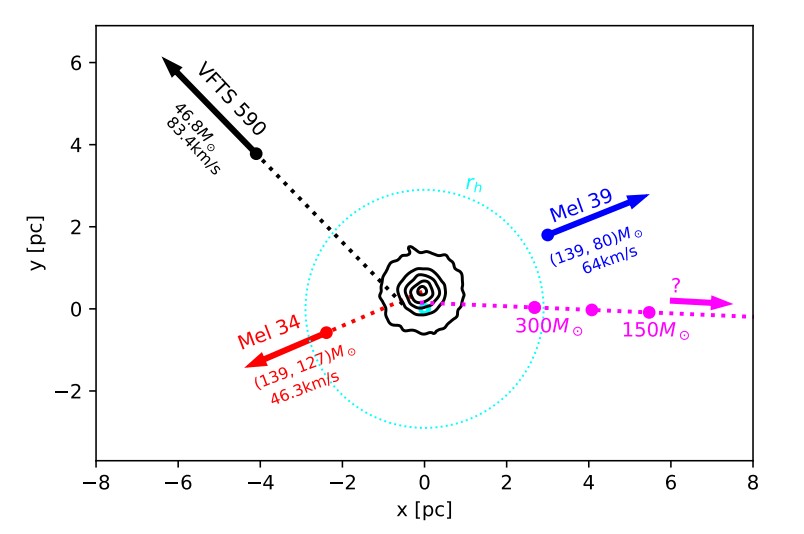
Figure 1: This figure shows the reconstructed paths of the stars that had a dramatic interaction in the dense star cluster R136. Like balls scattering on a pool table, the stars were flung in different directions after a close encounter. The arrows show their speeds and directions, with Mel 34 (red) and Mel 39 (blue) as massive pairs and VFTS 590 (black) as a single star. All masses are measured in solar masses. The black rings show where the interaction likely occurred. The dashed cyan circle marks the cluster’s half-mass radius where half the weight of the cluster is within this distance. A magenta arrow shows where a possible missing star might have gone to balance the interaction and its trajectory lies somewhat close to the actual observed binary Mel 39. By tracing these paths backward, the authors try to pinpoint the likely spot of the encounter, helping us understand how stars can be ejected from clusters. Figure 1 in the paper.
But here the plot thickens. A single star and two binaries that simultaneously meet up with each other and interact in a strong encounter is improbable, even for the dense R136 cluster. That means VFTS 590 must have been orbiting one of the interacting binaries.
Investigation time!
To stitch together what might have happened, the authors must pull out their toolbox and get some detective work done. Their method of choice in this case is N-body simulations. By making some assumptions about the orbits and comparing to the known outcome observed in R136, the authors simplify the situation to consider 8 different initial configurations for the 5-body encounter and let their simulations run. An example of the interaction can be seen in Figure 2.
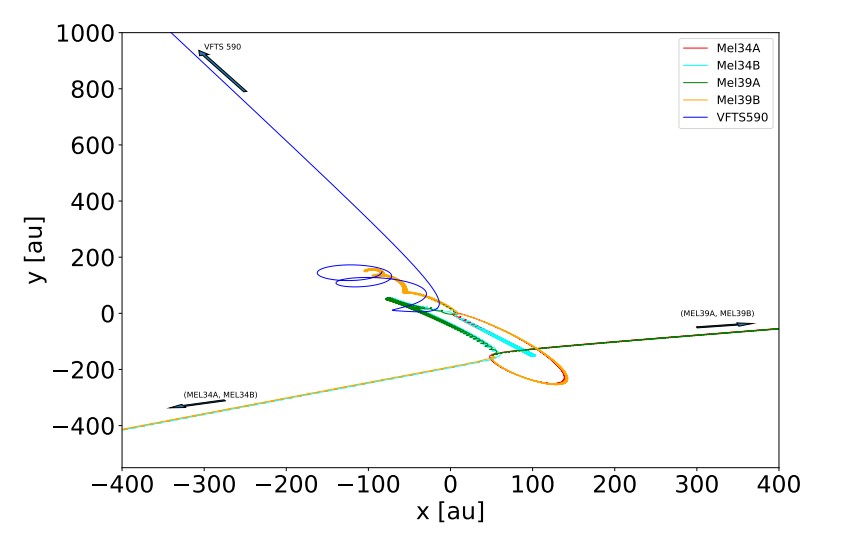
Figure 2: A pair of stars and a triplet got too close and had a chaotic encounter. As a result, one star—VFTS 590 (in blue)—was flung out on its own at high speed, while the two pairs (shown in red, yellow, green and orange) were thrown in opposite directions. Their swirling lines show how they moved during the interaction. Figure 2 in the paper.
Comparing the probability for each event, the authors favor a model where VFTS 590 was once part of a triple star system with Mel 39 A and B, orbiting the pair at a distance between 40 and 200 AU. The triplet then interacted with the binary Mel 34 which led to the ejection of all involved parties from the cluster. While the two tighter bound binaries remained together, VFTS 590 was flung away on its own.
The story doesn’t end there though. Even though the two massive binaries managed to eject each other in the interaction, the authors speculate that they may have been responsible for ejecting some of the other runaway stars in the cluster and maybe even many more not yet observed runaways. But for now the two ‘bully binaries’ as the authors label them will leave the cluster behind, interact and experience mass transfer, and in a few million years explode in spectacular supernovae explosions.
Astrobite edited by Neev Shah
Featured image credit: NASA, ESA, F. Paresce, R. O’Connell, Viktor Hahn and the Wide Field Camera 3 Science Oversight Committee. Edited in MS Paint by Kasper Zoellner.
