
Authors: Ken J. Shen
First Author’s Institution: Department of Astronomy and Theoretical Astrophysics Center, University of California, Berkeley, CA, USA
Status: Published in the Astrophysical Journal [open access]
Even stars get kicked around sometimes. When a white dwarf–a dense stellar corpse that’s run out of its nuclear fuel–gets pushed past its limit, the result is a spectacular thermonuclear explosion called a type Ia supernova (SN Ia). Two stars are needed to trigger a SN Ia explosion. In this binary system, the more massive star, called the primary, steals mass from the less massive companion star. As the primary gains mass, it undergoes a runaway thermonuclear reaction and explodes. Despite the violent nature of the blast, it doesn’t always destroy everything in sight. While the primary star is obliterated, the companion star might survive the explosion by being launched, or “kicked”, into space at incredibly high speeds.
A few of these hypervelocity survivors have been detected in surveys, particularly from the Gaia mission. Understanding how these stars survived a supernova provides important clues about how a supernova forms and explodes in the first place.
The D6 model: (Double the trouble) + (double the double the trouble)
In today’s post, we explore the “dynamically driven double-degenerate double-detonation” model, fortunately shortened to the D6 model. (Try to say that ten times fast!) The D6 model describes a binary star system of two white dwarfs, each of which is generally composed of an even mix of carbon and oxygen. (Sometimes white dwarfs composed of helium or a mix of oxygen and neon are also possible.) As the white dwarfs spiral towards each other, the more massive primary star steals material, often helium, from the less massive companion star’s outer shell. If this mass transfer is violent enough, it can trigger a detonation within the helium shell of the primary star. This detonation then triggers an explosion deep within the core of the primary star, causing a supernova.
For an SN Ia, it takes two stars to tango. What happens to the secondary (donor) star? One theory suggests that it can be blasted away from the scene of the crime at speeds ranging from approximately 1,000 to 3,000 km/s, becoming a so-called hypervelocity star. Of these observed “survivors,” the hottest of the bunch have been theorized to be heated by the supernova explosion itself. But some of these survivors have been cooler (in temperature). If these companion stars were in the vicinity of the blast, how could they not be heated by the explosion? What can their temperature tell us about their origin?
Defining the model
To explore the origins of these cool hypervelocity stars, today’s author used the stellar evolution code MESA to model the evolution of different types of white dwarf companion stars after (presumably) surviving a SN Ia. A key focus was on the Kelvin-Helmholtz mechanism, which is the process by which a star cools and therefore contracts over long periods as it radiates away its internal heat.
Because white dwarfs come in many flavors, they explored a range of possible elemental compositions for the companion white dwarf: helium-rich (He-rich), carbon/oxygen-rich (C/O-rich), and oxygen/neon-rich (O/Ne-rich).
One important detail of these models is that the stars were assumed to be fully convective, which is a common property of low-mass stars less than around 0.4 M☉. (You can think of fully convective stars almost like a massive lava lamp where the heat source is at the center of the sphere.) Extensive mass loss can cause a more massive non-convective star to become less massive and convective, which in turn makes it susceptible to cooling quickly and avoiding a fiery death as a supernova. (Hotter gas rises to the surface, where the particles lose kinetic energy by doing work, gradually slowing down and cooling off.) This is key if we want to produce cool, fast-moving stars.
Detonate first, simulate later
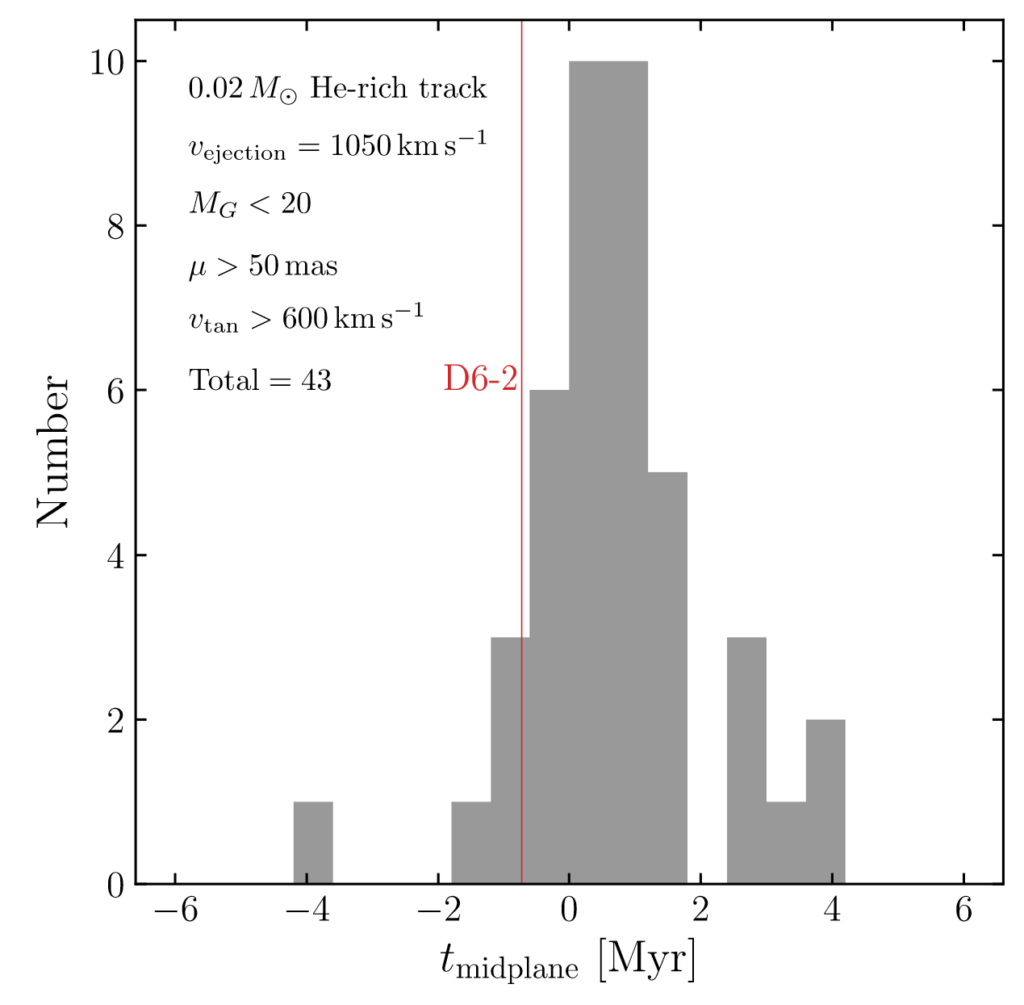
For helium-rich survivors, the simulations suggest that if the companion star loses enough mass either before or during the explosion, the star’s natural Kelvin-Helmholtz evolution can potentially explain why we observe some cool hypervelocity survivors. In the case of a star called D6-2, the simulations reproduced its low temperature and luminosity, assuming that it began its life as a helium white dwarf that was shredded but not entirely destroyed. This produces a tiny, convective, hypervelocity supernova survivor.
D6-2 is an interesting object, however, because it has a fairly low velocity for a potential hypervelocity survivor. Its velocity is estimated to be ~1,050 km/s, which simulations suggest should be higher based on its estimated mass. It’s likely that either the simulations and models need refining, or D6-2 had an altogether different origin.
What about the others?
So far, we’ve mainly talked about helium-rich stars, but what about those C/O-rich ones? These stars would likely appear cooler and redder since they evolve at a nearly constant temperature before moving onto the standard white dwarf cooling track. (This is called the Hayashi track.)
Red objects are harder for telescopes to detect and often get mistaken for other stars or objects, partially due to a pesky phenomenon called dust extinction, or interstellar reddening. To expand the search for these hypervelocity candidates, surveys like Gaia might benefit by expanding their search limits to include redder stars, although this opens up the possibility of increasing the number of false positives.
A different class of fast-moving, faint stars–like LP 40-365–could be related to this population. They are theorized to be remnants of white dwarfs around 1.4 M☉ that only partially exploded. Low-mass, O/Ne-rich survivors might match the observed temperatures and luminosities of LP 40-365, but the ages don’t line up as well as one might hope. (More work will be needed to figure out this particular puzzle.)
The odds of stellar survival
Based on these simulations, it’s estimated that ~2% of SNe Ia might leave behind a helium-rich hypervelocity star like D6-2 (see Fig. 1). If we consider C/O-rich survivors (like D6-2’s cousins D6-1 and D6-3), the rate drops to ~0.2%, which is interestingly a value close to the estimated rate of SN 2003fg-like events, unusually bright, slowly evolving SNe Ia that often display tell-tale signs of unburned carbon and oxygen in their spectra.
The presence of these hypervelocity survivors might be linked to rare types of supernovae, which would provide an interesting way to look into the origins of these oddball events.
Choose your own (stellar) adventure
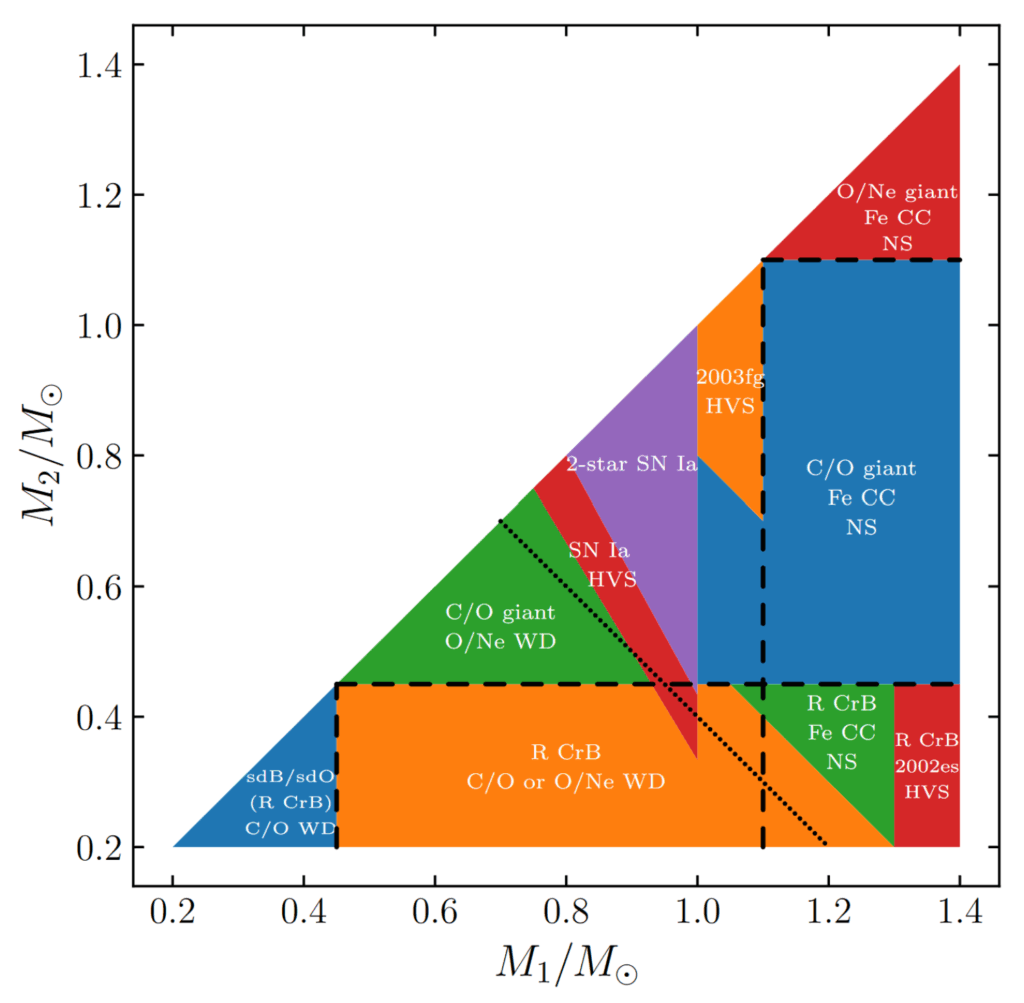
This paper suggests different evolutionary paths for how binary white dwarfs might evolve. Depending on the properties of the merger, the system might:
- Trigger nuclear reactions within the outer shell of the primary without detonating the primary’s core
- Become a normal SN Ia
- Leave behind a hypervelocity remnant
- Become a SN 2002es-like supernova, which is a fainter type of SN Ia
There are lots of potential outcomes for these types of binaries, and hypervelocity survivors indicate just a tiny fraction of a particular configuration of binary white dwarfs (see Fig. 2).
These stellar survivors are rare and fast. Cooler hypervelocity survivors, in particular, are fascinating because they may originate from white dwarf binaries with unusual properties. Studying these fast-moving stars helps piece together our understanding of SNe Ia as a whole. With improved surveys and simulations, we may discover more about these elusive escapees.
Astrobite edited by Chloe Klare
Featured image credit: Mckenzie Ferrari (made in Canva)
