
Title: Impacts of the Metagalactic Ultraviolet Background on Circumgalactic Medium Absorption Systems
Authors: Elias Taira, Claire Kopenhafer, Brian O’Shea, Alexis Manning, Evelyn Fuhrman, Molly S. Peeples, Jason Tumlinson, and Britton D. Smith
First Author’s Institution: Department of Physics & Astronomy, Michigan State University, East Lansing, MI
Status: Submitted to The Astrophysical Journal [open access]
When you think of the “edge of a galaxy”, you might imagine a clear boundary like the rim of the disk or the outermost spiral arm. In images, this definition makes sense – there is an “edge” where brightness significantly drops off due to a decrease in the density of stars. But in reality, galactic environments are much larger because each galaxy is embedded within a massive halo of gas, called the circumgalactic medium (CGM). This halo acts as a galaxy’s overflow reservoir – where processes like supernovae or active galactic nuclei push gas out of a galaxy and into the CGM. Once the gas enters the CGM, it can escape to the intergalactic medium or be reaccreted by the galaxy as fuel for future star formation. This means that the CGM can heavily influence the galaxy’s evolution. However, because CGM gas is diffuse and dim, it is notoriously difficult to observe.
Luckily, astronomers have developed clever techniques to probe CGM gas. One of the most common is background quasar absorption spectroscopy: if a bright object (like a quasar) happens to be behind a CGM we want to study, we can observe how the CGM absorbs specific wavelengths of the quasar’s light. In the absorption spectrum, each absorption line corresponds to an ion in the gas. CGM gas is nonhomogeneous (i.e. clumpy), so along the sightline from us to the quasar behind the CGM, many clumps of CGM gas create absorption. These clumps are befittingly called “absorbers”, and we can deduce their temperatures, densities, and metallicities through the absorption lines they create. However, absorbers in a CGM move at different velocities and can contain gas in single or multiple ionization states, which makes it challenging to disentangle the physical properties of their gas. To alleviate these difficulties and understand how the CGM evolves over time, the CGM has also been extensively studied using simulations.

Today’s authors used the FOGGIE (Figuring Out Gas & Galaxies in Enzo) galaxy simulations, which were specifically designed to have high resolution in the CGM. Simulating realistic galaxies requires modeling all known physics that creates real galaxies, which can introduce undesired uncertainties – especially when modeling physical processes we don’t fully understand yet. Today’s paper explores uncertainties that arise in simulated background quasar absorption spectra due to one of such modeled processes, the ionization of CGM gas from the metagalactic ultraviolet background (UVB).
Varying the UVB model
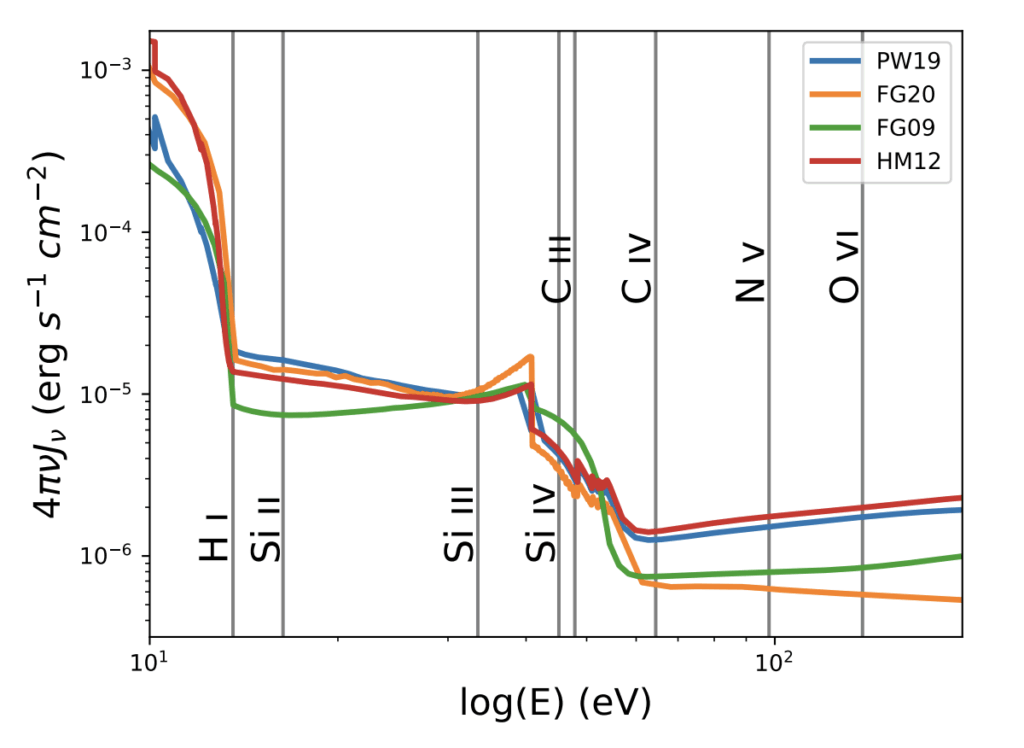
The UVB is faint UV radiation that permeates the universe. It originates from scattered quasars and young stars, and results in a cumulative radiation strong enough to ionize gas in the CGM. In simulations, this ionization is calculated from UVB models that are built from observations. Today’s authors consider two UVB model “families” with two models each:
Faucher-Giguère family
- FG09: Faucher-Giguère et al. (2009)
- FG20: Faucher-Giguère (2020)
Haardt & Madau/Puchwein family
- HM12: Haardt & Madau (2012)
- PW19: Puchwein et al. (2019)
Rather than the computationally expensive choice of rerunning an entire galaxy simulation for each UVB model, today’s authors instead choose to recalculate CGM ionization fractions as a post processing step. Specifically, each UVB model is applied to the CGM of the FOGGIE galaxy “Hurricane” at cosmic noon when the UVB was most intense due to high star formation rates across the universe. This way, they are comparing UVB models when their effects are maximized.
Comparing absorbers across UVB models
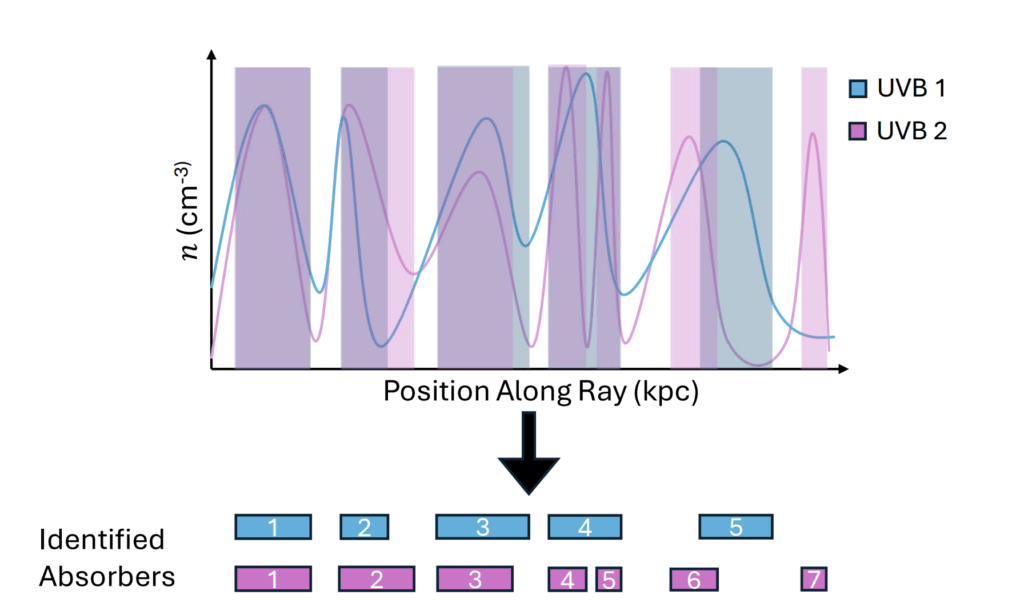
The authors created 100 quasar sightlines through the CGM of the simulated Hurricane galaxy to make mock observations. There were four versions of each sightline, one for each UVB model. Next, they identified the position and extent of absorber clumps by locating peaks in the simulated gas density for each sightline, and recorded the density, temperature, and metallicity of each absorber. Finally, absorbers were compared between sightlines of each UVB model.
Long story short, changing the UVB model resulted in significant differences in absorber densities, from 0.5 to 6 orders of magnitude, even when comparing models from the same family! Generally, differences between absorber properties were greater for ions with higher ionization energies because the UVB model spectra disagree at high energies (see C IV – O VI in Figure 2). There were also major differences for ions with ionization energies where the slopes of UVB model spectra are steep (see H I in Figure 2).
The FOGGIE simulations currently use the HM12 model while other cosmological simulations use other UVB models (for example, IllustrisTNG uses FG09). Simulations are a tool to compliment observations, but they’re not perfect, so understanding the magnitude and source of uncertainties from modeling is extremely useful when interpreting comparisons. Simulations help to improve our understanding of observations, and in turn, better understanding of observations will make simulations more realistic.
Astrobite edited by Erica Sawczynec
Featured image credit: Cinderella Love #1, 1950/Public Domain
