
Title: New Plasma Regime in Jupiter’s Auroral Zones
Authors: R. L. Lysak, A. H. Sulaiman, S. S. Elliott, W. S. Kurth, and S. J. Bolton
First Author’s Institution: University of Minnesota, Minneapolis, Minnesota, USA
Status: published in Physical Review Letters [open access]
Jupiter’s aurorae are hiding something extraordinary. Using data from NASA’s Juno mission, the authors of today’s paper have discovered plasma conditions so peculiar they don’t exist anywhere else we’ve ever explored in the solar system, giving rise to a whole new type of plasma wave mode. This astrobite will unpack the methods and instruments that made this discovery possible, and what makes this alien plasma so interesting.
A Plasma-tastic Mystery
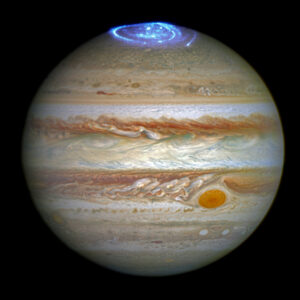
While we typically encounter matter in three familiar forms – solid, liquid, and gas – there exists a fourth state of matter known as plasma. Plasma comprises nearly all ordinary matter in the Universe (roughly 99.9%). It forms when a gas is energized to the point of ionization, splitting atoms into a cloud of charged particles. Nearly all visible matter in the cosmos, from stars to nebulae, exists in this plasma state. We observe plasma here on Earth through the Aurora Borealis, or Northern Lights, which are caused by the interaction of charged particles from the Sun with the Earth’s magnetic field, lighting up the night sky in breathtaking colors.
Aurorae can also occur on other planets with magnetic fields, and what better place to look for funky plasma than on a planet with a super strong magnetic field? That’s why the authors of today’s paper turn to Jupiter, with a magnetic field roughly 20,000 times as powerful as Earth’s. To study this plasma, the authors use Juno, a NASA spacecraft in a polar orbit around Jupiter. They utilize the Waves instrument on Juno to measure the electric and magnetic fields on Jupiter as it passes over Jupiter’s low-altitude polar regions. These measurements allow them to observe characteristic frequencies of these plasma waves, where they either can’t propagate (cutoffs) or where they resonate strongly (resonances). These cutoffs and resonances can be used to determine the electron density of the plasma.
Using these measurement techniques, Juno revealed just how bizarre the conditions are near Jupiter’s magnetic pole. They found that the plasma densities were extremely low, varying from 10-2–10-3 electrons per cubic centimeter. From this, they are able to estimate the electron plasma frequency (i.e., the frequency at which electrons oscillate in the plasma) by using the relation f=9 kHz√n, where n is the electron density. Normally, electrons oscillate at a much higher frequency than that of ions (i.e., the ion cyclotron frequency). But this calculation reveals that the electron plasma frequency on Jupiter’s magnetic pole is less than the ion cyclotron frequency (as shown in Figure 2). This result leads to a brand new type of plasma mode that has never been observed before.
Introducing the Alfvén-Langmuir Wave
Just like how ripples propagate through a body of water when perturbed, plasmas can also support waves, but with a greater variety of wave modes than in conventional fluids. The authors investigate the properties of this wave mode by varying the wave number and reveal something strange. At small wave numbers, it behaves like a type of wave known as an Alfvén wave, but at large wave numbers, it transitions into something resembling a Langmuir wave. Therefore, the authors name this strange new plasma mode the “Alfvén-Langmuir wave”. This wave has a uniquely shaped resonance cone structure. When a satellite like Juno passes over this plasma, it will first see the higher frequency waves that propagate at a large angle, and then will see the lower frequencies as the satellite is directly overhead. This will be observed as a V-shape, or saucer-like feature, which is shown at 11∶46 in Figure 2.

Because this new wave mode can only exist in such a low density environment, the authors also put forth explanations as to why the density in this region is so low. They suggest that an initial low density of electrons could cause the parallel electric field at very low altitudes, which can accelerate the electrons up the field lines, causing the electron density to increase. They state that further observations of Jupiter from Juno’s extended mission should help answer this question.
This discovery is exciting to astronomers and particle physicists alike. The authors suggest that these extreme conditions may also exist on the polar regions of the other giant planets in our solar system, as well as other highly magnetized exoplanets or stars. As we discover more exoplanets with extreme magnetic fields, understanding these exotic wave physics could become crucial for interpreting our observations.
Astrobite edited by Brandon Pries
Featured image credit: NASA
