
Paper: Reconstructing the dark energy density in light of DESI BAO observations
Authors: Maria Berti, Emilio Bellini, Camille Bonvin, Martin Kunz, Matteo Viel, and Miguel Zumalacarregui
First Author’s Institution: Département de Physique Théorique and Center for Astroparticle Physics, Université de Genève, Switzerland
Status: Published in Phys. Rev. D, available on ArXiv (open access)
For decades, our standard model of cosmology, known as “Lambda Cold Dark Matter,” or ΛCDM, has successfully accounted for an impressive array of observations encompassing a wide range of phenomena, including dark matter, dark energy, and the accelerated expansion of the universe (I highly recommend first checking out our Astrobites guide on ΛCDM for this astrobite, especially Section F). However, as our measurements become more precise, some cracks have appeared in ΛCDM. Independent methods disagree about how fast the universe is expanding (the Hubble tension), some surveys hint at less clumpy structure than expected (the σ8 tension), and new data occasionally pull the model in different directions. None of this has toppled ΛCDM on its own, but together, these nudges have become a clear invitation for researchers to poke harder and to dream and theorize about what comes next after ΛCDM.
One of the most intriguing cracks in ΛCDM recently came from the results of the Dark Energy Spectroscopic Instrument (DESI) one-year dataset, which was a result that prefers a time-varying dark energy equation of state (EOS) over a cosmological constant when combining baryon acoustic oscillation (BAO) measurements with cosmic microwave background (CMB) and type Ia supernova (SN) data. A time-varying dark energy would be a significant change to our understanding of the universe, and the DESI result has prompted further investigations into time-varying dark energy models. Today’s authors approach the question of time-varying dark energy from a different direction than the initial DESI analysis, and argue for a model-independent approach. This is a lot to unpack, so let’s dive in!
A critical piece of ΛCDM is a constant dark energy (that is the “Λ” part). Dark energy is the name we give to the thing that drives our universe’s accelerated expansion. Dark energy is a substance that exerts an expansive “pressure” on the space of the universe. To say that dark energy is constant is to say that it exerts this same expansive pressure everywhere and at every time in the universe. The dark energy EOS formalizes this idea; it is a measure of how much pressure dark energy exerts compared to how much dark energy is in a given volume. The EOS is usually parameterized by the letter w, and ΛCDM posits that w = -1. One critical additional piece of information is that the universe itself is expanding. This means that for things in the universe, such as matter, the average density of matter decreases over time because no new matter is being introduced, but the amount of space available for that matter to occupy is increasing. One might naively conclude that dark energy, as a form of energy (which Einstein told us is equivalent to matter), is also diluting in density in the same way. However, this would imply that the dark energy density is time-varying. To say that the dark energy EOS is constant is to say that its density stays the same even as the space it occupies expands! Formally, this would be represented by an EOS with w = -1. To say that w < -1 would mean that dark energy slowly dissipates as the universe expands, and to say that w > -1 is to say that dark energy grows as time goes on.
So, how do we bring data and observations into all of this? Both today’s paper and the initial DESI results brought together three sources of data: the CMB as the “early universe” observation, type Ia supernovae as the “late universe” observation, and observations of the BAO across different redshift ranges as the “mid universe” observation. Today’s paper utilizes the DESI data from redshifts 0.1 to 4.2 for BAO measurements. For Type Ia supernovae, they use two different datasets: one from a survey called Pantheon+ and another from the Dark Energy Survey (DES – not to be confused with DESI, which is a different entity). For CMB observations, they use data from Planck 2018.
The authors deviate from the DESI analysis in a few key ways. First, they use a model-independent approach. The way DESI did their analysis was to break w into two parts, w0 and wa. w0 is the “default value,” and wa is an additional time-dependent component. When running this model, if you recover wa, that is evidence for a cosmological constant. Today’s authors run their analysis without imposing a model in this way. Instead of analyzing w, they measure the dark energy density evolution (denoted by ΩX(z)) directly, which has several advantages over w that are beyond the scope of this bite. Instead of fitting a pre-specified function, they use a spline technique. Specifically, they create an “eight-node” and a “four-node” case. Each node is a point in redshift space where the authors calculate ΩX(z), and use a cubic spline to fit the data, which essentially means that cubic functions are used to fit the data between each node. From this spline fit, they calculate a “ΔΩX(z)”, which is the difference between their calculated dark energy density and the constant energy density expected from ΛCDM. If the dark energy density is constant, we would expect this value to be zero. Figure 1 shows the value of ΔΩX(z) as a function of redshift from z = 0 to z = 2.4 for the eight-node case.
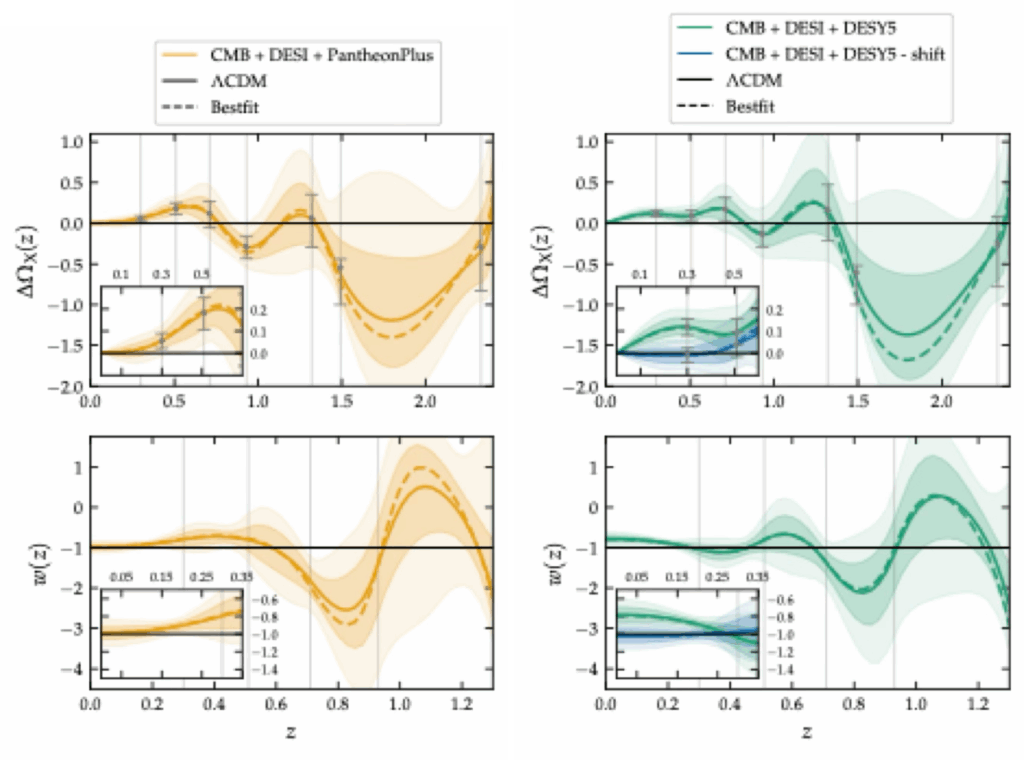
Figure 1 – Eight-node cubic spline fits for the difference between dark energy density as a function of redshift (top), and the subsequent dark energy EOSs derived from those densities (bottom). The left-hand side is calculated using supernovae data from Pantheon+ (orange), and the right-hand side is calculated using supernovae data from DES. A value of ΔΩX(z) of zero denotes no deviation from ΛCDM. Light and dark shaded regions represent 1 and 2 σ confidence intervals. Note that the redshift scale for w(z) (bottom row) has a different x-axis scale than the redshift scale for dark energy density (top row). Figure 2 in paper.
The authors find that, at lower redshifts (below about z = 1), there is a slight disagreement in the energy density with the standard ΛCDM cosmology, which is in line with DESI’s result. You may also note what appears to be an even larger disagreement at higher redshifts. The authors justify this statement by noting that this higher redshift deviation is reduced with the four-node spline and that at these higher redshifts, dark energy is a substantially more subdominant force in the universe (which means its effect on expansion is harder to measure).
The authors find similar results to DESI, so the mystery of the non-constant constant continues to grow. DESI is expected to release its next round of data and analyses soon, which will further enhance the BAO components of studies like this one. So stay tuned, because the next chapter of our cosmic understanding is currently being written!
Edited by: Ansh R. Gupta
