
Paper Title: Search for the Blazhko Effect in Field RR Lyrae Stars Using LINEAR and ZTF Light Curves
Authors: Ema Donev and Željko Ivezić
First-author institution: XV. Gymnasium (MIOC), Jordanovac 8, 10000, Zagreb, Croatia
Status: Published in The Astronomical Journal [Open Access]
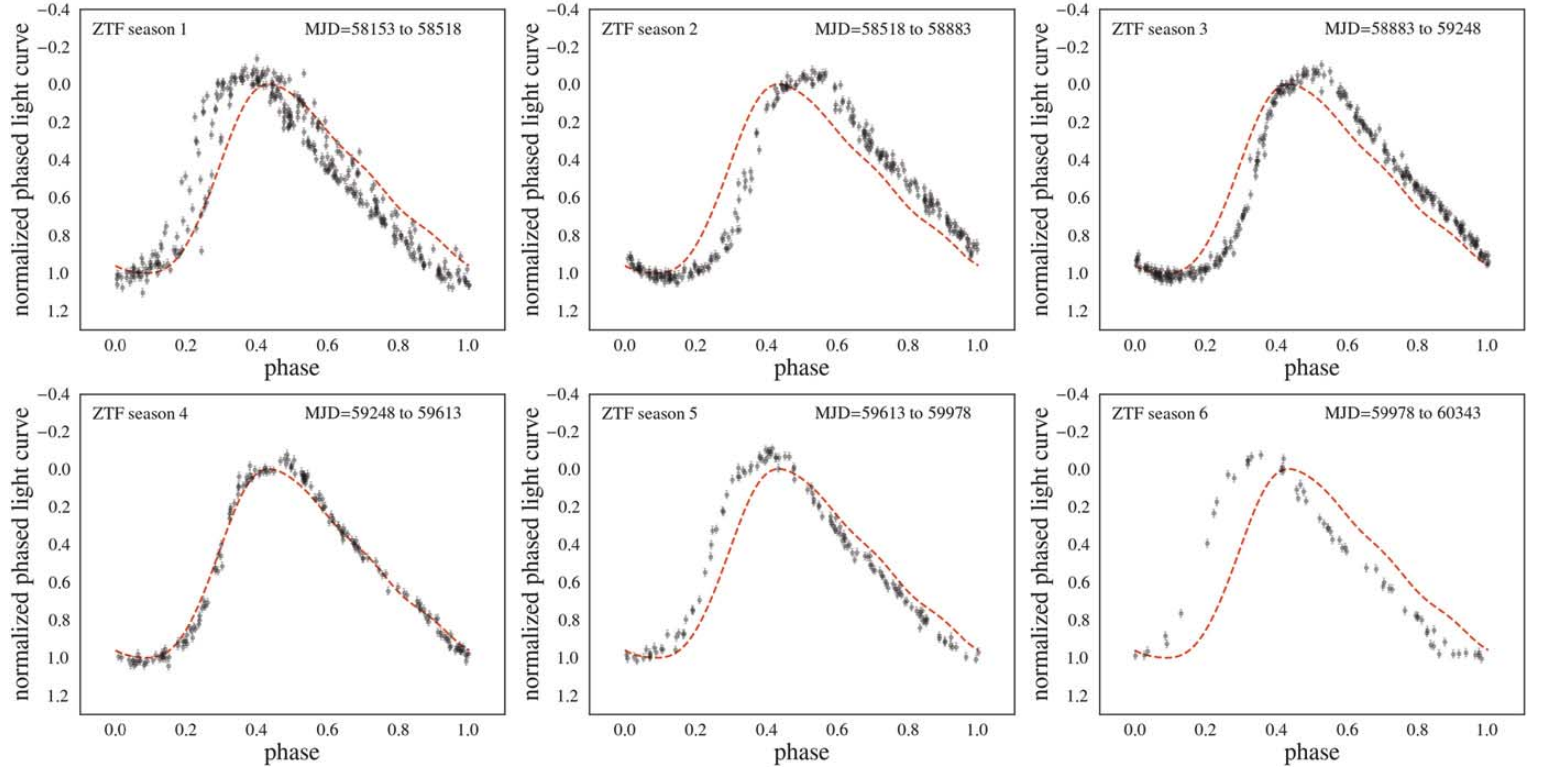
RR Lyrae are a class of pulsating variable stars, similar to better-known Cepheid variables, which sit on the Horizontal Branch of the HR Diagram. Because of the regularity with which they pulsate, these stars are useful for a number of scientific applications, including standard-candle distancing (helping astronomers set the scale of distances in the universe) and as probes of very old star formation in nearby populations (because most RR Lyrae are at least 10 billion years old). Today’s paper studies the Blazhko effect in RR Lyrae. Simply put, the Blazhko effect is a long-term change of the duration (period) or strength (amplitude) of pulsation in some RR Lyrae. Fig. 1 shows an example from today’s paper. While this effect was first observed as early as 1907, the physical mechanism for Blazhko modulation is still formally unknown, as is the percentage of RR Lyrae which exhibit it. Broadly speaking, there are three explanations for this effect: nonlinear resonance between a star’s primary pulsation mode and some higher-level pulsation, magnetic influence, or cycles in the convection activity.
Today’s paper searches for and identifies a population of Blazhko stars which may be used for future research into the Blazhko effect. Using data from the LINEAR asteroid survey and the Zwicky Transient Facility (ZTF) survey, the authors analyze around 2857 RR Lyrae stars found in both data sets. The LINEAR survey was taken over a period of ~6 years, and the ZTF survey over ~5 years. On average, there is a 15-year difference between the LINEAR and ZTF observations. Using both, therefore, allows the authors to search for Blazhko modulation in each survey individually, as well as comparing between the two over the 15-year period. They additionally require a source to have at least 150 data points in both surveys to be considered.
From this initial set of RR Lyrae, today’s paper identifies 531 potential Blazhko star candidates which are moved on to a visual inspection step. In order to identify the candidates for visual inspection, the authors establish two preselection methods based on the direct light curve and periodogram for each source:
- Light curve selection works by algorithmically assigning a score to each source, with higher scores indicating a greater expectation that the source is a Blazhko RR Lyrae. The scores are associated with best-fit pulsation models. One way a given source could earn points was by having a very high reduced χ2 statistic in one or both data sets. Blazhko modulation changes the characteristics of the pulsations over time, meaning the best-fit model will be a poor fit to many of the pulsations within one or both data sets. Generally, poorer fits mean higher reduced χ2 values. In addition, candidates could earn points by having a moderately high reduced χ2 statistic in one or both data sets, as well as a significant change in pulsation characteristics of the best fit model from one data set to the next. Such a change between data sets is an indication of long-term Blazhko modulation. From this 479 of the 531 candidates are identified.
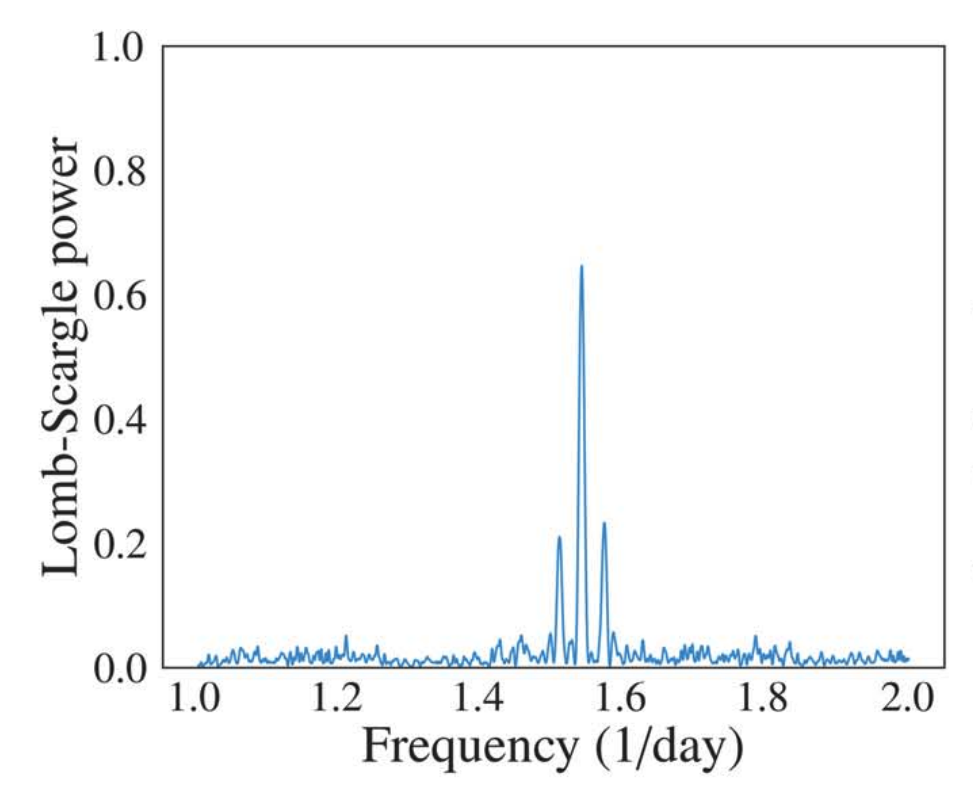
- Periodogram selection works by looking for interactions between the primary pulsation and Blazhko frequencies. First, they create a periodogram for the time-series data. In short, a periodogram plots a number of possible frequencies (or periods) of variability in the data versus the “power” associated with that frequency (or period), where higher power means the data varies more strongly at that frequency. When periodic data has only one associated frequency, the periodogram will show a single peak with high power. In the case where there are two effects of variation (in this case, the pulsation of the star and the Blazhko modulation) with disparate frequencies, a single, large peak will occur at the average frequency, with a smaller peak appearing to either side. Fig. 2 shows an example using simulated data. By identifying the location and strength of these side peaks, the authors are able to identify a handful of additional Blazhko sources (29), as well as estimate the frequencies of Blazhko modulation.
From here, the authors visually inspect the 531 candidates, and confirm 228 of them exhibit convincing Blazhko effect. They are able to place a lower limit on the percentage of RR Lyrae which are Blazhko sources at 11.4% ± 0.8%. In addition, they report that for a certain subclass of RR Lyrae, stars that show the Blazhko effect have pulsation periods 5% shorter on average, but no significant difference in amplitude. But a less common subclass of RR Lyrae stars show no significant difference in period or amplitude when comparing Blazhko sources to the general population. Finally, they highlight that some sources show Blazhko modulation in one data set, but not the other, indicating that the modulation itself may change over time. Further research into this finding may help us better identify the most likely physical mechanism(s) for the Blazhko effect.
Astrobite edited by: Kylee Carden
Featured image credit: adapted from Figure 8 from today’s paper
