
Title: X-ray reverberation modelling of the observed UV/optical power spectra of quasars
Authors: Marios Papoutsis, Iossif Papadakis, Christos Panagiotou, Elias Kammoun, and Michal Dovčiak
First Author’s Institution: University of Greece, Institute of Astrophysics
Status: Accepted to Astronomy & Astrophysics (open access)
Quasars are a unicorn among galaxies. Compared to the uninteresting, dormant supermassive black holes at the centers of many of their peers, a quasar’s central black hole is the place to be, and all the innermost stars, gas, and dust in the galaxy are lining up for the chance to fall in. Despite being supermassive (between 10 million and 10 billion times more massive than the Sun), these black holes are relatively small spatially, so not much debris can squeeze in at once, and instead, most of it swirls around in an accretion disk. As if the extreme brightness from swallowing up galactic bits wasn’t enough for quasars to stand out, they also can’t stop changing in brightness in every band of the electromagnetic spectrum (sometimes throwing in a radio jet for good measure). Here, our authors are interested in the brightness fluctuations quasars exhibit in the ultraviolet (UV) and optical bands, which occur a short time after similar patterns of changes in their X-ray brightness. Our authors are determined to answer some fundamental quasar questions: what is really going on behind the accretion disk? Are the X-rays and UV/optical light truly related, and, if so, why does the latter only appear after a time delay?
However, quasars are variable in brightness at most wavelengths of light, and on a myriad of timescales, from days to years, which causes an observational conundrum: how do we untangle a bunch of different fluctuations caused by a bunch of possible mechanisms? Like any good theorist, our authors embark on a three-step mission to uncover the origin of the UV/optical variability: first, they need a solid physical model to explain the variable emission; second, they need to know how this model will manifest in observations; and third, they need observations with which to test their theory! The third step is perhaps the most challenging, since we need a ton of brightness measurements for each quasar over long periods of time. Fortunately, recent astronomical surveys, such as the Sloan Digital Sky Survey, have made strides in achieving this (especially at optical and ultraviolet wavelengths), and upcoming surveys, like the Vera Rubin Legacy Survey of Space and Time, are expected to continue this exciting progress.
The X-ray reverberation model
Today’s authors decide to investigate one possible culprit of the quasar UV/optical fluctuations: X-ray reverberation, a process in which an X-ray source illuminates the accretion disk from within. In this model, the supermassive black hole sits (or spins, maybe) below a plasma corona periodically emitting bursts of X-rays, which then slam into the accretion disk (which was already busy making its own light) on their way out of the quasar. The disk absorbs all the X-rays and quickly spits some of them back out relatively unscathed. The rest of the X-rays hang around and warm the disk for a bit (try reheating your leftovers with an X-ray instead of a microwave and you’ll see what I mean), and eventually the disk re-emits them as less energetic UV and optical photons. This would explain the similarity of the X-ray and UV/optical fluctuation patterns. Additionally, our authors want to investigate the origin of the X-ray-burst-emitting corona, postulating that either the corona is stealing its energy from the innermost regions of the accretion disk, or something entirely external is creating the X-rays.
Observations: It’s complicated
So, what does the resulting UV/optical emission look like over time to our telescopes on Earth, and how do we differentiate fluctuations from X-ray reverberation from other possible causes? We measure the total UV/optical brightness of the disk, which consists of the intrinsic brightness due to whatever the disk was doing before it got zapped by the X-rays (relatively straightforward to figure out) plus the brightness from the coronal X-ray illumination (not straightforward in any sense). The second component depends on not only the current brightness of the X-ray corona, but also its brightness in the past, since the disk absorbs the X-rays for a bit before re-emitting them in the UV/optical. Additionally, the disk brightness is determined by how exactly the accretion disk will respond to the X-ray illumination (and it’s not like we can easily test this in a lab). The disk’s response depends on a multitude of physical conditions in the quasar, including the black hole mass, the rate at which debris falls into the black hole (called the accretion rate), the brightness of the X-ray corona and its distance from the black hole, the size of the disk, how much the black hole may be spinning…the list goes on and on!
A signal processing hero: Fourier transforms to the rescue!
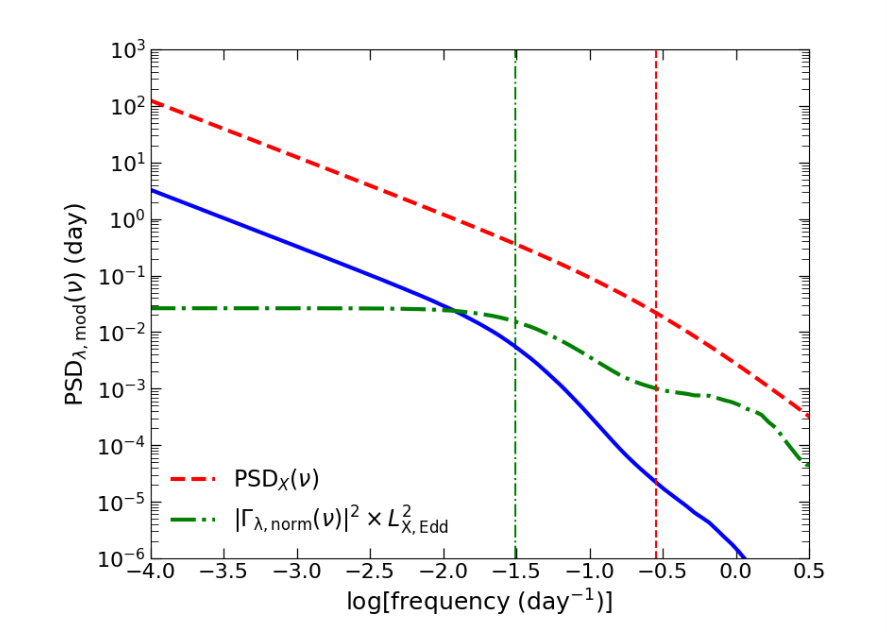
However, the problem gets even more complex! The relationship between all these factors and the UV/optical brightness we observe is given by the most dreaded of all mathematical operators, a convolution (a particularly nasty integral). Luckily, we have a powerful weapon, the Fourier transform – the Beowulf to our Grendel – which slays the convolution by turning it into multiplication. Like Beowulf, the Fourier transform can defeat more than one monster1; it also allows us to untangle the mess of different quasar brightness fluctuations by turning a light curve into a power spectrum. While a light curve shows the evolution of the quasar’s brightness in time, the power spectrum shows the relationship between how rapidly an oscillation in brightness occurs and how extreme the oscillation is, which is very powerful (excuse the pun) because it separates the jumble of fluctuations into neat, well-behaved plane waves.
The quest for El Dorado (the perfect quasar lightcurve)
Just like the temperature of an accretion disk under fire from X-rays, the tribulations of our authors continue to grow. The more often, and the longer, we measure the brightness of our quasars (or any time-varying quantity, for that matter), the more information we are able to glean from the power spectrum, but we will never truly have enough measurements (you can thank the Nyquist theorem for that). For example, as a research advisor, you couldn’t really conclude your graduate student was productive all day just because you saw her working diligently at 10am and 4pm – you have no idea how many coffee excursions she went on with her officemates when you weren’t looking! Likewise, if we only observe our quasar once a week, we have no information on what it may be doing in the intervening days! Not only will any squiggles on timescales shorter than our observation cadence be completely missed, they will contaminate the rest of the power spectrum too, a phenomenon known as aliasing. Luckily, aliasing has plagued everyone who has ever tried to reproduce a continuous process using discrete measurements (the majority of all the scientists, engineers, and mathematicians of the last century or so), so our authors are able to rely on some previously established methods to correct for aliasing.
Finally – testing the model!
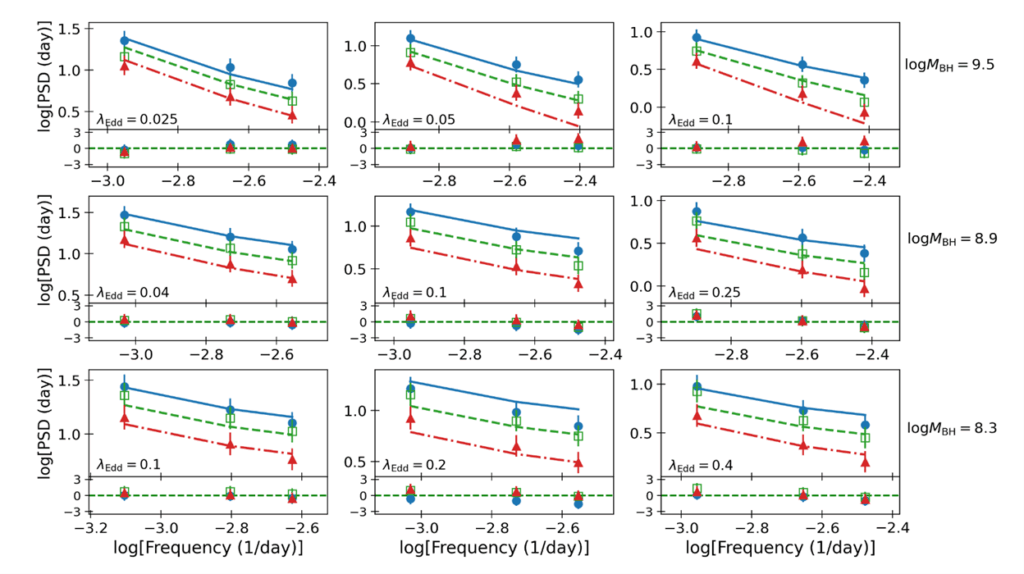
Lastly, our authors need a dataset of real quasars to test their theories! They use the observed UV/optical power spectra of around 8000 quasars (determined by their experimentalist counterparts here) with a wide range of black hole masses and distances from Earth. Since these quasars have no X-ray measurements, our authors approximated their X-ray power spectra using a sample of nearby Seyfert galaxies (the quasar’s less energetic cousin). The UV/optical power spectra were determined from light curves with a measly 6 brightness measurements, but while these extremely sparse power spectra aren’t great for extrapolating into a theory, they are sufficient for testing (and potentially ruling out) different models, such as X-ray reverberation! To our authors’ excitement, they found that the observed power spectra not only matched the predictions from their accretion-powered X-ray corona model (as shown in Figure 3), but they were entirely inconsistent with the externally powered X-ray corona model!
Conclusions
Lastly, our authors address a few more possible problems with the accretion-powered X-ray reverberation model: why the X-rays often come out of the disk polarized (this can happen to the photons getting re-emitted by the disk as X-rays); unaccounted for UV/optical variability in the disk itself (this would be so small and slow that it would be completely washed out by the X-ray illumination); additional emission from gas further out in the galaxy (maybe observed in Seyfert galaxies, but not quasars); and tidal disruption events (the sample of observed quasars have black hole masses much too big). Finally, our authors conclude that their model of X-ray reverberation is a promising origin of UV/optical variability in quasars, but only as long as the energy for the X-ray bursts is stolen from the accretion disk, and they advocate for further quasars studies using even longer, more densely sampled lightcurves!
1In the Beowulf analogy, the dragon (responsible for the titular hero’s demise) for our Fourier transform is the Heaviside step function; but that’s a story for another day.
Confused by my title? Here!
Astrobite edited by Sarah Stevenson
Featured image courtesy of NASA/Goddard Space Flight Center/Dana Berry (Skyworks Digital)

Shout out to an exceptionally great title and with a link to the video at the bottom.
Also , great article as well
Thanks Steve
Great work…Great scientists 🙂