
by Sophie Bergstrom

Sophie Bergstrom just graduated from Franklin & Marshall College with a B.A. in Astrophysics and Creative Writing, and a minor in Applied Mathematics. She is fascinated by supernovae, AGN, black holes, gravitational waves, and quantum mechanics. She hopes to pursue her PhD in astronomy in the near future. When she’s not debugging code, she enjoys swimming, reading, crocheting, and listening to Morbid.
Active galactic nuclei (AGN) are supermassive black holes surrounded by luminous accretion disks. The gravitational force of a black hole causes enormous amounts of matter to spiral around it; all of this gas is heated to millions of degrees, which releases radiation astronomers can detect. It is widely accepted that AGN dwell in the centers of massive galaxies thanks to the Hubble Space Telescope (HST), which was designed to probe the distant universe at high resolution. As HST’s sample of observed AGN grew, it became apparent that AGN exist in a positive feedback loop with their host galaxy: galaxies provide matter for the black hole to feed on, while AGN radiation sparks star formation within the galaxy. However, the discovery of HE0450-2958—a very luminous and distant AGN, called a quasar— posed an unexpected challenge. In the preliminary images, HST could not find a visible host galaxy. How could such a luminous AGN exist without a host galaxy to feed on?
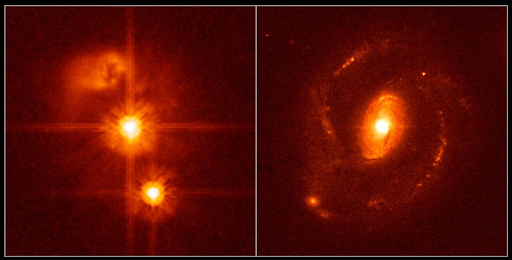

HE0450-2958 is around 3 billion light years from Earth, emitting infrared light. HST captured it lying at the edge of a gas cloud, called “the blob”, and interacting with a companion galaxy, as is shown in Figure 2. Based on the proximity of the blob to the quasar, it seems like the blob could be the host. However, when HST measured the blob’s spectrum in the optical band, there were no emission lines, suggesting that there is no stellar activity occurring there. This is inconsistent with what is known about galaxies and their spectra. The blob is also offset from the quasar’s center which is unlike other quasar-galaxy systems. The inability to detect a host galaxy around HE0450-2958 either means that it is too closely packed to the quasar to be extracted or that the brightness of the galaxy falls below HST’s detection limit. Further observations in more wavelengths were needed to figure out which explanation is most likely.
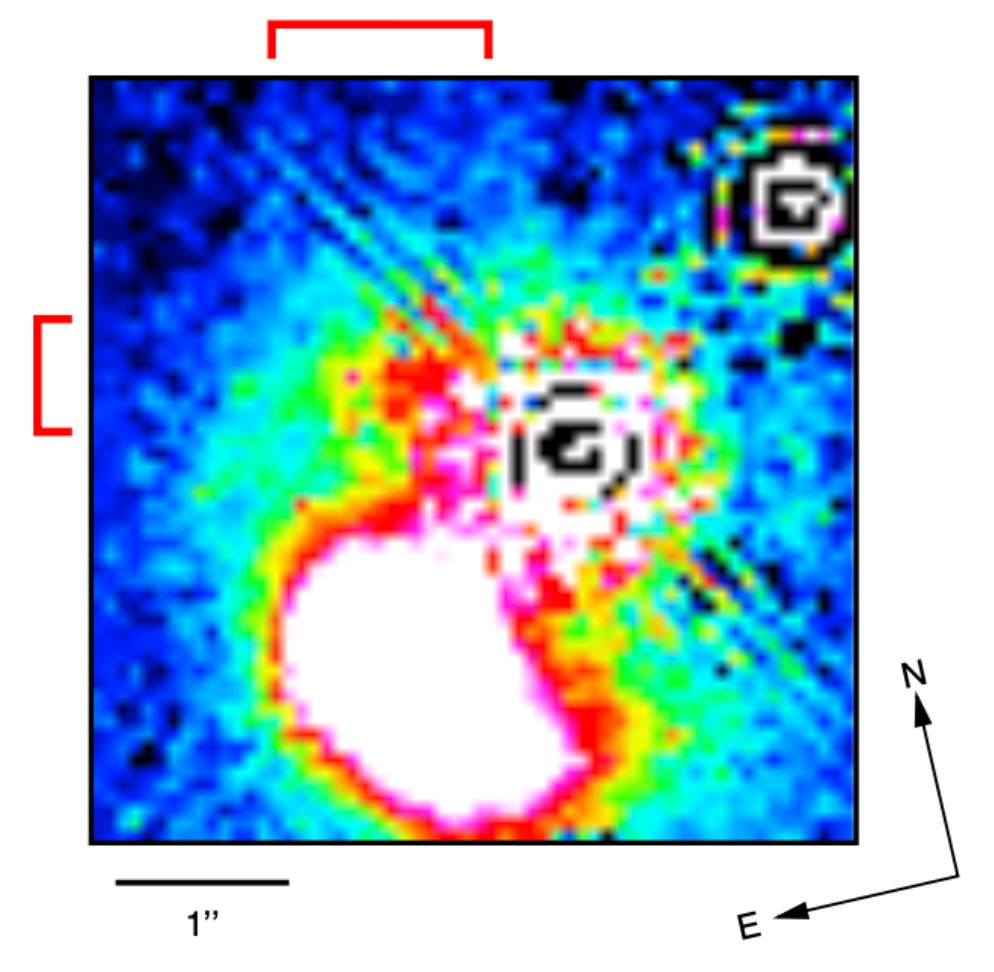
HST observed HE0450-2958 again, this time in the near and mid-infrared. After removing the flux contribution from the quasar, an extension of the quasar nucleus in the North-Eastern direction was revealed, dubbed the “NE-extension”. To astronomers, it looks like it could be part of a galactic spiral arm. They also calculated the age of the stellar population within the extension, and found it to be between 800 million years and 2.1 billion years, which is consistent with material originating from a quasar host galaxy. Although this is not a direct detection, it is promising evidence that HE0450-2958 lies within a host.
The Unit Telescope 4 and HAWK-I on the Very Large Telescope were also used to probe the host galaxy in deep near-infrared wavelengths. These observations revealed that the blob, which was previously thought to exhibit no stellar activity, has emission lies. They found strong lines for ionized oxygen and ionized sulfur; the ratio between the two matched the value typical of gas ionized by a central AGN. Additionally, after computing the flux contributions of each line, they appeared to account for only a small fraction of a larger continuum distribution. This means that the blob probably contains stars. As a result, the blob is thought to be the elusive host galaxy.
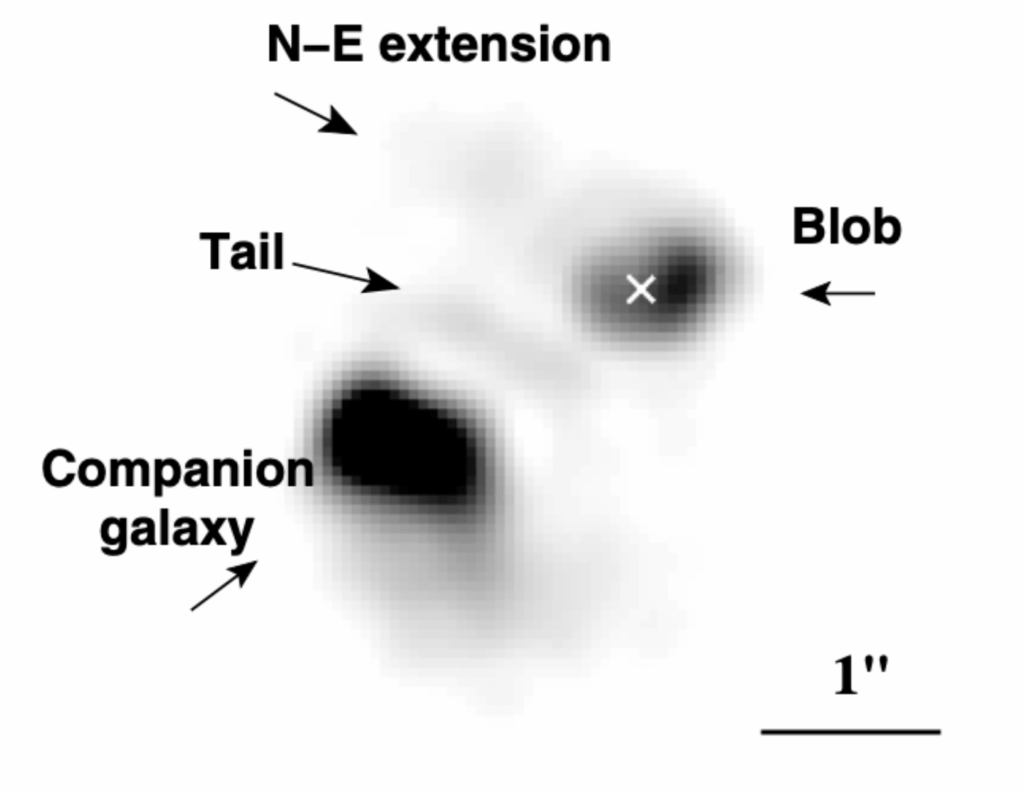
In these observations, another component of the system became apparent: the “tail”. It lies between the quasar and the companion galaxy, which suggests that the companion galaxy and quasar interacted in the past. The NE-extension feature provides further proof of some gravitational perturbation between the two galaxies as it is dispersed from the central blob. If the companion galaxy and host collided at some point in their history, this would also explain why the quasar is offset from its host galaxy. This is now the accepted explanation for what is going on in the system: a collision between the larger companion galaxy and the smaller host upset HE0450-2958’s structure, creating the features detected today. It is hypothesized that in the distant future all of these features will merge with the companion galaxy into one system.
While HE0450-2958 might appear to be a naked quasar in the optical bands, it is actually a much more complicated system. The quasar is being observed post-collision with a companion galaxy, causing the typical quasar-galaxy structure to be disrupted. Instead of observing a typical galaxy, we see pieces of one, evident in the NE-extension, tail, and blob. Further observations are needed to confirm that these extensions are indeed galactic in nature, but astronomers are limited by current technology’s sensitivity to faint and distant objects. For now, HE0450-2958 remains partially robed.
References
- J. Bahcall, S. Kirhakos, and D. Schneider (1994), https://ui.adsabs.harvard.edu/abs/1994ApJ…435L..11B/abstract.
- D. J. E. Floyd et al. (2003), https://ui.adsabs.harvard.edu/abs/2004MNRAS.355..196F/abstract.
- P. Magain et al. (2005), https://ui.adsabs.harvard.edu/abs/2005Natur.437..381M/abstract.
- K. Jahke et al. (2009), https://iopscience.iop.org/article/10.1088/0004-637X/700/2/1820.
- D. Cs. Molnár et al. (2017), https://ui.adsabs.harvard.edu/abs/2017MNRAS.467..586M/abstract.
- M. Kim et al. (2006), https://ui.adsabs.harvard.edu/abs/2007ApJ…658..107K/abstract.
- G. Letawe and P. Magain (2010), https://www.aanda.org/articles/aa/full_html/2010/07/aa14175-10/aa14175-10.html.
- D. Merritt et al. (2005), https://ui.adsabs.harvard.edu/abs/2006MNRAS.367.1746M/abstract.
Astrobite edited by Annelia Anderson
Featured image credit: Space Telescope Science Institute Press Releases, https://www.stsci.edu/contents/media/images/2007/16/2098-Image?news=true
