
Paper Title: Dispuτable: the high cost of a low optical depth
Authors: Noah Sailer, Gerrit S. Farren, Simone Ferraro, Martin White
1st Author’s Affiliation: Berkeley Center for Cosmological Physics, Lawrence Berkeley National Laboratory
Status: Available on arXiv (open access)

About the Author
This guest post is written by Ben Sherwin, first-year physics PhD student and NSF Graduate Research Fellow at Stanford University. Ben graduated from the University of Florida in 2024 with a Bachelor of Science in physics, astrophysics, and mathematics. He is interested in answering fundamental questions about the universe by connecting cosmic microwave background data to large-scale structure observations.
Cosmological Conundrum
Recently, there has been much intrigue about the results released by the Dark Energy Spectroscopic Instrument (DESI) collaboration, which was even reported on by the New York Times. The \(\Lambda\)CDM model, our current best theory of cosmology, assumes that dark energy, which drives the acceleration of the expansion of the universe, has constant energy density throughout time. DESI’s analysis shows a surprisingly strong preference for a model of dynamical dark energy, in which dark energy is no longer constant but instead has an energy density that varies throughout the universe’s history.
Cosmology can also provide interesting constraints on neutrino properties. The Standard Model of particle physics assumes that neutrinos are massless and come in three types (flavors). However, it has been shown experimentally that neutrinos have some tiny mass, at least six orders of magnitude less than that of the electron. If we add the masses of each of the three flavors of neutrinos, neutrino oscillation experiments suggest that this sum \(\left( \sum m_v \right)\) should be greater than 0.06 eV. . However, DESI’s results suggest a preference for a sum of neutrino masses that is lower than this bound.
If either dynamical dark energy or a subminimal neutrino mass sum is confirmed, it would represent a major paradigm shift in cosmology and completely change our understanding of physics. Therefore, our paper today begs the question…is there a simpler solution to these seemingly bizarre inconsistencies?
Blurred Beginnings
To explain the discrepancies that DESI found, the authors of this paper consider the effects of increasing the parameter \(\tau\) , called the optical depth to reionization. Reionization is the epoch where the first stars and galaxies began to form about 150 million to 1 billion years after the Big Bang. One way to study reionization is through its effects on the Cosmic Microwave Background (CMB), the relic radiation from when photons decoupled from matter. The optical depth to reionization, \(\tau\), is a measure of how many CMB photons were scattered by free electrons created during reionization. It is also the least constrained parameter in the \(\Lambda\)CDM model because its signal is very difficult to isolate from other effects.
A larger \(\tau\) means that more CMB photons were scattered during reionization, leading to a slight blurriness in the CMB we observe. To put it simply, it’s like looking through fog. If the fog is thicker (larger \(\tau\)), then more light will be scattered in the fog, making it difficult to see.
The CMB has been observed with high precision using telescopes like Planck, influencing the development of the \(\Lambda\)CDM model. The CMB is detected to be a nearly uniform blackbody at a temperature of 2.73 K. However, there are small fluctuations in the CMB temperature, which provide insight into the early universe.
Also, spectroscopic surveys, like DESI, map out the 3D positions of tens of millions of galaxies. With these positions, we can detect a clustering pattern imprinted by baryon acoustic oscillations (BAO), sound waves that traveled through the early universe as density perturbations. Check out this video for an awesome visual. In this paper, a combination of Planck CMB primary temperature and polarization data and DESI BAO data is used to draw conclusions.
Tweaking Tau
To test the effects of changing the optical depth to reionization, the authors use CMB data and choose two different values of \(\tau\). One is \(\tau\) = 0.06, the value obtained by Planck, and the other is a slightly higher value of \(\tau\) = 0.09. The latter choice is justified by considering Planck’s difficulties in precisely controlling systematics and foreground effects. Assuming a higher value of \(\tau\) leads to better agreement with the DESI BAO measurements (Figure 1), neutrino oscillation mass bounds (Figure 2), and the \(\Lambda\)CDM model (Figure 3). Simply altering the value of the optical depth dramatically weakens the aforementioned tensions from 3\(\sigma\) (a relatively serious mismatch) to ~1\(\sigma\) (a mild difference). The authors also ask the converse question: what value should \(\tau\) take on, given a model and the data. In their analysis, they find that \(\tau\) should be about 0.09, matching their previous conclusion.
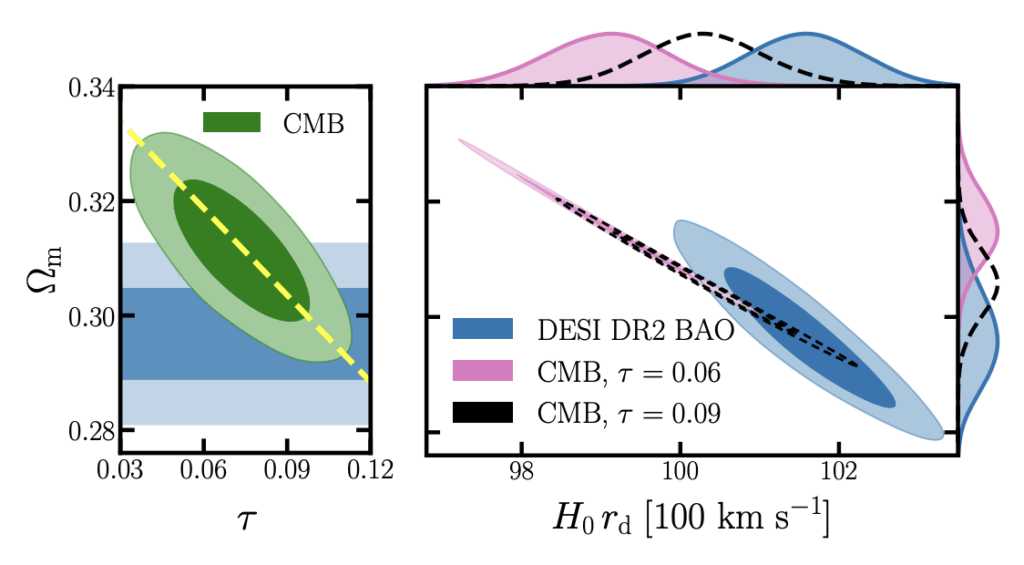
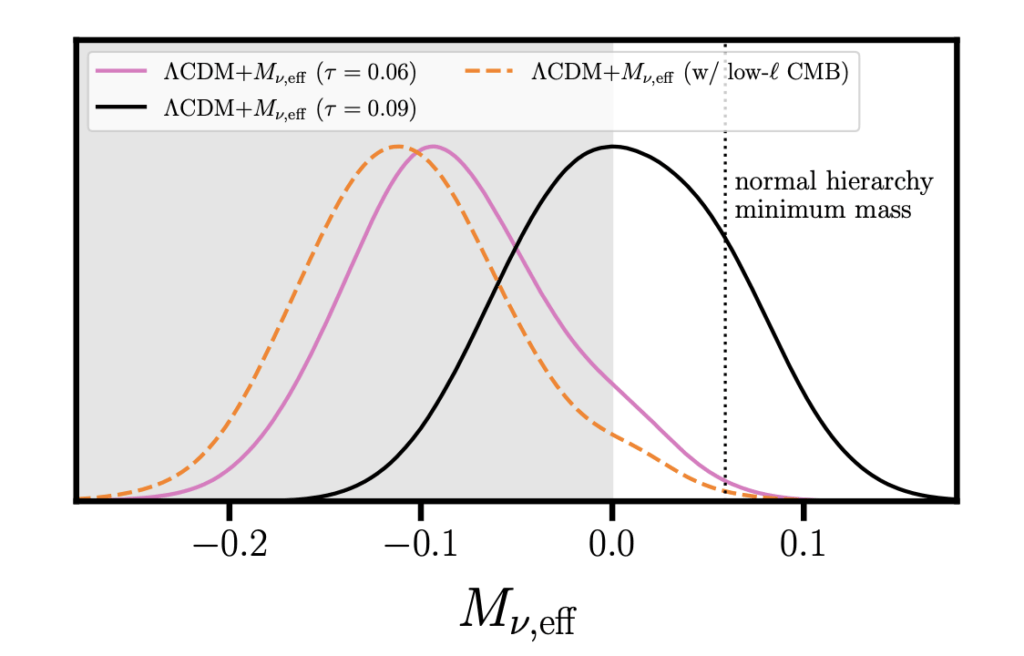
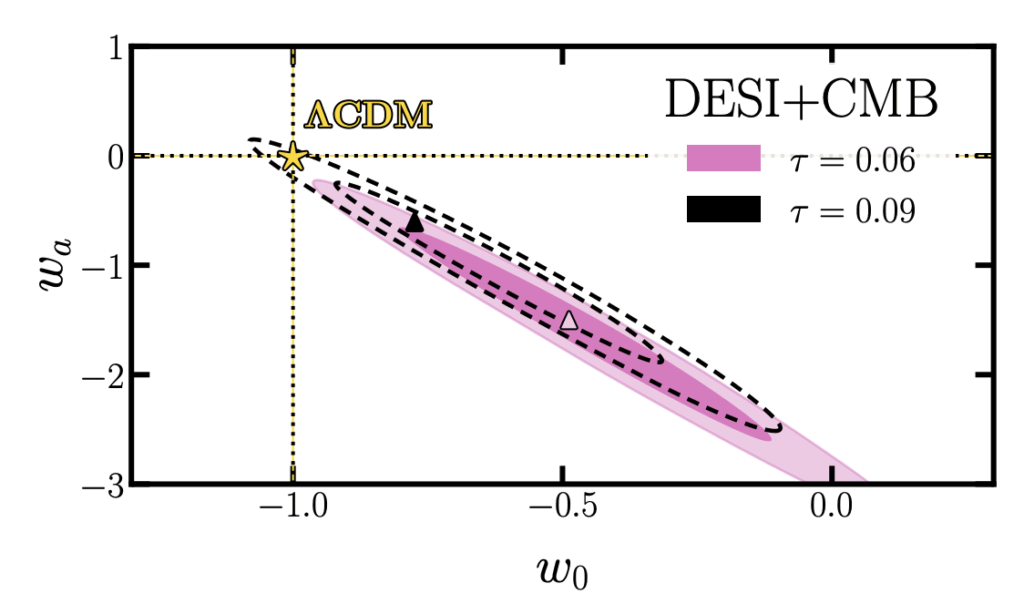
This study highlights that while CMB measurements of \(\tau\) remain robust, small shifts within the range of uncertainty can significantly impact the inferred cosmological parameters across datasets. The discrepancies we see may stem from subtle systematic effects or statistical analysis techniques rather than new physics. Overall, these results reinforce the importance of jointly analyzing different cosmological probes and scrutinizing our data and assumptions.
Future Focus
We often think a “clearer” view leads to better understanding. But in this case, a lower \(\tau\)— less scattering, less fog— raises more questions. While current measurements of \(\tau\) from CMB data show no clear signs of major errors, there are still uncertainties. This paper shows that even small changes in the optical depth to reionization can have major cosmological implications. Thus, future experiments that measure \(\tau\) more precisely, or probe reionization directly, will be important in refining our models. Perhaps the path to breakthrough discoveries in cosmology does not require completely new physics, but rather a closer look at details we thought were settled.
Edited by: Maria Vincent
Featured Image Credit: Wanderer above the Sea of Fog by Caspar David Friedrich (Public Domain)

