
Title: Multifrequency polarimetry of high-synchrotron peaked blazars probes the shape of their jets
Authors: F. Bolis, E. Sobacchi, F. Tavecchio
First Author’s Institution: DiSAT, Università dell’Insubria, Via Valleggio 11, I-22100 Como, Italy; INAF – Osservatorio Astronomico di Brera, Via E. Bianchi 46, I-23807 Merate, Italy
Status: Published in A&A [open access]

Active Galactic Nuclei (AGN) can emit relativistic plasma outflows from the rotation of their central supermassive black holes. When these outflows are aligned along our line of sight, we call them blazars, as relativistic beaming effects increase their apparent brightness. Much of that emission comes from synchrotron radiation, where electron populations spiral along magnetic field lines and emit light (Figure 1). The energy of the electrons determines the energy of the emission, which can range across the electromagnetic spectrum.
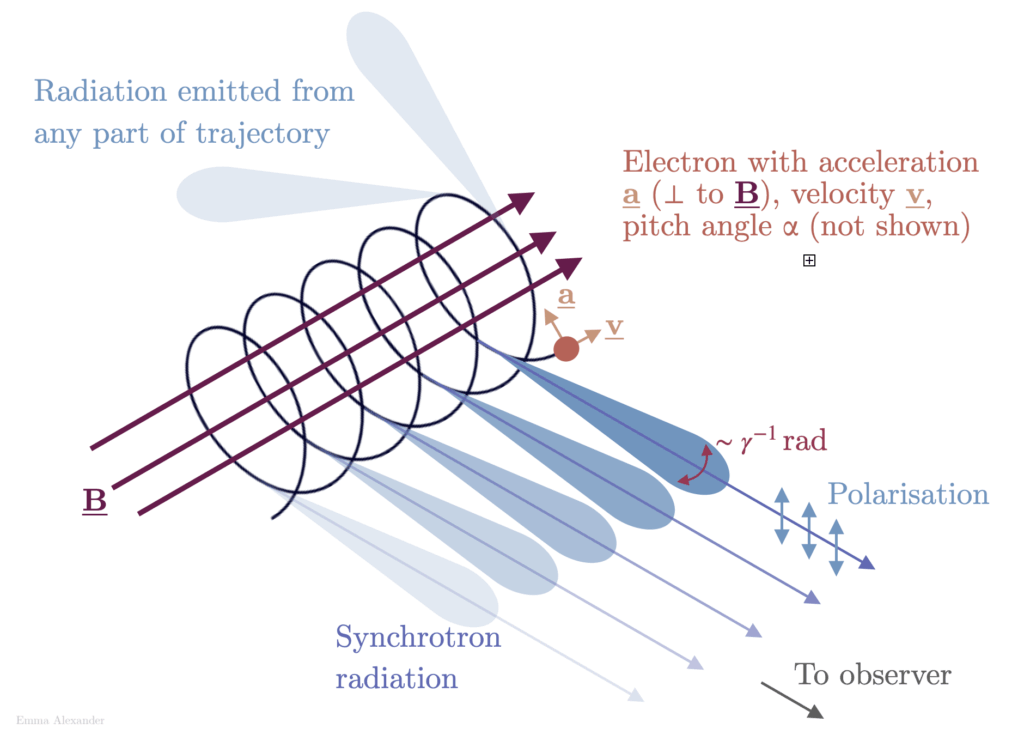
Blazars have recently become a favored target for the X-ray polarization mission IXPE. Polarization is a measure of the alignment of the EM vectors that make up light, and can indicate the level of organization of the magnetic fields in a region. The electric vector position angle (EVPA) is the angle of the polarization ellipse; the polarization ellipse is defined by the alignment of the EM vectors (see also). The polarization measurements of blazars are higher than many other sources, suggesting the presence of interesting magnetic fields.
Today’s study considers models of high-synchrotron peaked (HSP) blazars. These blazars have a high-frequency peak (>1015 Hz) in their synchrotron emission, which means observations of the source in optical and in X-ray have emissions from synchrotron. Recent observations of blazars show a higher degree ~10-20% of X-ray polarization, with a smaller level of polarization in optical measurements.This phenomenon is known as chromaticity, and is defined as the ratio of X-ray polarization over the optical polarization; X-ray blazars have a chromaticity around 2.
Some authors have suggested that these polarization observations support a model of shock wave acceleration. These shocks could accelerate the electrons as it passes by them, and there are some studies to support this theory. This model works to explain the observed chromaticity, as the electrons would emit at progressively lower frequencies as they diffuse away from the shock front, making the higher frequency X-ray polarization stronger than the lower frequency optical.
This paper, however, considers jets that are magnetic flux dominated, which are more likely to have electron acceleration and emission through magnetic reconnection. In this scenario, the magnetic fields within the jet form new arrangements, which could accelerate electrons.
The magnetic field distributions in Poynting-dominated jets are highly dependent on the shape of the jet, which the authors consider in this work. They produce different jets that are parametrized by q, which defines the shape of the jet, ranging from very cylindrical to parabolic (Figure 2). After producing the jet and its magnetic fields, they assume an electron population in the jet and simulate the polarization an observer would see.
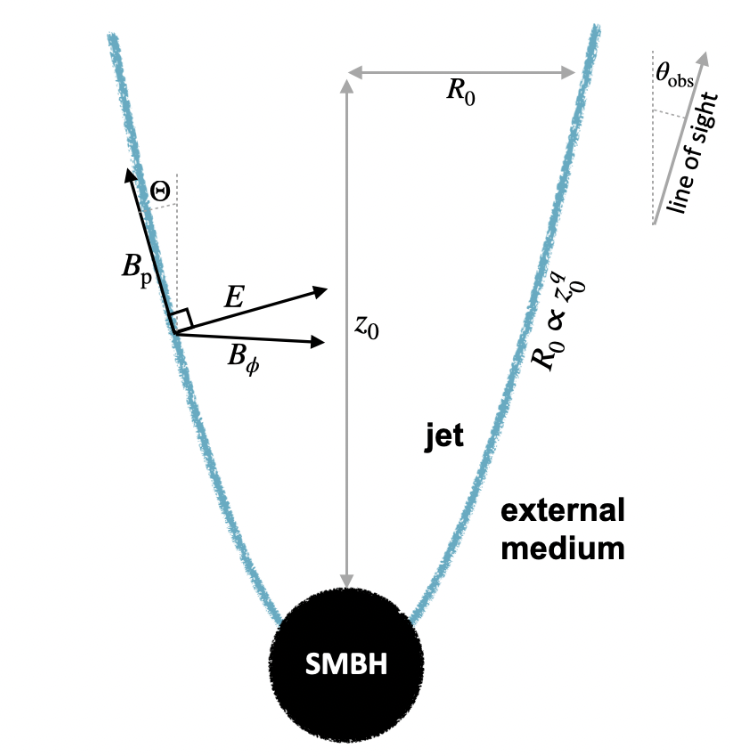
They found that cylindrical jets’ polarization measures essentially rule them out, with X-ray polarization of ~70% and optical of ~60% – weakly chromatic. Parabolic jets produce appropriate levels of polarization (X-ray ~15-50%; optical ~5-25%) and chromaticity, and the EVPA is aligned parallel to the jet axis, as it is in observations.
In this model, the magnetic domination suggests the acceleration is dominated by magnetic reconnection, not shocks. But it’s hard to say if that reconnection would be caused by Kelvin Helmholtz instabilities (KHI), or the kink instability. Both can produce current sheets and reconnection, but the kink instability produces them more uniformly through the jet while the KHI is mostly at the borders. Polarization isn’t sensitive to this distribution, so existing measurements can’t tell them apart.
However, this isn’t an open-and-shut case. Polarization can’t currently determine what process is accelerating the electrons, and our observations still could be explained by a shock acceleration model. More work is needed with a larger sample of sources and more sophisticated models of the internal magnetic fields and electron populations to form real conclusions about the source of polarization in blazars.
Astrobite edited by Shalini Kurinchi-Vendhan
Featured image credit: NASA/JPL-Caltech/GSFC

